
CanucksArmy has no direct affiliation to the Vancouver Canucks, Canucks Sports & Entertainment, NHL, or NHLPA
Wagner’s Weekly: Under Foote, Canucks no longer protect the guts of the ice
Photo credit: © Nick Turchiaro-Imagn Images

Jan 11, 2026, 16:52 EST


It was a constant refrain from Rick Tocchet when he was head coach of the Vancouver Canucks: “You have to protect the guts of the ice.”
There are lots of names for the entrails of the rink, with various distinctions in definitions: there’s the slot, the house, the home plate, or the rails. Whatever you call it, it’s the most dangerous area of the ice where most goals are scored.
The Canucks had their faults under Tocchet, but failing to protect the guts of the ice was not one of them. Tocchet had no patience for players who abandoned the most dangerous areas in the defensive zone to chase the puck or chase hits.
This season, under new head coach Adam Foote, the guts of the ice are wide open.
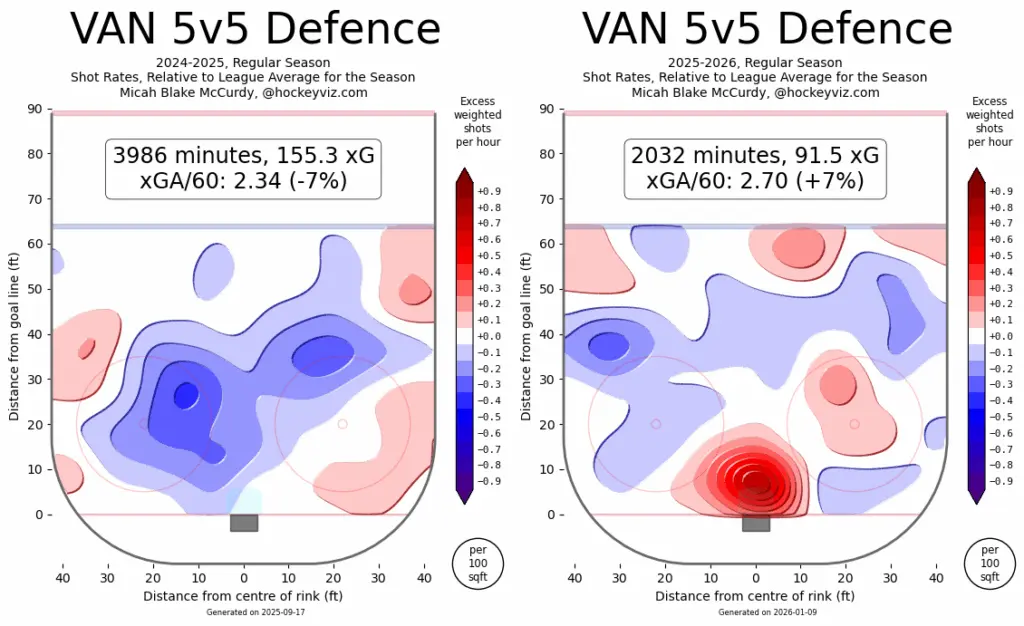
That should be readily apparent from watching literally any Canucks game this season, but sometimes a visual aid is helpful. Below are the heatmaps from HockeyViz for shots given up by the Canucks at 5-on-5. Last season is on the left; this season is on the right.
 HockeyViz
The difference is stark. The blue in the slot in last season’s heatmap indicated the Canucks gave up fewer shots than average from that area.
The deep, deep red in front of the Canucks’ net this season indicates that they give up far, far more shots from that area than the NHL average.
That is, to be blunt, very bad.
The easiest explanation for why this is happening is that the Canucks changed their defensive system.
Tocchet’s box+one zone defence
Under Tocchet, the Canucks played a box+one zone defence, a system that has become increasingly popular around the NHL.
At its most basic, the box+one is exactly what it sounds like: four players form a box, with one additional player available to attack the puck.
Here’s a simple breakdown of what this looks like:
The idea is that no matter where the puck is on the ice, there will always be a defenceman and a forward in the “rails” between the hashmarks, ensuring that the guts of the ice are protected.
Additionally, the defencemen never stray too far from the front of the net. If a defenceman moves into the corner to pressure the puck and their opponent skates up to the point, the defenceman does not follow them. Instead, he returns to his zone in front of the net and passes off that check to a forward.
There are downsides to a box+one system. It can be too passive, giving up a lot of possession on the outside. It can also be exploited by skilled players finding gaps in coverage, as individual players are not as tightly marked.
But, for Tocchet, the benefit of the guts of the ice always being protected outweighed these downsides.
Foote’s man-on-man defence
Under Foote, the Canucks have moved away from a zone defence to a man-on-man defence, though defenders are encouraged to make reads and be ready to out-man the opposition — often called swarm defence — when the puck is below the hashmarks along the boards.
There are obvious upsides to this system.
It simplifies defensive reads, apart from reading when to out-man the puck. Aside from that, you just have to know who your man is and stick with him.
When done properly, no opponent should be open in a man-on-man system. There should be no holes in coverage to exploit. No matter who gets the puck, there should be a defensive player right on top of them to disrupt the play.
The problem is, there will always be mistakes.
This season, we’ve heard Foote say, “We had a mistake,” about as much as we heard Tocchet talk about “protecting the guts of the ice.” That’s been his explanation for dozens of goals against this season.
That’s been the big issue with the Canucks’ man-on-man coverage: when someone makes a mistake, the entire system falls apart.
It falls apart in little pieces on the floor
There was an obvious example of this in the Canucks’ game against the Detroit Red Wings: J.T. Compher’s goal midway through the second period that made it 3-1.

At the start of the clip, every Canuck has a man, even if the assignments are a little haphazard after being stuck in the defensive zone for a while. Tyler Myers has Ben Chiarot, who is shooting the puck; Zeev Buium has James van Reimsdyk in the slot; David Kämpf is battling with Compher in front; Jake DeBrusk has Lucas Raymond behind him at the point; and Kiefer Sherwood has Axel Sandin-Pellikka at the other point, though he’s cheated into the slot with the puck on the left side of the ice.
All of this is fine, apart from how long the Canucks have been stuck in the defensive zone.
Where things go wrong is that as Myers follows Chiarot to the point, Sherwood lapses into the mindset of most wingers: the defenceman at the point is my man. He and Myers double-team Chiarot, but that means Sherwood has left Sandin-Pellikka open.
From there, it’s a domino effect: DeBrusk leaves Raymond behind to check Sandin-Pellikka; Kämpf leaves Compher in front of the net to check Raymond; and Buium is too gassed to prevent Van Reimsdyk from setting up Compher for the goal.
The NHL’s goal visualizer makes it all too clear:

Obviously, Sherwood made a mistake, but that mistake is exacerbated by the system. In a box+one zone system, Myers never would have chased Chiarot to the point: when Chiarot went to the point, Myers would have simply returned to the front of the net and picked up Compher, freeing up Kämpf to check someone else.
In other words, a zone system like the box+one can be more forgiving of mistakes, because the focus is primarily on defending a dangerous area rather than checking an individual player.
The problem isn’t the system — not exactly
Let’s be clear: a man-on-man system can absolutely work.
The defensive system that Foote has the Canucks playing is essentially the same as what the Florida Panthers have used to win back-to-back Stanley Cups.
The Panthers play an aggressive man-on-man system that often sees their defencemen following players up to the point the way that Myers did on the Compher goal, leaving a forward to defend players in front of the net. When the puck is below the hashmarks along the boards, the Panthers will attack with numbers, looking to support the puck and create turnovers.
That aggressive man-on-man system has been very effective for the Panthers. They constantly break up possessions and turn the puck back up ice, spending as little time in the defensive zone as possible. They’re not interested in protecting the guts of the ice with a more passive zone defence — they just want the puck back.
It wouldn’t surprise me if Florida’s success with this system is why Foote and his coaching staff introduced it to the Canucks this season.
There’s just one problem: the Canucks don’t have the horses.
The man-on-man system works very well for the Panthers because they have players who can win the one-on-one battles that are created by man-on-man coverage. Their forwards thrive in that type of aggressive system, including a couple of the best two-way forwards in the NHL, such as three-time Selke winner Aleksander Barkov.
Their defencemen, as well, seem to fit this system, particularly their mobile number-one defenceman, Gustav Forsling.
The Canucks, on the other hand, are struggling. That’s particularly true for lengthy defencemen Tyler Myers and Marcus Pettersson, who seemed to fit right into a zone system that saw them primarily responsible for defending the home plate area with their size and reach, but are getting lost in a system that sees them chasing opponents all over the defensive zone.
The Canucks’ forwards, unlike the Panthers’, aren’t winning the one-on-one battles required of man-on-man coverage, and both forwards and defencemen are failing to make the right defensive reads for when to out-man the puck.
Then there are forwards like Sherwood and Evander Kane or the team’s young defencemen like Elias Pettersson and Tom Willander, who are making mistakes in coverage, causing a cascade effect that leads to opposing players wide open in the guts of the ice.
In other words, it’s not that the system itself is fundamentally flawed; it’s that the system is not a good fit for this particular roster. It certainly seems like a zone defence that’s more forgiving of mistakes would work better, because the Canucks are certainly making a lot of defensive mistakes.
Sponsored by bet365


Breaking News
- Meet the three men reviving beloved ‘Sports Page’ in an all-new format
- Canucks Game Day: Dealing with the Devils in early Saturday start in New Jersey
- The Canucks have every reason to give Leevi Meriläinen a run of starts
- A look inside the Canucks early-season penalty killing struggles
- ‘Best news ever’: Max Lapierre thrilled to see Canucks put Sedins, Johnson, and Malhotra in charge

Vancouver CanucksTeam Cap Summary

Cap Summary
2026-27
2027-28
Projected Cap Hit
$88,074,947
$71,329,167
Projected Cap Space
$15,925,053
$42,170,833
Current Cap Space
$16,790,545
$42,170,833
Active Players
23/23
13/23
Draft Picks
Round
'27
'28
1
1
1
2
2
2
3
1
1