
CanucksArmy has no direct affiliation to the Vancouver Canucks, Canucks Sports & Entertainment, NHL, or NHLPA
What might an in-season 2025-26 Canucks rebuild actually look like?
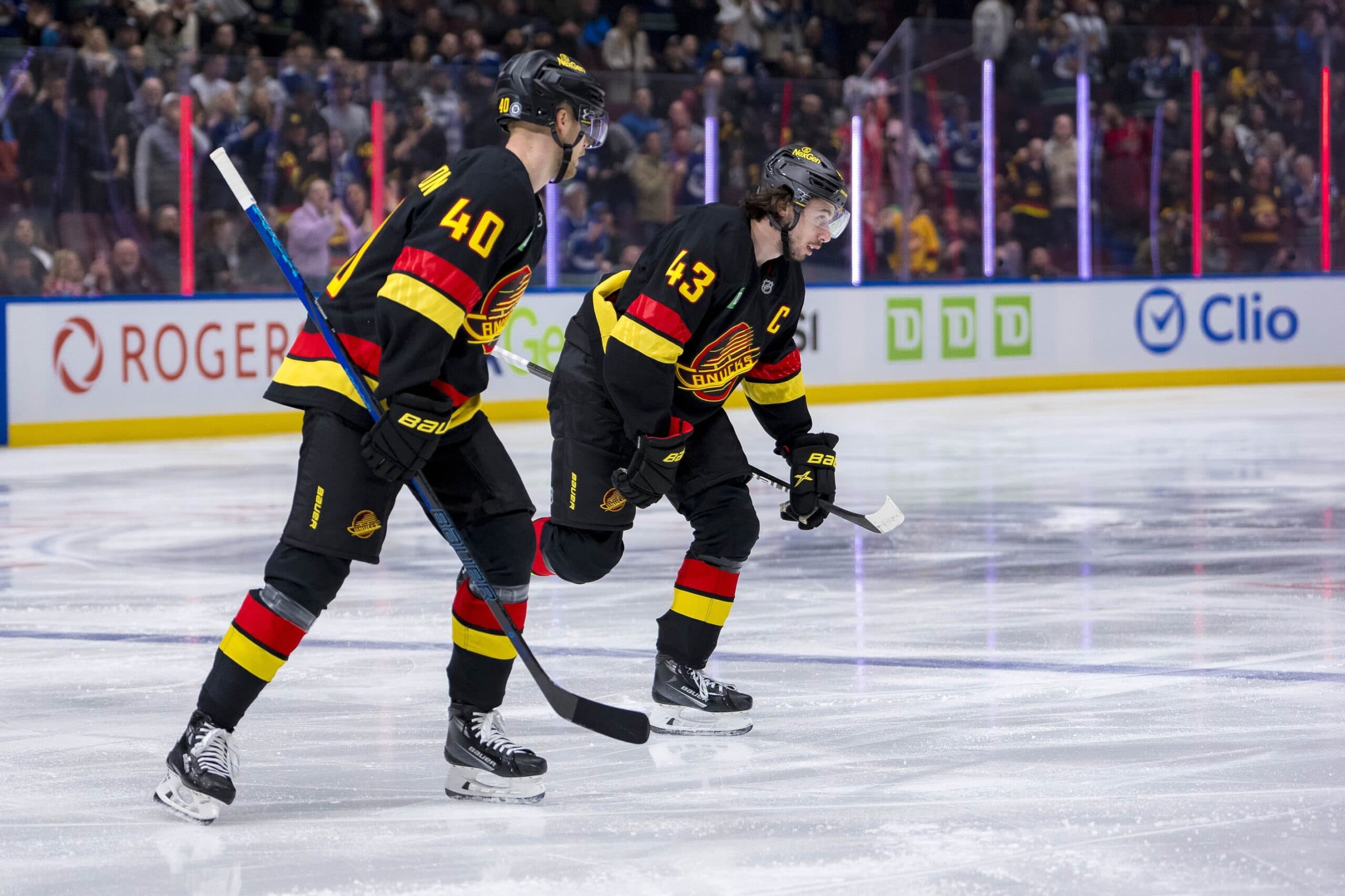
Photo credit: © Bob Frid-Imagn Images

Nov 8, 2025, 14:07 ESTUpdated: Nov 9, 2025, 00:44 EST


Let’s skip the preamble this time.
You know why we’re talking ‘rebuild.’ Because everybody seems to be talking rebuild right now. The Vancouver Canucks have started off the 2025-26 season in a tie for the third-worst record in the league after 14 games, and once again, the topic of tearing down the roster to start it over again somewhat from scratch has been raised. The fans are talking rebuild, the local media are talking rebuild, and even the national press has started to pick up the topic.
It’s something that has come up a number of times before in franchise history, and we’re not sure it’s a realistic outcome quite yet, or anytime soon. But it’s a hot enough button right now to at least justify some pre-emptive thoughts on what a Canucks rebuild might even look like – especially one that began in-season, this season.
Let’s make one thing clear: this still all comes down to Quinn Hughes. The rebuild begins – or should begin, anyway – the moment that Hughes makes it clear he is not interested in talking extension with the Canucks. If Hughes is willing to re-sign, it’s a much different discussion, as a team could rebuild a dozen times over and not wind up with a player as talented as Hughes. It took the Canucks a good 50 years of franchise history before they found just one Hughes, after all.
But if Hughes is on his way out the door, a rebuild becomes a near necessity. And we may be reaching that point sooner, rather than later. Elliotte Friedman spent the bulk of his most recent 32 Thoughts podcast talking about this, noting that “Every game is a vote. Every game is a referendum on how does Quinn feel about this.” And if that’s the case, the latest polls are certainly not in the Canucks’ favour.
So, an in-season 2025-26 rebuild begins, tragically, with a Hughes trade. And not just a Hughes trade, but with the absolute must-do of nailing a Hughes trade and truly maximizing the value on his return. This might be the first step, but it’s also the likely origin point of the most incoming future-based assets in the entire process. Canucks management would really have to squeeze every last bit of profit out of Hughes as is possible.
This does not necessarily mean just shipping Hughes to New Jersey to join his brothers right away. If Hughes is traded during the 2025-26 season, he’ll still half a year-and-a-half left on his contract and, more importantly, two potential playoff runs. In a league where rental players typically go for packages including first round picks and blue-chip prospects, two playoffs worth of Hughes should bring back something truly astonishing. We’re talking three, four, maybe even five premium pieces. Hughes is on the books at about half his true value with just a $7.85 million for now, and the Canucks could – and maybe should – juice that even further by employing retention. Hughes also has no trade protection on his current contract, meaning every playoff-bound team could get in on the bidding.
A rebuild of the current Canucks should most definitely be built upon the bones of a Quinn Hughes trade return of epic proportions.
Once that is in the books, some of the rest of the rebuild is almost automatic. There are those pieces already in place – the likes of young players like Tom Willander, Jonathan Lekkerimäki, Elias Pettersson II, Braeden Cootes, Victor Mancini, Aleksei Medvedev, Kirill Kudryavtsev, and Aatu Räty – that should mostly be held on to throughout this process. Put those folks together with whatever is brought in from a Hughes trade, and we’ve suddenly got a decent foundation for a decent roster a few years down the road.
Further assets would have to be brought in by selling high on the 2026 UFA class. Yes, this unfortunately means selling extremely high on Kiefer Sherwood, who is a total playoff package and should return at least a first round pick, if not more. PK specialists like Derek Forbort and Teddy Blueger should also return some alright draft capital, and one never really knows how playoff-bound teams in need of some bite might value Evander Kane. Supplement that Hughes trade income with a series of rental sales, and the prospect and pick cupboard should be as stocked as it ever has been.
The next series of decisions is more difficult, and becomes highly-dependent on the whims of various players. Several veterans Canucks are not just under contract for multiple years yet, but many of them have no-trade or no-movement clauses to navigate. What the Canucks would have to hope is that at least a few of these veterans would choose to be traded rather than go through a rebuild, so as to allow the Canucks to cash in on them, too.
The number one target here would have to be Filip Hronek. The odds seem solid that, with Hughes gone, Hronek might be willing to seek greener pastures, too. And if so, the market on a 28-year-old top pairing RD signed to a reasonable contract until 2031 would be enormous. Hronek’s trade value might not reach that of Hughes, but it wouldn’t fall entirely outside of that ballpark, either. By flipping their entire first pairing, the Canucks could quickly find themselves nearing the top of the NHL future-watch.
Connor Garland is also one to somewhat hope is willing to take a trip out of town. He’s currently in the midst of his best season yet, and his six-year extension hasn’t even kicked in yet. This is probably the peak of Garland’s value, and while it won’t be in the Hughes or Hronek territory, it would be large and considerable all the same.
The rest of the vets have to be taken on a case by case basis. Surely, some will want to stay on board as mentors for the rebuild, and that’s both fine and somewhat necessary. Brock Boeser and Tyler Myers seem like obvious candidates here, and maybe Jake DeBrusk.
The likes of Marcus Pettersson, Drew O’Connor, and Filip Chytil – if healthy – are, as we said, a case-by-case basis, and won’t make or break the rebuild one way or another. Folks like Nils Höglander and Lukas Reichel fall somewhere in between, a bit of a take-it-or-leave-it as far as a rebuild is concerned.
The major, major points of contention here will come at the top of the centre depth chart, and in the crease.
What to do with Elias Pettersson the Elder? That’s really tough to say. He is only 26, and thus feasibly young enough to still be an effective centre at the tail-end of a rebuild process. But his two-way presence on the team might be a bit of a distraction from any medium-term tanking attempts, and that $11.6 million cap hit is a distraction of a different nature.
With the total dearth of available top-six centres right now, one has to think there is still at least something of a market for Pettersson’s services. One option that falls into the category of so-crazy-it-just-might-work? Retaining on all seven remaining years of Pettersson’s contract so as to truly maximize his value. A half-price Pettersson should still bring in a far-better-than-decent return, and maybe the thinking there is that the retained salary won’t matter during the years of a rebuild, and then will be dwarfed by cap increases thereafter.
Either way, Pettersson clearly represents the most difficult decision and set of negotiations.
There is also the matter of what to do with Thatcher Demko and Kevin Lankinen. With none of the Canucks’ various goaltending prospects ready to step up yet – save for the one in Pittsburgh – one of the two should probably be held on to. Lankinen is in the first year of a five-year, $4.5 million AAV extension, and has a full no-movement clause. Any trade would have to be of his volition.
Demko, meanwhile, has no current trade protection, but does begin a three-year, $8.5 million extension as of next year. From our perspective, it makes sense to have a frank discussion with Demko about the realities of a rebuild, and then see if he’s willing to be traded somewhere else as a result. If not, he becomes one of those guiding veterans, and the team doubles down on its efforts to move Lankinen.
That covers the ‘tear-down’ portion of the rebuild well enough, and should leave the Canucks with an overstuffed set of future-based assets. However, there is another and even more vital step to rebuilding, and it’s one the Canucks might already be on the way to – being bad enough in the standings so as to procure some very high draft picks.
Few of the prospects the Canucks have on hand could be considered truly high-end, with an exception potentially made for Willander as an RD and Lekkerimäki as an RW. Cootes is terrific, but likely tops out at a 1C. A successful rebuild will demand a more elite quality of future talent. The trade returns will help, but elite talent mostly arrives via top-ten draft selections. It is, after all, how the current Canucks obtained their most elite talents (Pettersson at fifth overall, Hughes at seventh).
For better and for worse, that seems like a highly achievable goal for the Canucks. With this current roster, they’re already in the NHL basement. Strip this team down even further, and the bottom should fall out of an already-rocky boat. With teams like the San Jose Sharks and Anaheim Ducks on the rise in the Pacific Division, there is a real opportunity for the Canucks to stay stuck at the bottom of the standings for a few years running, and that would lead to top-five draft opportunities, and those pieces – more than the current slate of prospects, more than the Hughes trade return, more than the other veteran trade returns – would form the true foundation of the future Canucks. Combine a high-drafted centre and a high-drafted D or two to the mix of what the Canucks already have and what they should reasonably get back in trades, and now you’ve got not just a future, but a future that fans can believe in.
These are, in the end, just pre-emptive thoughts about one possible path the Canucks could go down. We’re not yet at the point of saying they should do this, and we’re certainly not at the point where we actually believe that the organization is willing to do this.
But it does speak, at the very least, to a real opportunity that exists within this current 2025-26 season, and that’s more than could be realistically stated about a rebuild at most points in this franchise’s past.
PRESENTED BY VIVID SEATS



Breaking News
- Instant Reaction: Canucks struggle defending off the rush in 6-2 loss to Rangers
- Abbotsford weekly: Cootes and Lind tally 3 points each in Canucks’ first win of the season
- NHL fines Devils’ Evan Rodrigues $5,000 for high-sticking Canucks’ Marco Rossi in the neck
- Canucks Game Day: Desperate to shore up the penalty kill against the Rangers
- The Statsies: D Elias Pettersson leads Canucks in CF% in loss to Devils

Vancouver CanucksTeam Cap Summary

Cap Summary
2026-27
2027-28
Projected Cap Hit
$88,074,947
$71,329,167
Projected Cap Space
$15,925,053
$42,170,833
Current Cap Space
$16,975,056
$42,170,833
Active Players
23/23
13/23
Draft Picks
Round
'27
'28
1
1
1
2
2
2
3
1
1