
CanucksArmy has no direct affiliation to the Vancouver Canucks, Canucks Sports & Entertainment, NHL, or NHLPA
Canucks’ Tyler Myers might be difficult to move, but he still holds great trade value that should be explored
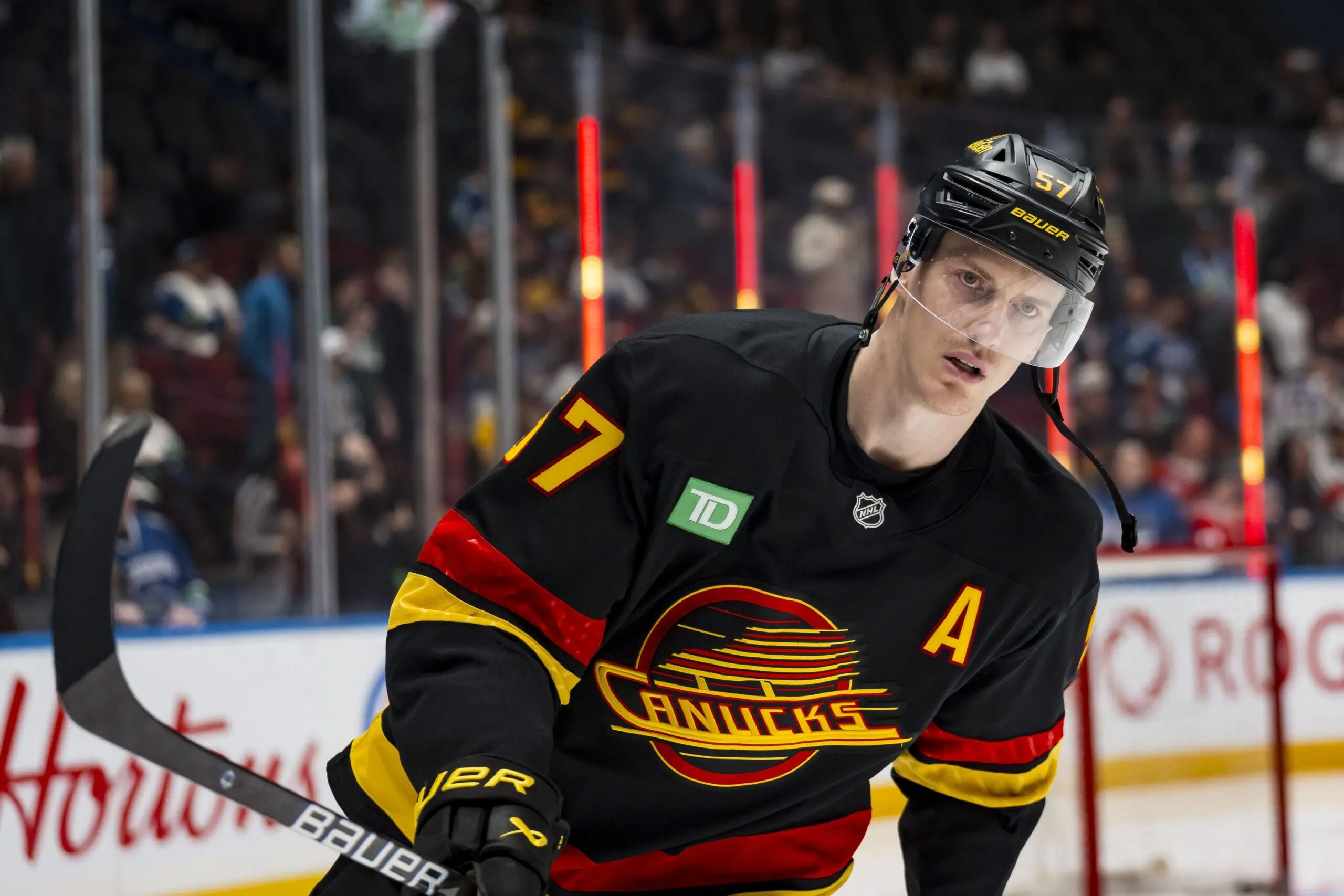
Photo credit: © Bob Frid-Imagn Images

Jan 4, 2026, 15:00 EST


The Vancouver Canucks are in a rebuild. Maybe. Actually, it might be more of a ‘hybrid rebuild.’ Or, on second thought, it might actually be the kind of hybrid rebuild where the team also re-signs veterans like Kiefer Sherwood instead of trading them.
It’s tough to say what exactly the Canucks are doing at this point, and maybe the obfuscation is the point. But it’s probably safe to say that, between now and the 2026 NHL Trade Deadline, at least some of the team’s current slate of veterans are going to be traded.
The front office, as voiced by POHO Jim Rutherford, has already expressed that their main plan is to hang on to their trio of veteran defenders in Filip Hronek, Marcus Pettersson, and Tyler Myers. They like the insulation the vets provide for their trio of young defenders: Tom Willander, Zeev Buium, and Elias Pettersson. They like that the vets buy the youngsters extra time to develop. They like that it conveniently matches up to two right-shooting vet D and one left-shooting vet D to complement two left-shooting young D and one right-shooter.
But does that really mean that the Canucks should not explore trading one of their veteran blueliners at all? We’re not so sure about that.
We’ve already talked about the possibility of trading Hronek, who is probably the Canucks’ single-most valuable asset right now, aside from their under-23 class. The haul they might get back for Hronek – a top-pairing RD signed until 2032 at a very reasonable rate – would be presumably enormous.
But trade Hronek, and the team is instantly without a top-pairing RD, or arguably without a top-pairing D at all. That would then require folks like Willander and Buium to step into that role right away rather than developing toward it, which could be a net negative for the team’s long-term goals.
But then, if keeping Hronek is the plan, one has to wonder: do the Canucks really need two veteran RDs sticking around?
Or, on the other hand, should the team be doing what it can to explore the trade value of Myers? Because, make no mistake, while navigating Myers’ no-trade clauses may prove difficult, were that barrier to be overcome, he would hold immense value all his own.
First, let’s talk practicalities. There’s no real reason the team can’t go into the next 2026-27 season with Hronek, Willander, and Myers still patrolling the right side together. There are only two other right-shooting defenders under contract in the entire organization right now, with those being Victor Mancini and Jett Woo, along with two unsigned prospects in Aiden Celebrini and Parker Alcos.
So, if we’re talking in-house options on the right side, the only name worth mentioning is Mancini. But his name deserves plenty of mention. The emergence and near-instant success of Willander have made many forget that Mancini beat Willander out fairly cleanly for a roster spot during the most recent training camp. Injuries got in the way, and Mancini is now plying his trade down in Abbotsford once again.
The expectation should be that Mancini once again puts up a good showing in Training Camp 2026 and earns himself another spot. That’s not necessarily an issue, as the team could always rotate through a four-piece set of RDs in Hronek, Willander, Myers, and Mancini. But, let’s be honest here, an NHL coaching staff is almost never going to scratch a Myers-type in favour of a Mancini-type. Suffice it to say, then, that if the Canucks go into 2026-27 with all four in the mix, the end result will almost certainly be reduced minutes and increased press-box time for Mancini – or another trip down to Abbotsford.
Mancini will have another season of waiver-exemption after this one, as he’s only in his second professional season. So, sending him to Abbotsford will be an option next year. At the same time, however, Mancini will turn 24 this summer. It’s approaching the point at which, if Mancini is going to be any part of the long-term plan, you really want him playing those NHL minutes. Especially if he’s once again earned them in Training Camp.
Clearing space for Mancini is one of the primary drivers behind any thought toward trading Myers. But it’s not just clearing roster space. It’s also making room for a future piece to grow into the kind of player the Canucks need him to be, and that requires NHL minutes.
So, onto the topic of Myers’ various clauses. Myers is in the second year of a three-year contract. In this current 2025-26 season, Myers possesses a full no-movement clause. That means he cannot be traded, waived, or re-assigned anywhere without his express permission.
As of July 1, 2026, that NMC morphs into a 12-team modified no-trade list, which means that Myers can designate 12 teams to whom he will not accept a trade.
To move Myers right now, he has to be on board. But all that no-movement clause really does is give him a say from between now and the Trade Deadline. As soon as that NMC becomes an NTC, Myers becomes moveable again, because we’re pretty certain that there are more than 12 teams out there that would be interested in his services.
Perhaps the team’s pitch to Myers is this: accept a trade at the 2026 Trade Deadline, and we can give you full say in where you are headed. Wait until the offseason, and you could be going to any one of 20 potential destinations. This doesn’t have to be an adversarial or acrimonious conversation, either – it’s the nature of the deal that Myers signed, and attempting to give him more say over his next home is a sign of respect and doing right by the player.
Assuming GM Patrik Allvin and Co. were able to get Myers on board with a trade within this current season, that’s when we could start talking about trade value, and that’s where it gets exciting.
At 35 going on 36 next month, Myers is the oldest Canuck. But he’s also aged a bit like wine. Anyone observing him over the past couple of seasons will attest that Myers’ mid-30s have gone better than his early-30s did.
This year, he’s playing an average of 20:22 per night; a bit below his career average, but also the 35th most minutes of any right-shot defender in the NHL. That puts Myers’ deployment at borderline top-pairing, definitively top-four territory.
His defensive metrics are not great this year, but then again, Myers is playing difficult minutes on a very porous team, so how could they be? One has to imagine that, on a better team that asks less of him, Myers’ results would be much better.
But, really, when we talk about Myers’ value, we’re talking about supply and demand, anyway, and the supply of available top-four RDs of any variety is very minimal at the moment. As we look at the various RDs on various teams that might feasibly be available for trade within this 2025-26 season, we find very few who could be considered as good or better than Myers. There are some names, to be sure – like Erik Karlsson, Colton Parayko, and Dougie Hamilton – but they’re all of a significantly more expensive class of asset. For any team looking to improve the right side of their blueline without breaking the bank, Myers doesn’t just look like a good option; he may end up being one of the only options, period.
Again, that is, if Myers does end up making himself an option.
Here, Myers’ salary bears mentioning. A cap hit of $3 million already looks like a bargain for what Myers delivers. Within the context of right-shooting D and what they typically get paid, it looks like even more of a bargain, and within the context of available right-shooting D, it’s several steps past bargain.
It’s a cap hit that, since the extension was signed and the cap itself has ballooned, has quickly become a well below-average NHL salary, never mind the average for a top-four defender.
There quite simply isn’t another RD of this quality available on the market at that price.
A team trading for Myers within this current season would get him at that $3 million cap hit for the remainder of this season, the 2026 playoffs, and the entirety of the 2026-27 campaign. That’s an awful lot of bang for not that many bucks.
And then there are the potential suitors to consider. Now, Myers will have a say in how many suitors there truly are – but the rest of the league doesn’t necessarily need to know that. If we’re just talking contending teams that could use another RD, the list is long, very long. In fact, we’d hazard a guess that most teams headed to the playoffs this year – within a couple of RD-laden exceptions – would have at least passing interest in Myers. And almost all of them could afford him, at least in terms of contract.
Let’s not forget that the postseason tends to favour defenders like Myers, the types with size who are not afraid to use it, especially when the threshold for penalty calls gets raised. Myers isn’t just an able addition to any playoff blueline; he’s of the type that teams are constantly trying to get their hands on for the specific purpose of doing better in the playoffs.
So, all that said, were the Canucks able to move Myers before the 2026 Trade Deadline, what could they expect to get back for him? We don’t want to get too ahead of ourselves here, but the value seems like it should approach the range that is currently being discussed for Kiefer Sherwood as a rental. Both players fall into the same no-better-bargain-available camp.
One-and-a-half seasons (and two playoff runs) of top-four play from the rarest position in the sport of hockey? In a 6’8” package? With just a measly $3 million cap hit in this season and the next?
We see no reason why an asset of that ilk shouldn’t return at least a first-round pick, if not more. And if we have that right, that should probably be enough impetus for the Canucks’ front office to at least start exploring this idea, if not starting the conversation with Myers quite yet.
Sponsored by bet365


Breaking News
- Vancouver Canucks practice in Tampa Bay; Abbotsford signs defenceman to PTO
- Why did Canucks fans rate Aatu Räty higher than the rest of the league?
- What the Canucks are getting in new trade acquisitions Jacob Quillan and Brandon Buhr
- The Statsies: Tom Willander leads Canucks in xGF in overtime loss to Panthers
- The Stanchies: Brady Tkachuk’s natural hat trick extends Canucks losing streak to 6 in OT loss to Panthers

Vancouver CanucksTeam Cap Summary

Cap Summary
2026-27
2027-28
Projected Cap Hit
$87,295,050
$71,329,167
Projected Cap Space
$16,704,950
$42,170,833
Current Cap Space
$18,206,519
$42,170,833
Active Players
23/23
13/23
Draft Picks
Round
'27
'28
1
1
1
2
2
2
3
1
1