
CanucksArmy has no direct affiliation to the Vancouver Canucks, Canucks Sports & Entertainment, NHL, or NHLPA
The Canucks are a rebuilding team without a rookie on the roster…is this a problem?
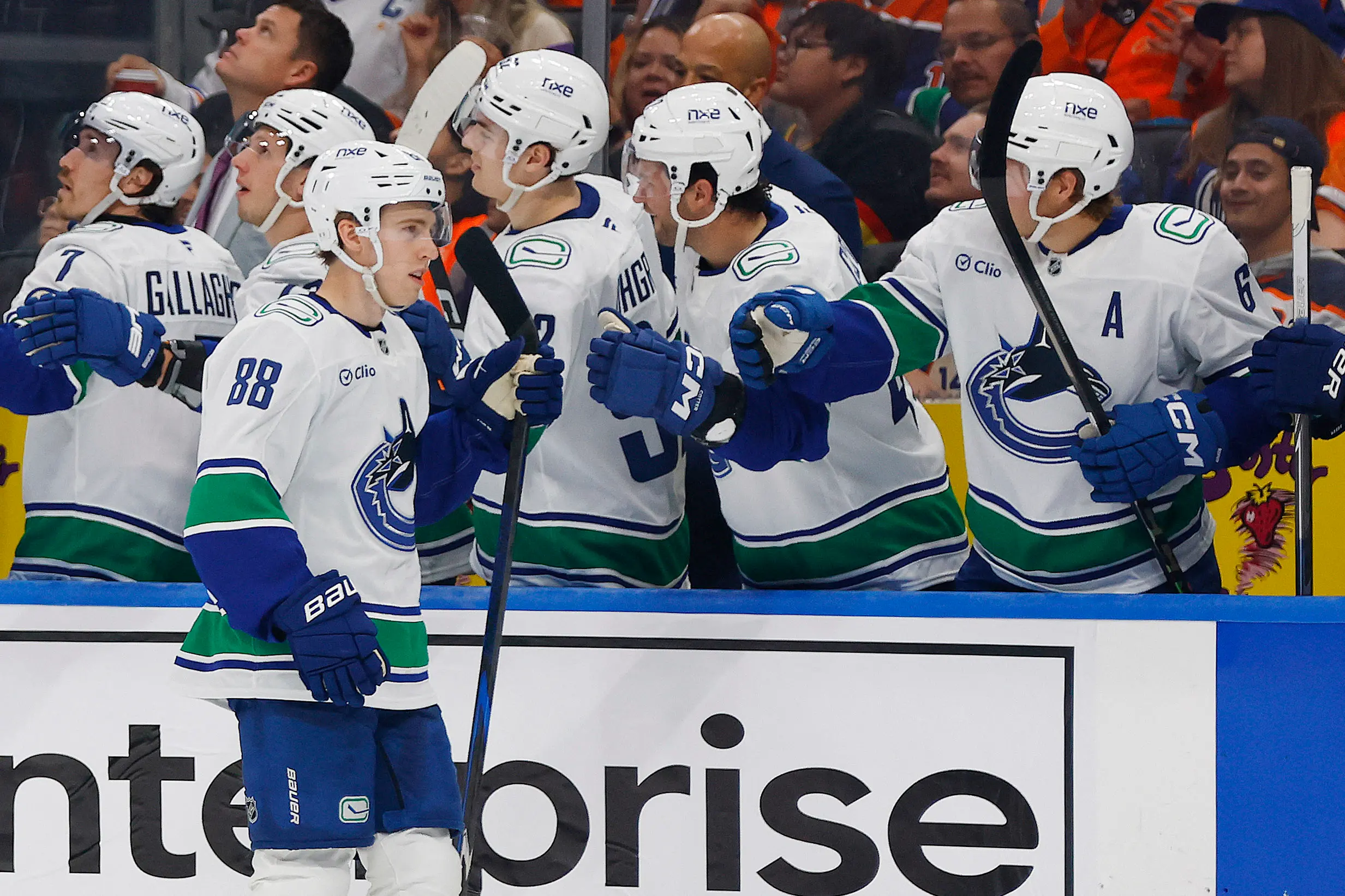
Photo credit: Perry Nelson for IMAGN IMAGES via Reuters Connect

Oct 1, 2026, 12:36 EDT


The Vancouver Canucks are indisputably in a rebuild right now. They’ve announced the rebuild, they’ve committed to the rebuild, and they’re doing the rebuild. And with said rebuild seeming to have officially begun with the January 2026 trade of Quinn Hughes to the Minnesota Wild, that makes this current 2026-27 campaign the first full season of the rebuild.
The Canucks’ opening night roster was definitely a young one. According to EliteProspects, the Canucks entered the year with an average age of 26.68, making them the eighth-youngest roster in the NHL.
At the same time, however, the Canucks’ opening night roster was entirely devoid of NHL rookies. Which does strike us as a bit odd for a rebuilding team.
The Canucks do have plenty of sophomores on the roster, including Zeev Buium and Tom Willander, but all 25 players on the roster have passed the 25-game threshold to lose their rookie status. Somewhat ironically, the player who is closest to that threshold on the roster is Guillaume Brisebois, the longest-tenured Canuck, at 30 career games – though at age 29, he’s far too old to be considered a rookie, anyway.
Vancouver does have some rookies on the periphery of the roster. Braeden Cootes and Kirill Kudryavtsev were both cut from the team and reassigned to Abbotsford, but both are expected to make an impact on the roster sooner rather than later, and that could include some appearances this year. All indications, however, are that GM Ryan Johnson will prefer to keep his prospects in the minors for most of the year and use most of his call-ups on more veteran tweeners. That could mean the Canucks go the entire 2026-27 campaign without any rookies playing significant minutes.
It’s odd, like we said. But is it a problem?
Let’s check out the rest of the rebuild crowd. The Chicago Blackhawks finished second-last to the Canucks in 2025-26. They’ve opened the 2026-27 season with two high-profile rookies on their roster, including Anton Frondell and Roman Kantserov.
The Calgary Flames, who finished tied for third-last and might be the only other team in the same phase of rebuild as the Canucks, opened the year with just one rookie, Samuel Honzek, on their roster.
The New York Rangers, who finished tied with the Flames, have the 18-year-old Alberts Smits, who they just drafted at fifth overall, on their blueline to start the year.
Somewhat unexpectedly, the team with the most rookies on its roster is the Anaheim Ducks, who made the playoffs last year. They’ve got four, including Roger McQueen, Nikita Klepov, Judd Caulfield, and Tyson Hinds.
This all shows us that, while it may be a bit unusual for the Canucks to have zero rookies on their roster, they’re really not that far off from the rest of the rebuild pack, who only have one or two of their own.
It is, ultimately, something that is in keeping with a proper rebuild philosophy of patience, and of putting the truly long-term ahead of any present-tense perspectives.
Would this rebuild be a little easier to ‘sell’ if the Canucks had a player or two competing for the Calder Trophy this year? Sure. But you can’t just conjure rookies out of thin air. The Canucks just committed to this rebuild. They’ve had one draft since, and the top player they picked in that draft had already committed to playing this season in the NCAA. Four of the Canucks’ top eight prospects were just selected in June. Two more were selected in 2025. There’s naturally a bit of a wait for such picks to be ready for primetime.
But it isn’t an idle wait. All the while, those players are developing in leagues better suited to their current status.
The Canucks clearly chose to place Cootes and Kudryavtsev in Abbotsford because it was the best place for their own individual development at this point. In other words, they’re not starting their NHL careers quite yet so that they can have a stronger start to those careers at some point down the road.
Having rookies on the roster isn’t something you can or should force.
If there’s a ‘consequence’ to be found here, it’s that it might push the Canucks’ future window of contention a little further into the future.
The rookies will be arriving soon enough. Cootes and Kudryavtsev should be on the team next year, unless they’ve forced their way onto the roster at some point this season. Caleb Malhotra should arrive next year, too, and may cameo toward the end of 2026-27. And after that, it should be a fairly steady stream of new arrivals. Adam Novotný can’t be that far behind, and then come the likes of Brooks Rogowski, Niklas Aaram-Olsen, and more. And that’s to say nothing of the players the Canucks will draft in 2027, 2028, and so on.
That does probably mean that the Canucks’ hopes of competing again lie closer to the year 2030, and perhaps beyond. All these players will need time to hit the big leagues, find their feet, and develop into their playing prime. That’s a years-long process that has only barely begun as of 2026-27.
Suffice it to say, then, that the Canucks’ current lack of rookies is a temporary thing, brought on almost solely by the fact they’ve spent the last nine months transitioning from a would-be contender to not-even-pretender. The turnaround to a full-scale rebuild has been impressive in its speed, but it was never going to be an instantaneous changeover.
In many ways, it can be taken as a positive, in that it’s a sign that the best and most exciting bits of this rebuild are still yet to come. A fairly constant influx of rookies is coming to the Vancouver Canucks. They’re just not here yet.
Sponsored by bet365


Breaking News
- The Stanchies: Hot dogs fall from the sky as Canucks fall 6-3 to the Hurricanes
- Instant Reaction: Canucks’ penalty kill perfect in 6-3 loss to Hurricanes
- A look at the underlying metrics of the Canucks’ defence pairings through 10 games
- Scenes from morning skate: Meriläinen starts, Rossi out again as Canucks host Cup champs from Carolina
- ‘Sucks to see him go’: Max Sasson and Linus Karlsson reflect on Aatu Räty trade

Vancouver CanucksTeam Cap Summary

Cap Summary
2026-27
2027-28
Projected Cap Hit
$87,295,050
$71,329,167
Projected Cap Space
$16,704,950
$42,170,833
Current Cap Space
$18,732,718
$42,170,833
Active Players
23/23
13/23
Draft Picks
Round
'27
'28
1
1
1
2
2
2
3
1
1