
CanucksArmy has no direct affiliation to the Vancouver Canucks, Canucks Sports & Entertainment, NHL, or NHLPA
Canucks D Elias Pettersson’s promising start is running into a tougher test
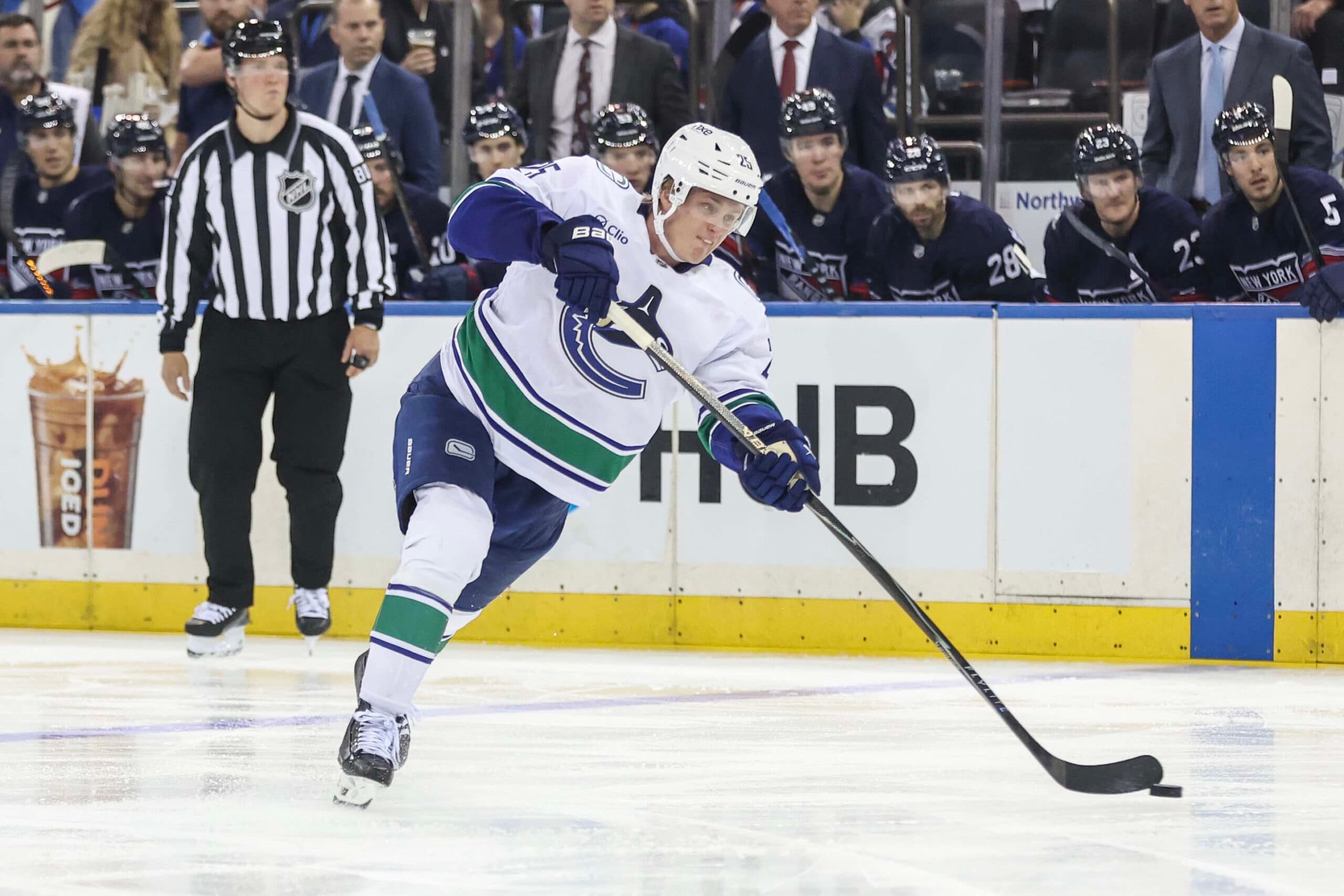
Photo credit: Wendell Cruz for IMAGN IMAGES via Reuters Connect

By Elijah Ford
Nov 27, 2026, 09:00 ESTUpdated: Nov 27, 2026, 00:53 EST


For the first few weeks of the season, Elias Pettersson looked like one of the Vancouver Canucks’ most promising developments, period.
The young defenceman was playing with an edge. He finished checks, competed physically, and played with a confidence that seemed to soften for stretches last season. There were signs of growth in his offensive game, and he appeared increasingly comfortable jumping into the play to create scoring chances. He was not simply surviving his minutes; he looked like a defenceman beginning to understand how he could make an impact at the NHL level.
Since the calendar turned to November, however, the picture of his season has become considerably blurrier. His puck movement has been inconsistent, his decision-making under pressure has become a concern, and his underlying numbers have taken a noticeable step backwards.
The split is stark.
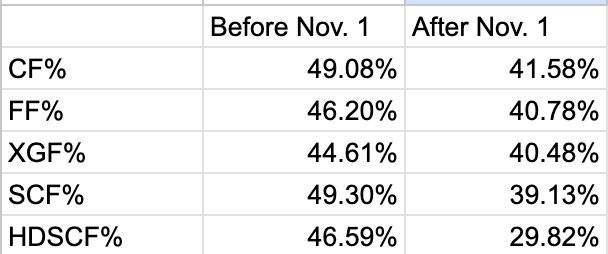
All numbers at five-on-five
Those numbers early on were not dominant in general terms, and they should not be mistaken for evidence that Pettersson had already become a high-end NHL defenceman. But they were much healthier than what has followed. The recent decline suggests the promising start was not yet sustainable, particularly as the level of competition and responsibility increased.
Pettersson’s usage is an important piece of context. He has more often been asked to play alongside Filip Hronek, who typically draws difficult assignments against opposing top lines.
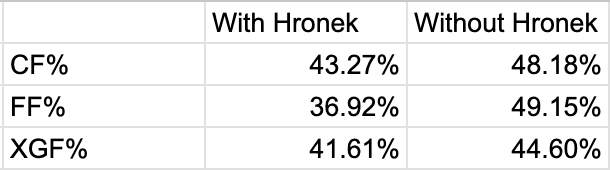
All numbers at five-on-five
That does not mean Hronek is the problem, or that Pettersson cannot play with him. It does, however, underline how much harder Pettersson’s minutes can become when he is exposed to an opponent’s best players. A young defenceman who looked comfortable against depth competition is now being tested in situations where small mistakes are more likely to end up in the back of his net.
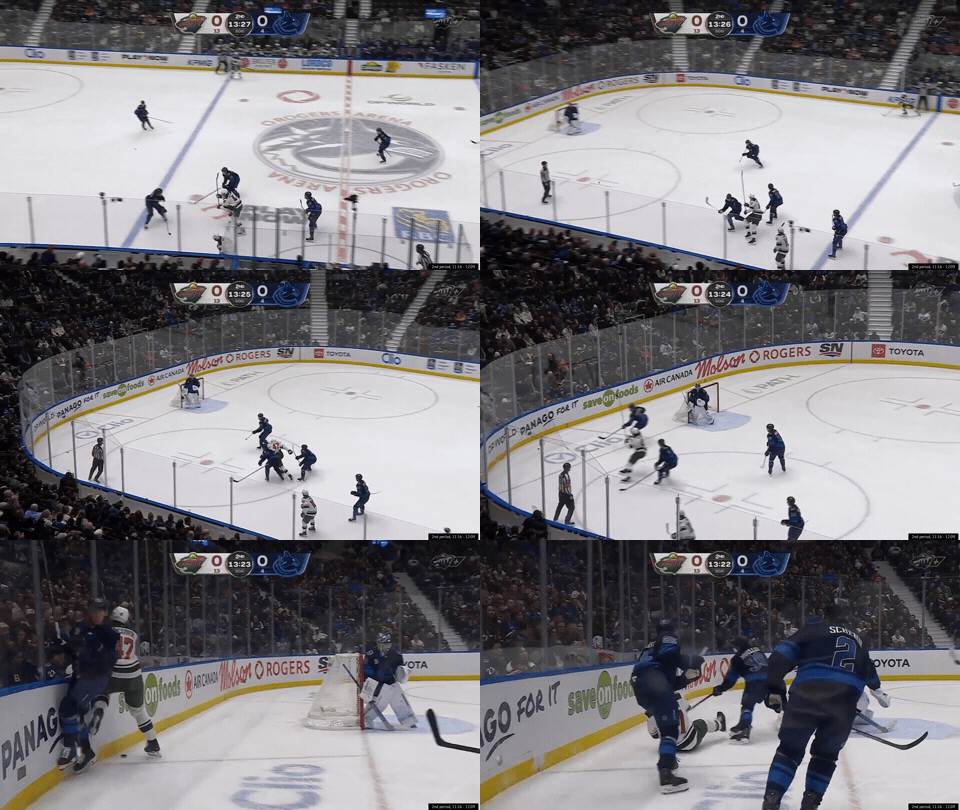
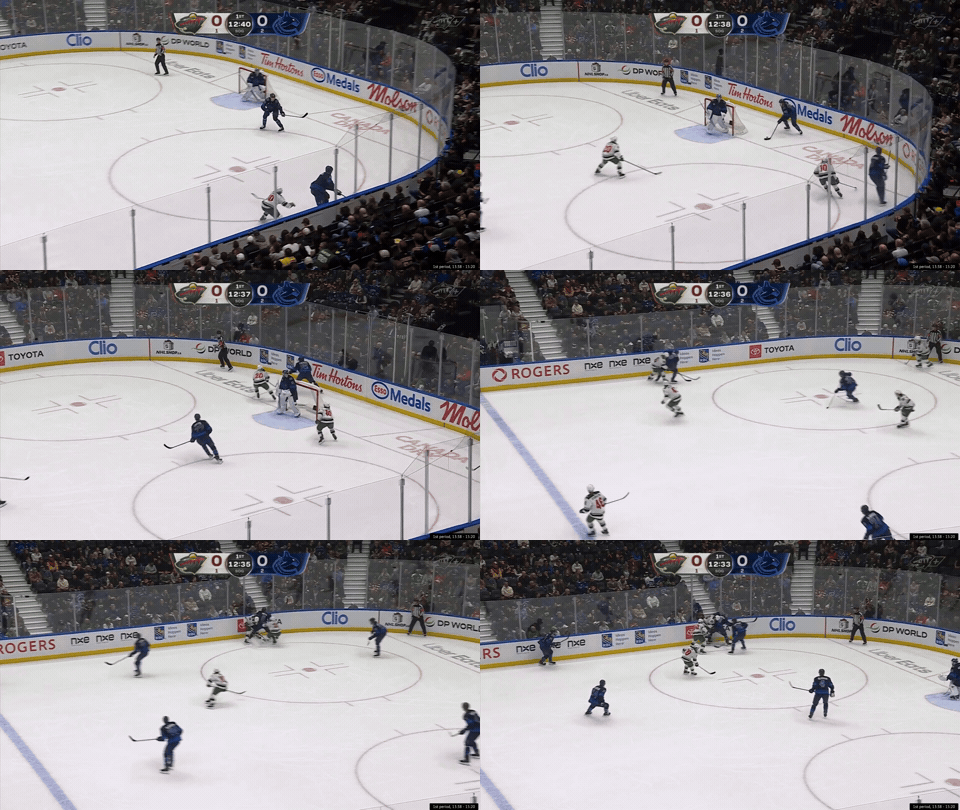
That difference is visible in his recent play. Pettersson has appeared to struggle with arguably the most crucial element of defending in the NHL: retrieving the puck, identifying his options, and making a clean first pass. His slower pivot speed can leave him late on retrievals or breakout reads, putting him and his partner under pressure before the Canucks can move up ice. And when he does get the puck, his reads have been hit and miss. On a few occasions, Pettersson has turned the puck over while attempting relatively low-percentage slip passes rather than keeping the play to the outside. On this play, he has a simple backhand pass to Luke Schenn available but instead tries to slip the puck to a supporting Ty Mueller, resulting in a turnover.
There are also moments when Pettersson’s positioning lapses. He can become fixed on the puck, lose track of the player or space behind him, and find himself reacting rather than anticipating. Those are understandable mistakes for an inexperienced NHL defenceman, but they are also the details that separate a player who can handle sheltered minutes from one a coach can trust against top competition. Here we see him leave his position in the diamond penalty kill to check Connor McDavid, leaving the middle of the ice open.
Some of those issues may be connected to Pettersson’s skating. His mobility is not a red flag, but his first few strides are not especially explosive. He also does not always use his shoulders and hips to disguise his intentions or create space for himself. When his first read is unavailable, he can struggle to manufacture another option. At this level, a fraction of a second matters, and a defender who cannot quickly change direction or evade pressure can find himself making hurried decisions. Below Pettersson receives the puck, with time, behind the net. When Pettersson stickhandles to his backhand, the forechecker commits to the right side of the net. The ideal play would be to pull the puck back to his forehand and hit Jamie Oleksiak with the outlet pass. Instead, Pettersson allows his passing lane to be cut off and settles for a pass to a forward who is already well covered.
There are still many parts of Pettersson’s game that offer a reason for optimism, though. His physical edge is real, and it can change the energy of a game. When Vancouver was badly outplayed in the first period against Chicago recently, Pettersson delivered an open-ice hit after a lengthy television timeout.
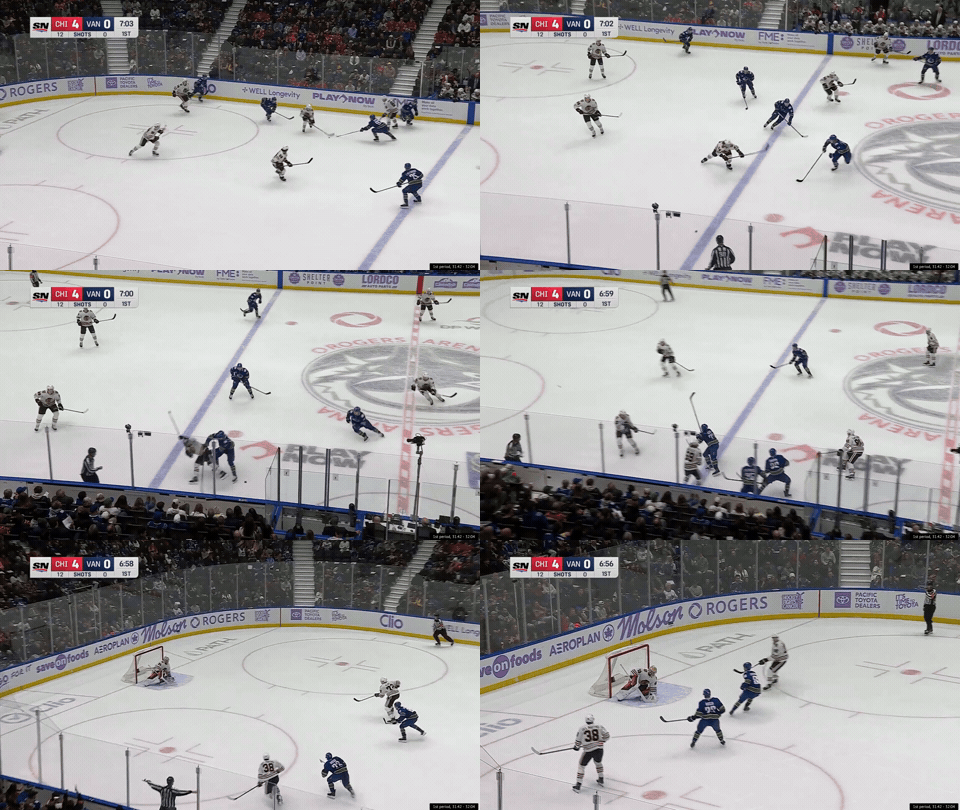
This helped give the Canucks a jolt, led to an offensive-zone faceoff, and eventually led to their first goal of the game. It was a small sequence, but a useful reminder of the identity he can bring.
He has also continued to provide value on the penalty kill, where he has played the second-most minutes for the Canucks, behind only Filip Hronek. That role gives him a clear way to contribute while his five-on-five game slowly develops, as there are signs that a lighter workload may currently suit him best.
Pettersson averages 15:30 of five-on-five ice time per game. In games he has played fewer than 15:30, his Corsi share (50.48%) and other underlying numbers are considerably higher than in games where he has played more (45.85%). His minutes have also dipped recently, playing 14:08, 12:12, and 13:46 in his last three games.
That reduction has coincided with some better results. In Detroit, he posted a team-best Corsi share (78.95%) and expected goals share (76.01%). One strong game is not enough to declare the problem solved, and those numbers are heavily influenced by a small sample. Still, his performance in a more limited role is an encouraging sign. It may be that the Canucks are better served allowing him to rebuild confidence and sharpen his reads before asking him to take on a larger workload again.
The takeaway should not be that Pettersson’s early-season progress was a mirage, nor that his recent struggles are proof he cannot handle an NHL role. The more realistic conclusion is that he is still learning how his game fits at this level, shift to shift. His physical tools, penalty-killing work, and willingness to compete give him a high floor. But his puck retrievals, breakout decisions, positional awareness, and ability to manage pressure need to become more consistent.
For now, Pettersson looks more like a young defenceman who can help in the right circumstances than a player ready to take on difficult matchups every night. To be clear, that is not a failure whatsoever; it should be expected. Development on the blueline rarely follows a straight line, and the Canucks need to be patient enough to let him learn from these stretches without asking him to do more than he is ready for.
The first month showed what Pettersson can bring when the game is moving at a pace he can manage. November has shown how much work remains before he can deliver that impact consistently against the NHL’s best higher in the lineup.
PRESENTED BY VIVID SEATS


Breaking News
- Canucks D Elias Pettersson’s promising start is running into a tougher test
- Canucks don’t need a goalie solution anytime soon, and this season proves it
- WDYTT: What one thing do you need the Canucks to get better at as a whole?
- Canucks prospects Bernat and Aaram-Olsen named to World Juniors rosters
- The Statsies: Pettersson rebounds at 5v5 as Canucks stumble in Detroit

Vancouver CanucksTeam Cap Summary

Cap Summary
2026-27
2027-28
Projected Cap Hit
$88,379,919
$69,329,167
Projected Cap Space
$15,620,081
$44,170,833
Current Cap Space
$22,281,586
$44,170,833
Active Players
23/23
11/23
Draft Picks
Round
'27
'28
1
1
1
2
2
2
3
1
1