
CanucksArmy has no direct affiliation to the Vancouver Canucks, Canucks Sports & Entertainment, NHL, or NHLPA
Canucks: Using comparables to establish Aatu Räty’s updated NHL ceiling

Photo credit: Bob Frid-Imagn Images

Sep 13, 2025, 13:00 EDTUpdated: Sep 12, 2025, 23:47 EDT


Despite making some very big proclamations at the onset of the offseason about their need to get a second line centre — Jim Rutherford saying it would be expensive to go out and get a 2C but it would be more expensive not to comes to mind — all signs point to the Vancouver Canucks being done with their offseason work.
That means they’ll roll with a centre corps consisting of Elias Pettersson, Filip Chytil, Teddy Blueger, and Aatu Räty. Now, you might argue that Räty deserves to be ahead of Blueger on that list, and that’s fine. Blueger’s offensive abilities are limited, and Räty has shown some offensive flashes so far in his young career. Räty was also the Canucks’ choice for 3C on night one of the regular season last year (thanks to an injury to Pius Suter).
Now waiver eligible, it would seem to be do-or-die time for Räty as he heads into his third training camp with the Canucks.
Räty’s Canucks career so far
At 16, Räty was being talked about as a surefire top three pick for the 2021 NHL Entry Draft. By the time the draft actually rolled around, he ended up falling to the second round, where the New York Islanders scooped him up with the 52nd overall pick. During his first full season with the Islanders, Räty found himself as part of the pre-deadline deal that sent Bo Horvat from Vancouver to New York.
Upon arriving in Vancouver, Räty went through an adjustment period with AHL Abbotsford and got into three NHL games with the Canucks down the stretch. The following season, Räty spent the entire year in Abbotsford, where he put up a more than respectable 52 points in 72 games as a 21-year-old. This past season, Räty was an all-situations centre for the AHL club, and scored at a near point-per-game pace with 40 points in 43 games. Räty also appeared in 33 NHL games, which included the Canucks’ first three games of the season after Räty turned in a strong training camp.
Räty then spent most of November and just under half of December with the Canucks, but tallied just two goals and one assist through 17 games over that stretch. He went back down to the AHL, and didn’t get called back up until late March. During that stretch however, Räty looked like a more mature and complete player.
Through his final 12 games of the regular season, Räty potted five goals and added two assists. On top of that, he established himself as a valuable faceoff ace, even starting overtime frames just to win the puck back to Quinn Hughes, then go off for a change.
And so as Räty heads into his age-23 season, the Canucks are certainly hopeful that what they saw down the stretch last season wasn’t just a flash in the pan. Last year, Räty knocked down the door and earned a roster spot when not many people expected him to.
This year, the Canucks are counting on Räty to be a solid third-line centre for them right from the hop. So how many players have been able to take that jump in their early-mid 20s in the NHL’s modern era?
Comparables for Räty
When sifting through my memory bank for centres who paid their dues in the AHL before making the jump to the NHL in their age-23 season, one name stood out above the rest: David Desharnais.
Now, Desharnais was essentially the centre version of Conor Garland (and no, not just because Desharnais was 5’7). While Desharnais spent most of his career pivoting the Canadiens’ third line, he routinely jumped up to the top six and while that wasn’t necessarily ideal, he performed admirably in that role.
Where the comparison between Desharnais and Räty really becomes a good one is when you examine the seasons Desharnais turned in during the years leading up to becoming an NHL regular. In his age 22 season, Desharnais put up 58 points through 77 AHL games. Obviously, that’s very similar output to the age 21 season Räty enjoyed in 2023-24. The next season, Desharnais got his first taste of NHL action, but spent most of his time in the AHL, where his scoring totals improved.
2010-11 — Desharnais’ age 24 season — would be his last season spending any time in the AHL. After putting up 22 points in 43 NHL games, Desharnais stuck as the Canadiens’ 3C for the next six seasons. So the step Desharnais took from AHL to NHL actually came a year later than when the Canucks are hoping Räty can take it at age 23.
Now, it’s also worth mentioning that Desharnais is likely a bit of a high-end comparable for Räty. If Räty can put up point totals like these, nobody will be complaining:
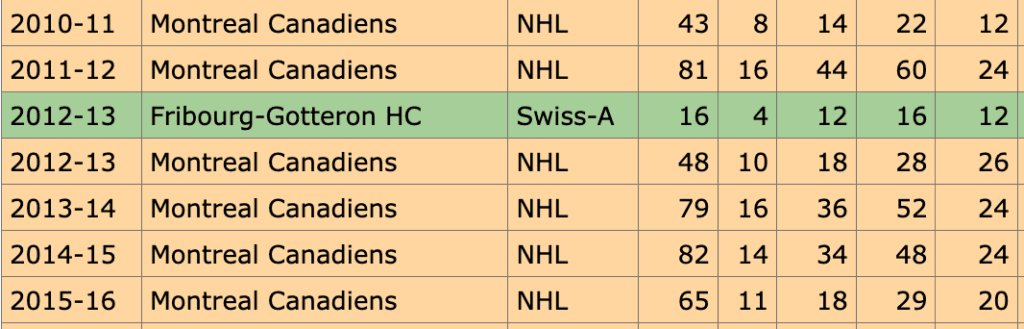
From HockeyDb.com
While Desharnais might be the closest comparable for Räty in the modern era, there are obviously other centres who took the step into being NHL centres at age 23 or 24. Some more names that come to mind (and are imperfect comparables to Räty for various reasons): Brian Boyle, Tyler Bozak, and Tomas Plekanec.
Räty’s ceiling
What these comparables do help us with is establishing a ceiling for Räty. There just hasn’t been a centre with Räty’s statistical profile in the NHL’s modern era to amount to anything beyond a solid third-line centre in their career. And of course, that would be absolutely fine for Räty and the Canucks.
As mentioned earlier, if Räty can establish himself as a consistent 45-55 point centre, capable of taking on key matchups, killing penalties, and hopping over the boards when the team needs a big faceoff win in the defensive zone, nobody will be complaining.
How fast he’s able to do that is another question, and we could get our answer to that in a matter of weeks.
READ NEXT: Can Aatu Räty make the jump to the NHL? Canucks goals and expectations for 2025-2026
Sponsored by bet365


Breaking News
- How the Canucks compare to other NHL basement dwellers three weeks into the season
- JPat: A word on Aatu Räty’s past, present, and future as Canucks place young centre on waivers
- Canucks place Aatu Räty on NHL waivers
- WWYDW: Who or what has most surprised you through 10% of the Canucks’ season?
- The Statsies: Brock Boeser has his best game of the year in Canucks’ loss to Islanders

Vancouver CanucksTeam Cap Summary

Cap Summary
2026-27
2027-28
Projected Cap Hit
$88,074,947
$71,329,167
Projected Cap Space
$15,925,053
$42,170,833
Current Cap Space
$17,163,668
$42,170,833
Active Players
23/23
13/23
Draft Picks
Round
'27
'28
1
1
1
2
2
2
3
1
1