
CanucksArmy has no direct affiliation to the Vancouver Canucks, Canucks Sports & Entertainment, NHL, or NHLPA
Using past scoring profiles to find comparables for top prospects in 2026 NHL Draft
Photo credit: © Matthew O'Haren-Imagn Images

By Tyson Cole
Jun 26, 2026, 09:00 EDTUpdated: Jun 26, 2026, 04:05 EDT


The day has come, Vancouver Canucks fans. We’ve finally reached draft day for the 2026 NHL Draft. With that, we’re finally going to see who the next crop of prospects will be that will hopefully play a major role in the next best Canucks team.
There is a consensus top-two in this draft – Gavin McKenna and Ivar Stenberg – and then there’s a real decision to be made for the Canucks at third overall. But Vancouver’s day won’t be over there, as they have another selection at 24th overall.
So, I thought it would be an interesting project to dive into the 39 of the top prospects in the 2026 NHL Draft and look at their scoring profiles in their respective leagues, and compare them to other NHL-drafted prospect scoring profiles in their draft year.
Before getting into the criteria for this study, I just wanted to remind everyone that there is much more to prospect evaluation than just their scoring profiles. Size, skill, skating, defensive play, compete level, leadership, and finding those with NHL traits are all contributing factors teams must consider before making their selection that won’t necessarily show up on the stat sheet.
So, this isn’t a perfect science. Nonetheless, digging up these scoring profiles did paint a bit of a picture of the level of NHL scorers these players could become. These are just teenagers, and drafting is just part of the project. Teams must work with them to develop these young players to reach their max projection.
I had seven prerequisites for this study:
- The season used in the comparisons was the year the player was drafted.
- The prospects and their comparison had to have played in the same league in that draft year.
- The comparison must have been within 0.03 points per game in either direction of the prospect’s draft season. (Unless there weren’t any examples within those parameters. Then, comparables were extended to 0.1 in either direction.)
- These are just scoring profiles. Player type was not a part of the findings.
- If a player split his season between two leagues, we went with the league in which he played the most games.
- The players must have been drafted into the NHL.
- All (but one instance, which will be explained) of the season comparisons were from the 2000s.
We will break down the prospects by league: WHL, OHL, QMJHL, NCAA, USNTDP, USHL, and European Leagues (SHL, SHL U20 Nationell, Allsvenskan, LIIGA, and MHL). Some prospects will have many comparables; others just a few. At the start of each screenshot, I included the top point-per-game draft-year leaders in each league to paint a full picture of the true ceiling for each league. I did my best to pluck out the overagers, but if I left a few in here, I apologize. And for fun, we’ll try to give our best bet at the best NHL-drafted comparable for each prospect based on those points per game totals in their league.
Alright, enough yappin’. Let’s get into it.
WHL
Forwards
Here are the four WHL forward prospects we studied.

And their point-per-game comparables:
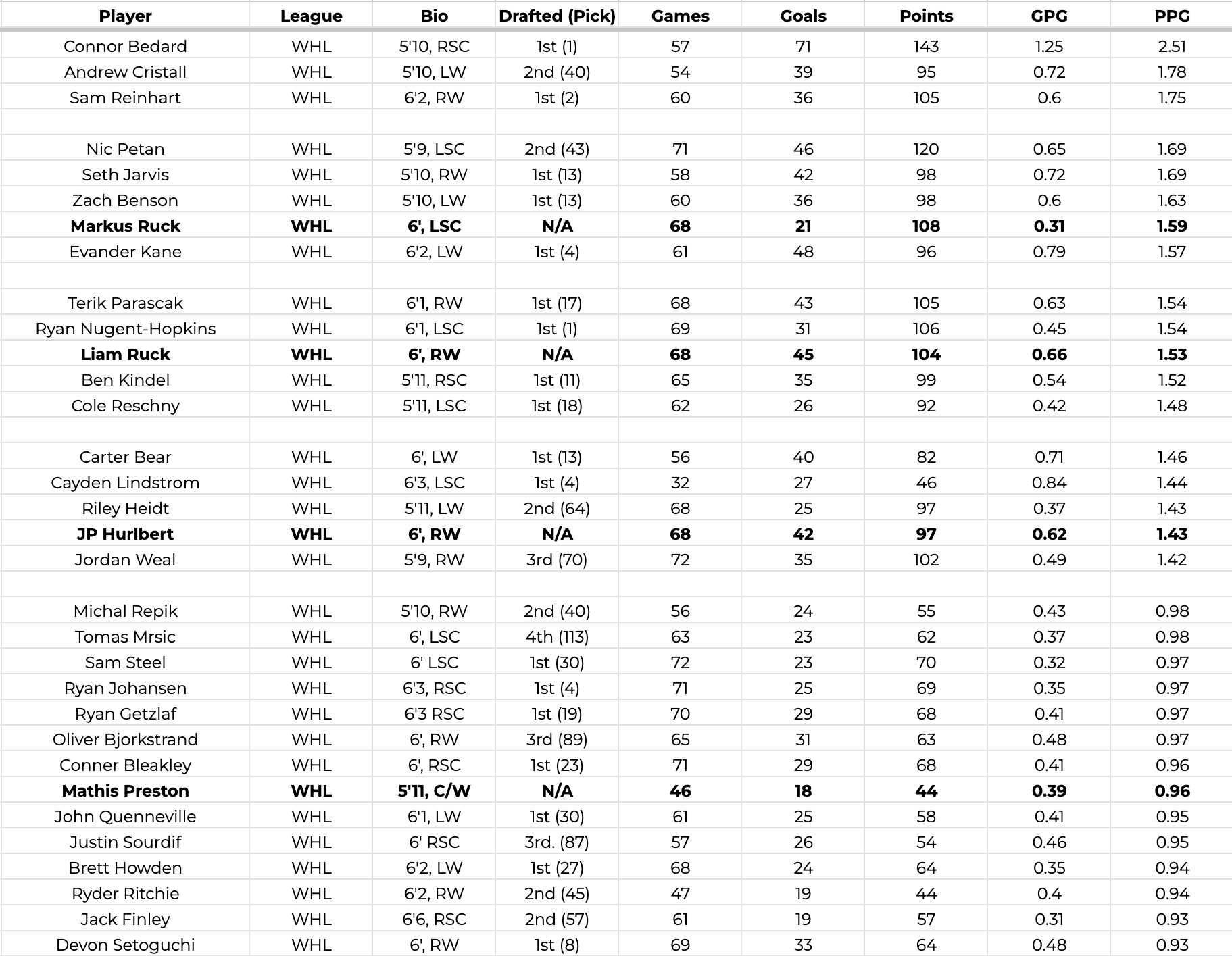
Markus Ruck: He is more of the playmaker of the twins. However, his comparables are more prolific goal scorers than Markus is. For that reason, there really doesn’t appear to be a perfect match for Markus in his scoring range, given his more playmaking ability. I don’t want to start with a pass, but it just doesn’t seem right considering the comparables.
Liam Ruck: Markus’s twin brother, Liam, has much closer comparables. Oddly enough, the players in his profile scoring range are less of that prototypical goalscorer than Markus’s group. However, Terik Parascak seems to be a near-perfect comparable for Liam’s projection; 0.03 off his goal-scoring pace and 0.01 off the point production. Parascak is turning pro next season after his draft-plus-one and two seasons in the WHL, which matches Liam, who’s returning to the WHL next season before jumping to the NCAA the following year.
JP Hurlbert: Like Markus, Hurlbert didn’t have that perfect fit. But we like Carter Bear might be a good projection for Hurlbert. Both 6′ wingers who can score over a 0.5 goal per game, and are in a similar point range. I have questions about Hurlbert’s skating and ability to create separation outside of junior hockey, and that was a criticism of Bear in his draft year.
Mathis Preston: Preston has a ton of comparables at just under a point-per-game. They’re a wide range of high-end NHL talent, like Stanley Cup Champion Ryan Getzlaf, but also stoop as low as Conner Bleackley, who never played an NHL game. Most of the group are middle-six wingers, like Sam Steel, Oliver Bjorkstrand, Justin Sourdif, and Brett Howden, and that’s likely where he finds himself at the NHL level. However, if we’re basing our analysis solely on scoring profiles, Preston nearly mirrors Bleackley’s per-game numbers. If the Canucks do select him at 24th overall, fans pray he does not have the same career arc as Bleackley.
Defencemen
Here are the three WHL defencemen prospects we studied:

And their point-per-game comparables:
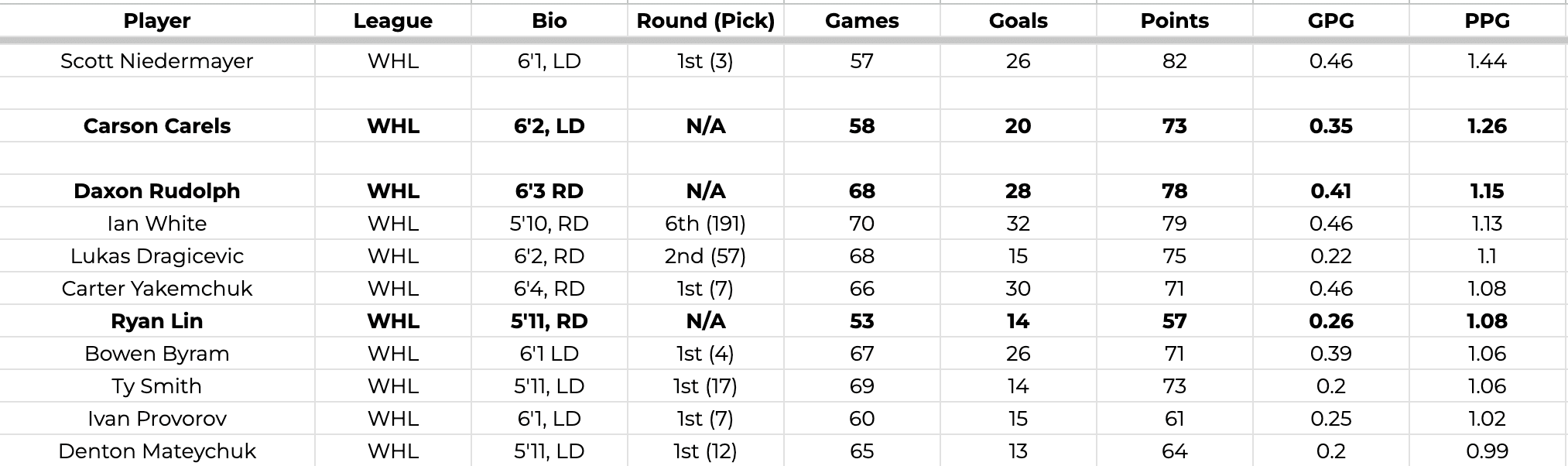
Carson Carels: As mentioned above, there was one scenario in which we did not have comparable data after 2000: Carson Carels. He is the point-per-game leader among WHL defencemen in their draft year since 2000. The closest and most recent to him is Scott Niedermayer – ever heard of him? Carels had a phenomenal year and will go high in today’s draft because of it.
Daxon Rudolph: Carels is the first on that list, but Rudolph is not far behind him. However, Rudolph had players close behind him in Ian White and Lukas Dragicevic.
Ryan Lin: Lin is where we see some of the better comparables on this list. He doesn’t have quite the goal-scoring profile of a Carter Yakemchuk or a Bowen Byram, but he gains an edge on their passing. Byram has had more success at the NHL level, but Yakemchuk projects to be an important piece for the Ottawa Senators moving forward, so we like them both as comparables for Lin. Most of the examples listed were top-half first-round picks, which is where we likely see Lin go today.
OHL
Forwards
Here are the six OHL forward prospects we studied.

And their point-per-game comparables:
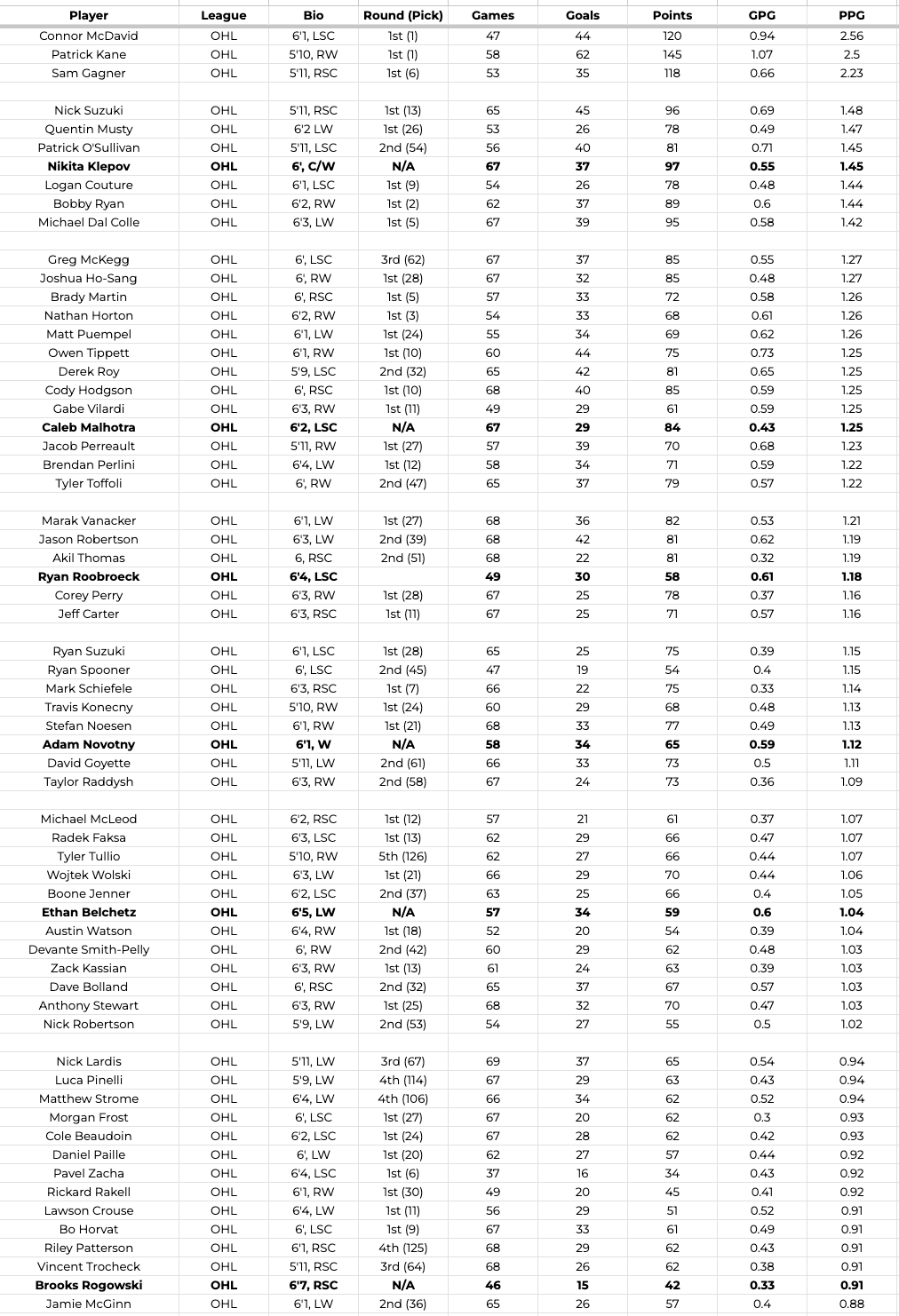
Nikita Klepov: A lot of high-end talent in the comparable range of Klepov, Nick Suzuki, Logan Couture, and Bobby Ryan highlights the list, although a bust in Michael Dal Colle accompanies them. So there are massive ranges of outcomes here, but there are many more success stories of OHL-leading scorers going on to have successful NHL careers. Based on these numbers, Logan Couture and Bobby Ryan seem like the two best comparables for Klepov.
Caleb Malhotra: Now Malhotra’s scoring profile is the one with a ton of outcomes. There are some NHL busts in Joshua Ho-Sang, Matt Puempel, Cody Hodgson (sorry Canucks fans), and Jacob Perreault, but also success stories with Nathan Horton, Owen Tippett, Derek Roy, Gabe Vilardi, and Tyler Toffoli. There aren’t many top-line NHL contributors on this list, but Gabe Vilardi looks like a strong scoring profile comparable to Malhotra.
Ryan Roobroeck: Surprisingly, there are a lot more heavy hitters in Roobroeck’s production range than Malhotra. Two studs from the infamous 2003 draft in Corey Perry and Jeff Carter, and a current top-line winger in Jason Robertson. While there are some inconsistencies regarding Roobroeck’s on-ice effort level, the best scoring comparable would actually be Robertson.
Adam Novotny: Novotny is one of the better goalscorers in this class, and topped his comparables in goals per game. So, it’s tough to find his best match. However, we would go with a Stefan Noesen or David Goyette.
Ethan Belchetz: The same goes for the 6’5″ hulking power forward, besting his group in the goal-scoring department. It seems weird that defensive centreman Dave Bolland is the best comparable for Belchetz over a Radek Faksa or Wojtek Wolski, but the numbers are the numbers damnit!
Brooks Rogowski: If a towering 6’7″ centreman can put up the points like a Bo Horvat or Vincent Trocheck at the next level, whoever drafts him is laughing. Although, he doesn’t project to produce like that in the NHL, we could see him becoming more of a Lawson Crouse or Jamie McGinn.
Defencemen
Here are the two OHL defencemen prospects we studied:

And their point-per-game comparables:
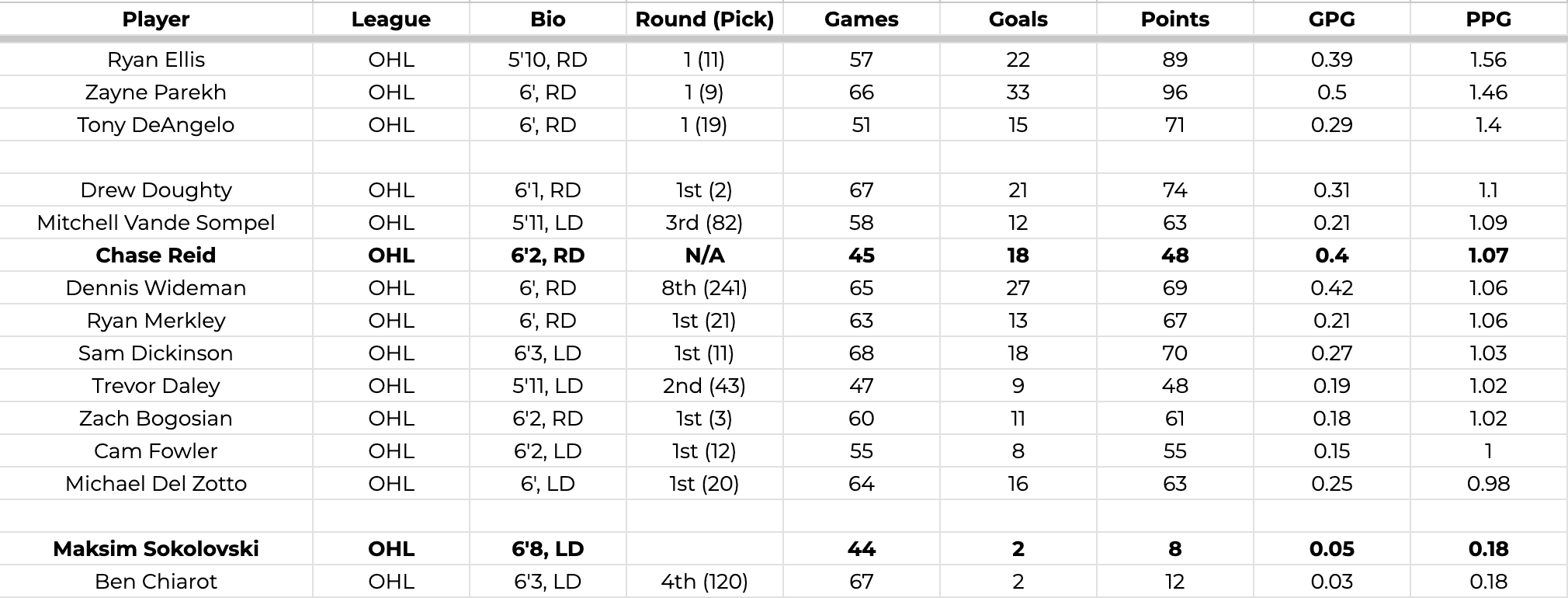
Chase Reid: Despite being viewed as this draft’s top offensive defenceman who can quarterback a top power play at the NHL level, Reid’s production didn’t match the best OHL draft seasons. In saying that, he certainly has some talent in his group with Drew Doughty and Cam Fowler. But his closest scoring comparable appears to be Dennis Wideman, who went on to have four seasons above a 0.5 point-per-game throughout his NHL career.
Maksim Sokolovskii: Using point-per-game comparables for a defensive defenceman seems unfair. However, we did find one in Ben Chiarot, who has been a solid defensive defenceman throughout his career, which fits Sokolovskii’s projection.
QMJHL
Forwards
Here are the two QMJHL forward prospects we studied:

And their point-per-game comparables:
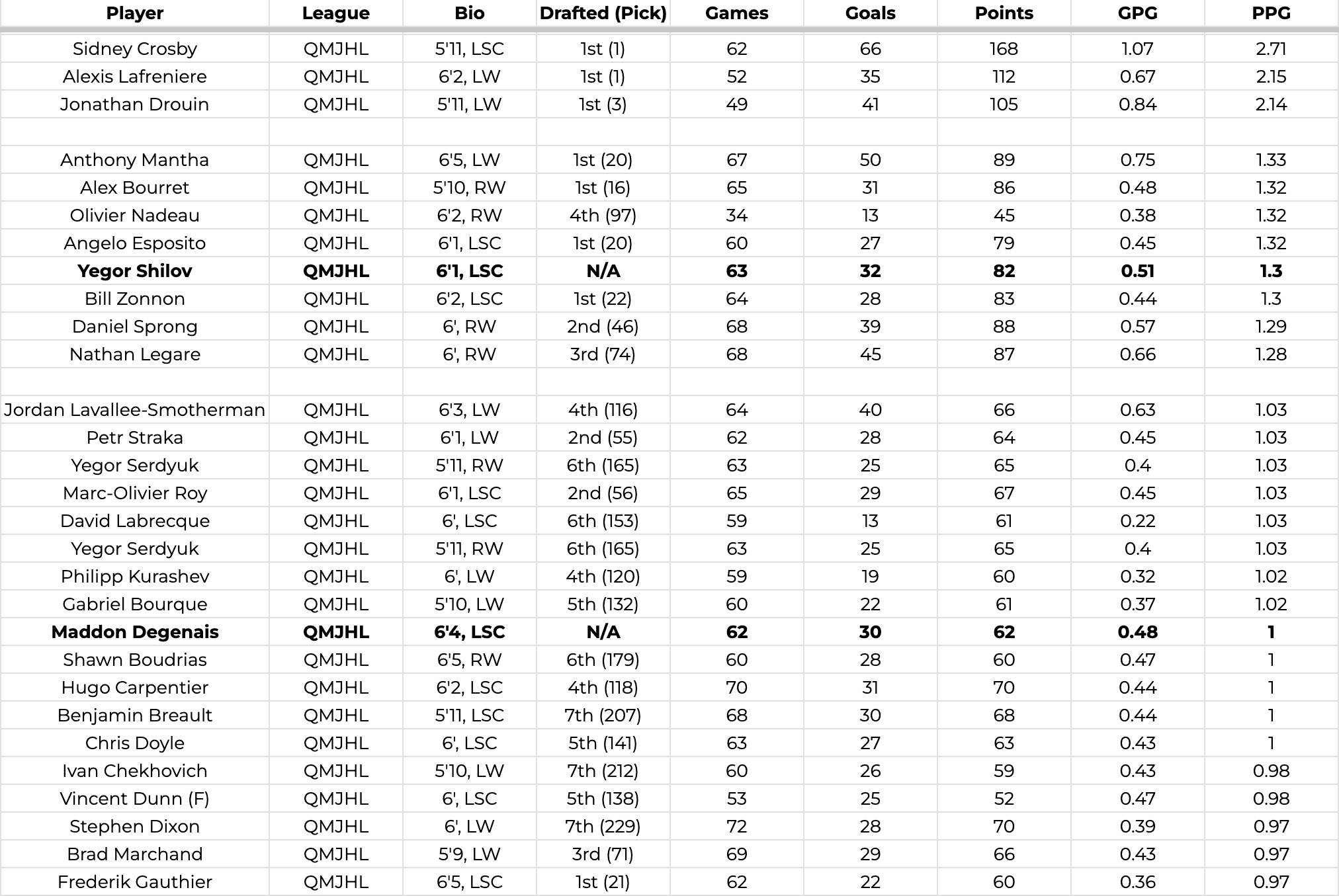
Yegor Shilov: I always knew the QMJHL was the weaker of the three CHL leagues, but boy, did going through these comparables ever prove that. Shilov has all the skills in the world, but the question is whether he can put them all together at the next level. Considering that, Daniel Sprong seems to be a glaring comparable for Shilov.
Maddox Dagenais: Shawn Boudrias has nearly identical numbers to what Dagenais produced this season. Unfortunately for Dagenais, Boudrias never made it to the NHL, played just four AHL games, and the 26-year-old spent last season in Ligue nord-américaine de hockey, a Quebec senior league.
Defencemen
Here are the two QMJHL defensive prospects we studied:

And their point-per-game comparables:
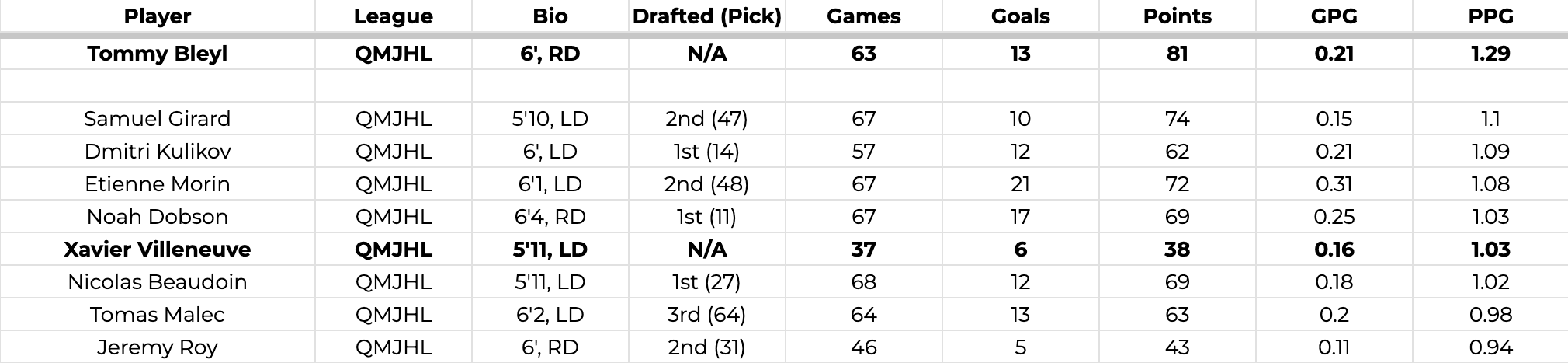
Tommy Bleyl: Like Carels, Bleyl’s production this season is the top among draft-eligible QMJHL defencemen scorers. His season was special, and the consensus is that he will now hear his name called late on Day 1.
Xavier Villeneuve: Viewed as one of the best pure offensive defencemen, Villeneuve sits among the top defencemen scorers. If he hits his projected ceiling, he would be the best of the group, but based on his scoring profile, he matches Nicolas Beaudoin. Beaudoin went on to play in the NHL but has spent the last two seasons playing overseas.
NCAA
Forwards
Here are the four NCAA forward prospects we studied:

And their point-per-game comparables:
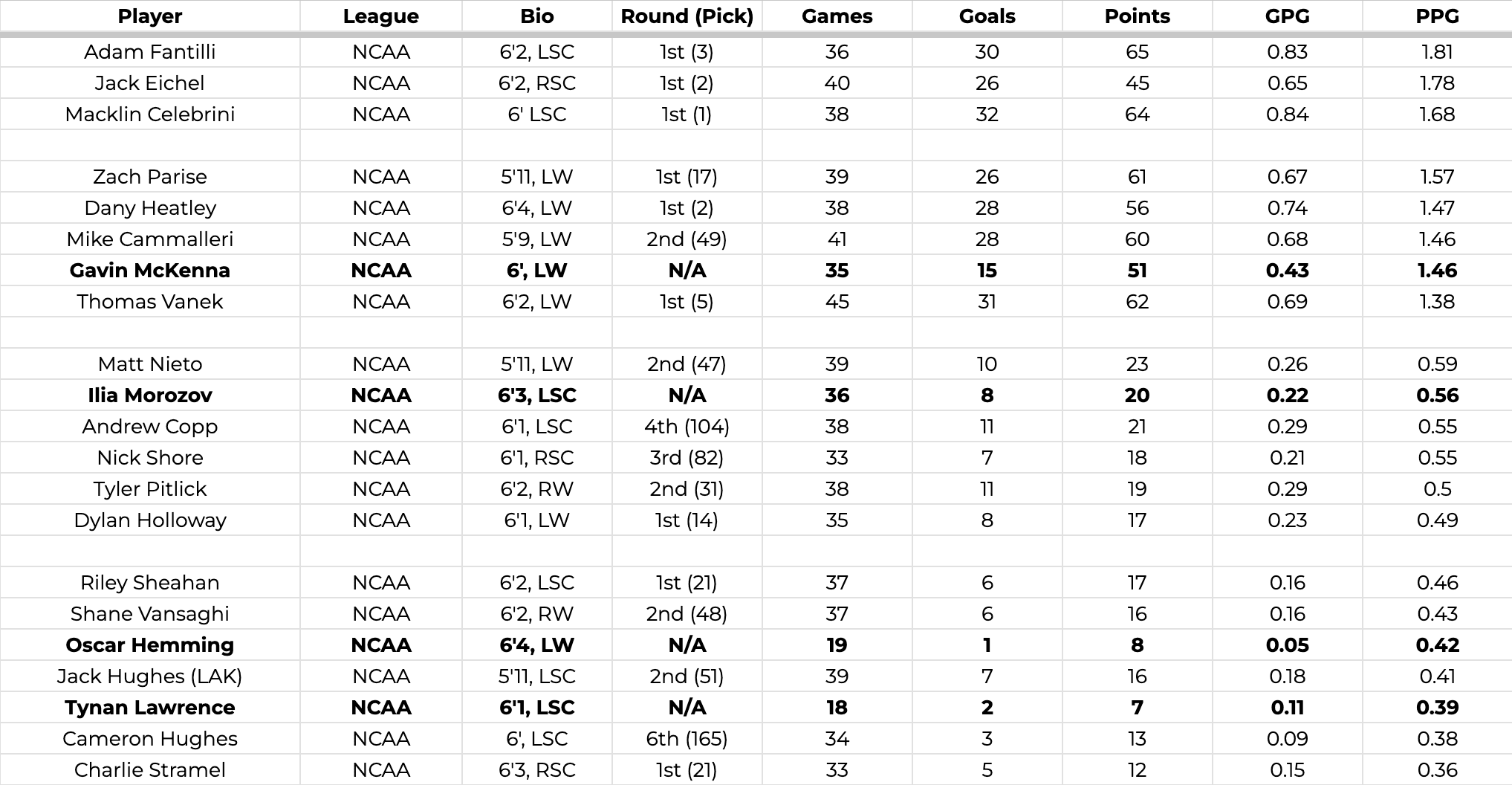
Gavin McKenna: What McKenna did this year as a draft-eligible in the NCAA sits among some of the best to ever do it in college hockey. He’s not far behind Adam Fantilli, Jack Eichel, and Macklin Celebrini at the top. Had he played more than 35 games, he likely inches closer to that top group. His ceiling remains with that trio, but based on these numbers, his comparables are Zach Parise and Mike Cammalleri. You may all laugh at that, but that’s what the numbers said, and let’s not forget that both of these players put up multiple 80-point seasons.
Ilia Morozov: There is a significant drop-off after McKenna in the quality of draft-eligible NCAA forward talent. This is where we see the defensive-minded forwards come into the picture. Andrew Copp seems to be the best scoring comparable for Morozov.
Oscar Hemming: It doesn’t seem very fair to give Hemming a comparable after the wild season he had. He was denied permission by his Finnish team to join the Kitchener Rangers, resulting in him not playing hockey for most of the first half of the season. He found a home in the NCAA, but maybe a little too early for his development, which likely skews his numbers.
Tynan Lawrence: Another player who had a weird year was Lawrence. He made a questionable decision to leave the USHL and join the NCAA, and it didn’t go well. He wound up finding his footing toward the end of the year, but I still don’t think there’s really a fair comparable to give him here.
Defenceman
Here is the lone NCAA defensive prospect we studied:

And his point-per-game comparables:
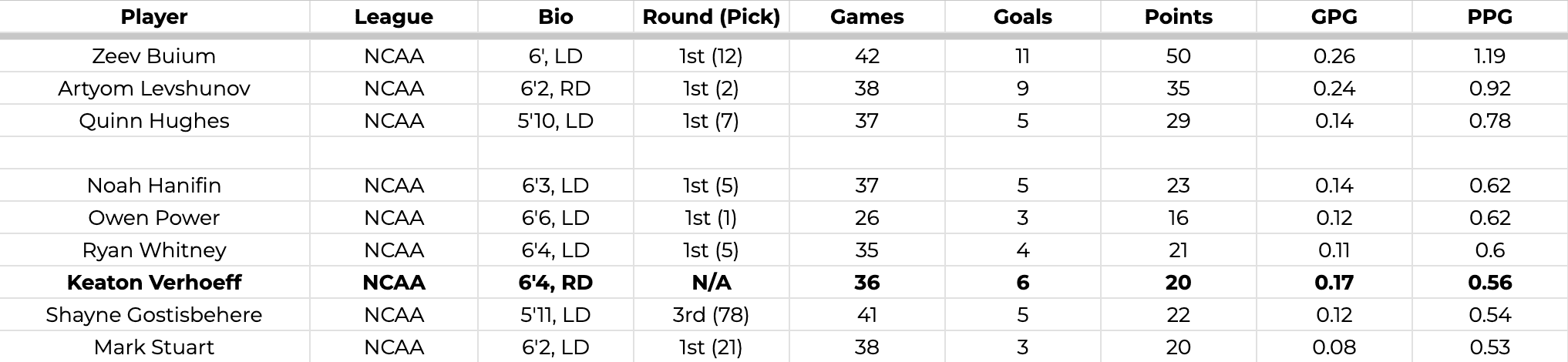
Keaton Verhoeff: There are some definite reasons for Verhoeff falling from the top-three selection to the 7-10 range, but scoring profile is not one of them. Verhoeff is among the elite NCAA defenders in terms of scoring profile. Owen Power and Ryan Whitney, both of whom went top-five in their respective draft classes, would be our close comparables for Verhoeff.
USNTDP
Forwards
Here are the two USNTDP forward prospects we studied:

And their point-per-game comparables:
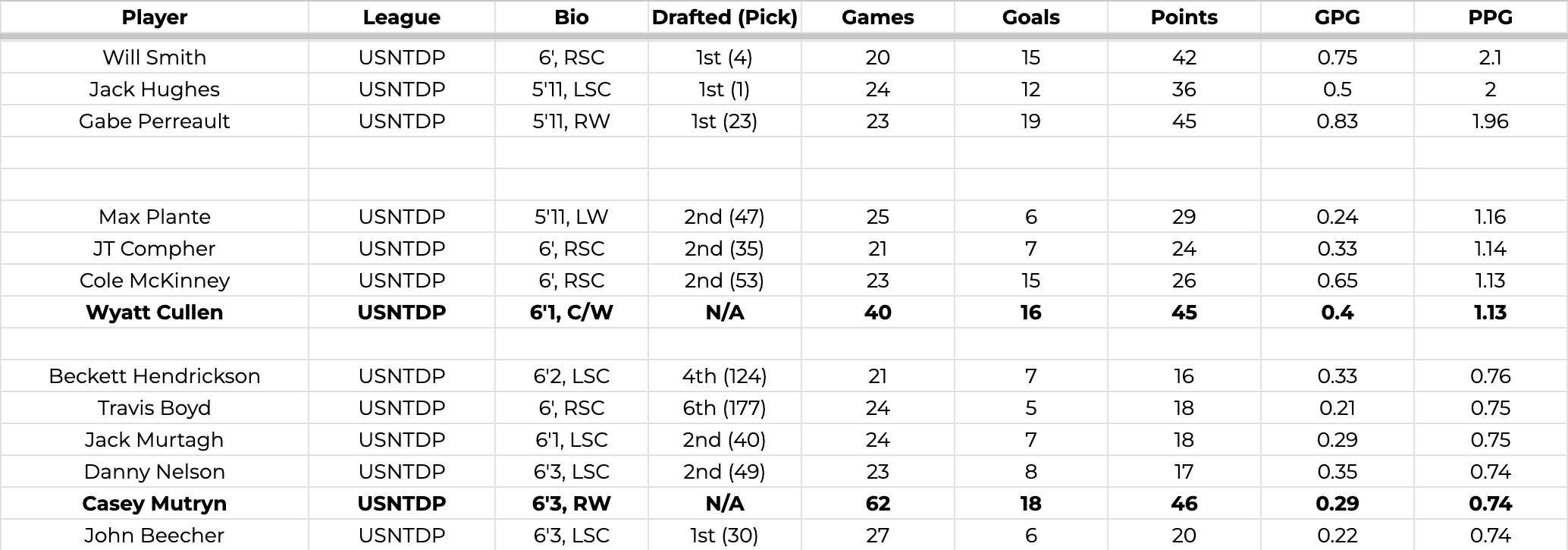
Wyatt Cullen: Cullen’s rise has been the most fascinating to watch since the World Championships. He is not teetering on being a top-10 pick, although his scoring profile in the USNTDP closely resembles those who went in the second round. JT Compher would be his best scoring comparable.
Casey Mutryn: Mutryn’s scoring profile is a bit of an outlier, considering he played nearly triple the number of games as all of the other comparables on this list. Jack Murtagh, whom the Flyers selected in the second round last season, would be the closest comparable for Mutryn.
USHL
Forward
Here is the lone USHL forward prospect we studied:

And his point-per-game comparables:

Jack Hextall: There were slim pickings for Hextall in the USHL. With just one player in a similar range – a good one, might I add – it can only be Matthew Knies.
SHL
Forwards
Here are the two SHL forward prospects we studied:

And their point-per-game comparables:
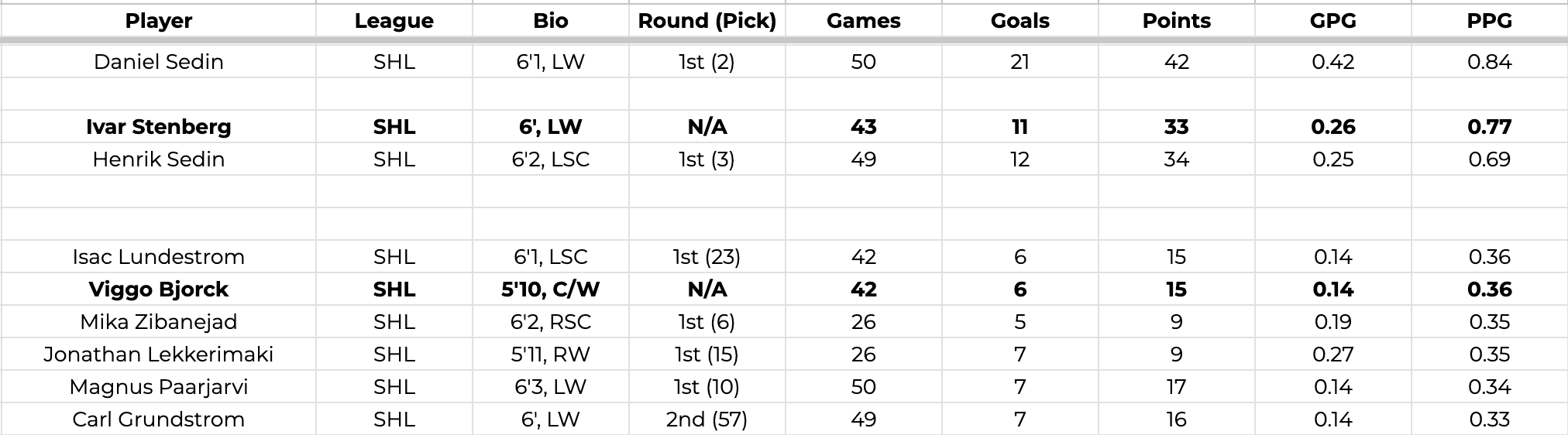
Ivar Stenberg: Now we get to the good stuff. Whenever you’re sandwiched in between two Hockey Hall of Famers, you’re quite comfortable drafting that type of scoring profile. Stenberg’s season was special, and for most of the season, he was pacing to break the SHL record for points by a draft-eligible player. Who knows if Stenberg hits the ceiling of what Daniel and Henrik Sedin became, but having those two as comparables is a good start.
Viggo Björck: It may not be a list of Hall of Famers like Stenberg, but Björck has some highly-drafted talent among his group as well. He narrowly edges Mika Zibanejad, but he has the exact same numbers as Isac Lundestrom in his draft year, so it would just be wrong to not pick him as a comparable, even though Björck’s ceiling is much higher.
Defenceman
Here is the lone SHL forward prospect we studied:

And his point-per-game comparables:
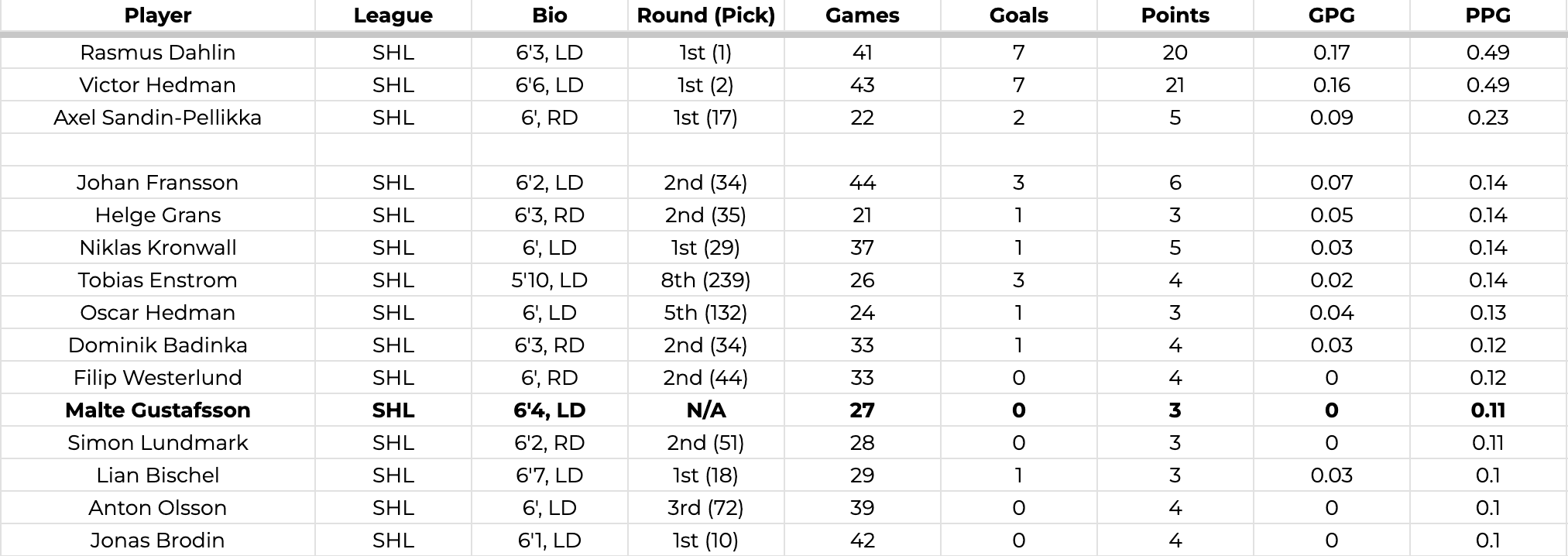
Malte Gustafsson: Like Sokolovskii, Gustafsson projects as more of a defensive defenceman, but with a little more offensive pop than him. There are a lot of those types of defenders among his group, Niklas Kronwall, Lian Bischel, and Jonas Brodin, so with such thin margins, we’ll pick that trio as a comparison for Gustafsson.
SHL U20 Nationell
Forwards
Here are the three SHL U20 Nationell forward prospects we studied:

And their point-per-game comparables:
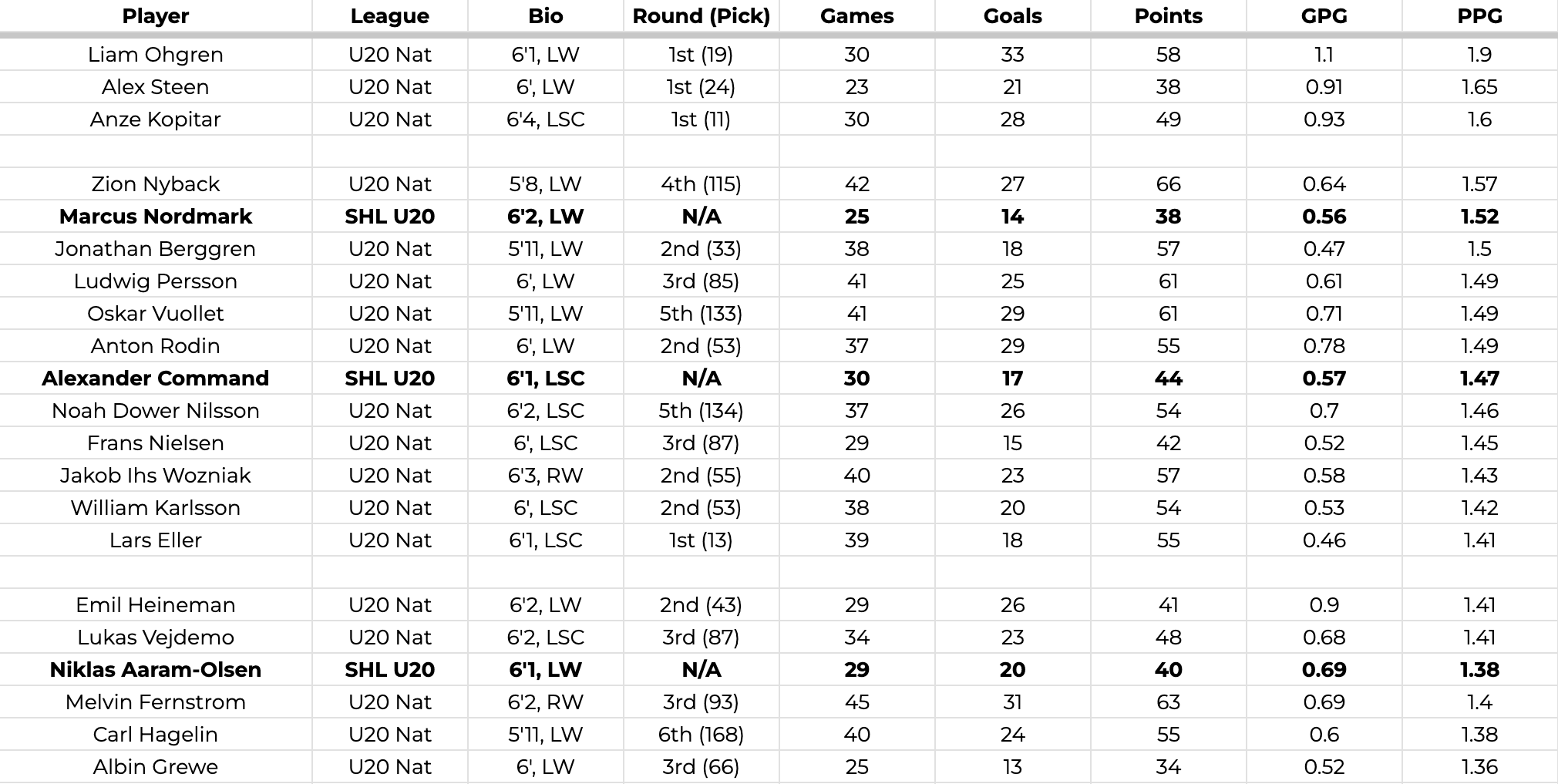
Marcus Nordmark: Like Shilov, Nordmark has similar questions about his play as well. But he sits just shy of some of the U20 Nationell greats, who all went in the first round. However, his point production range doesn’t have a single first-round pick. The closest would be Jonathan Berggren, who is also his closest comparable.
Alexander Command: I mentioned William Karlsson as a comparable for Command on our latest episode of Blackfish, and Dave Hall loved the comparison. And looking at their draft-year scoring profiles, the numbers match that theory.
Niklas Aaram-Olsen: Although the game totals don’t closely match, the point totals do for Aaram-Olsen and former Canucks draft pick, Melvin Fernstrom. And as I type this, I realize Fernstrom and Aaram-Olsen are out of order. My bad, but that doesn’t change the numbers!
Allsvenskan
Forward
Here is the lone Allsvenskan forward prospect we studied:

And his point-per-game comparables:
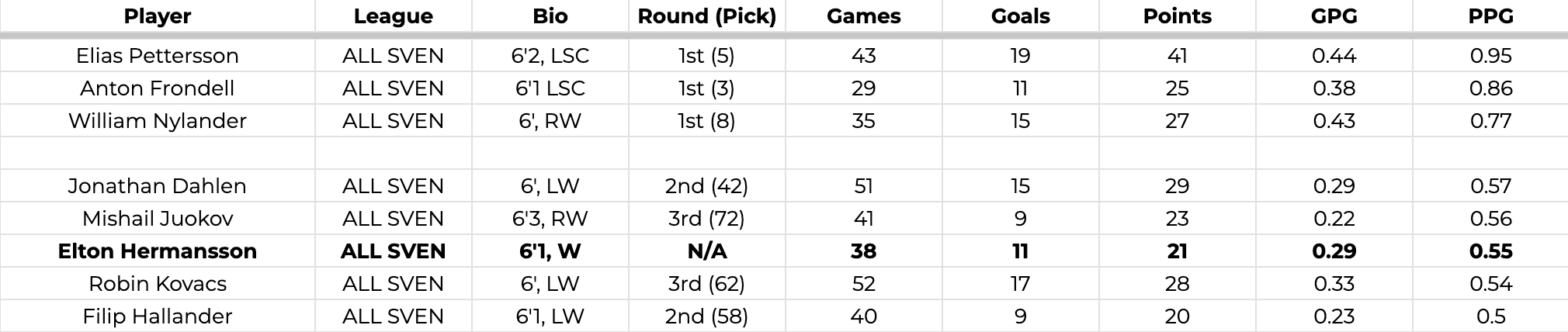
Elton Hermansson: The Allsvenskan has produced some top-of-the-line talent in their respective draft years: Elias Pettersson, Anton Frondell, and William Nylander. However, the list of comparables for Hermansson isn’t the best for his projection to the NHL level. However, Jonathan Dahlen, who was considered a high-end NHL prospect for some time, would be Hermansson’s closest scoring comparable.
Defenceman
Here is the lone Allsvenskan defensive prospect we studied:

And his point-per-game comparables:
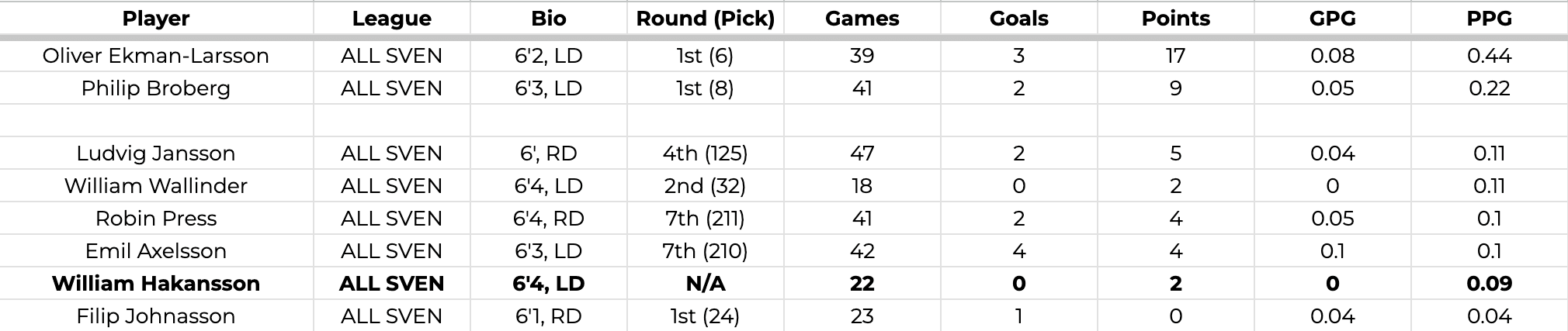
William Håkansson: Like Gustafsson, Håkansson is viewed more as a defensive defenceman, and the point totals reflect that. And there aren’t many games played within this crop of defenders. Which isn’t an encouraging sign for Håkansson. He could break the mould if a team takes a shot on him late on Day 1.
LIIGA
Forward
Here is the lone LIIGA forward prospect we studied:

And his point-per-game comparables:
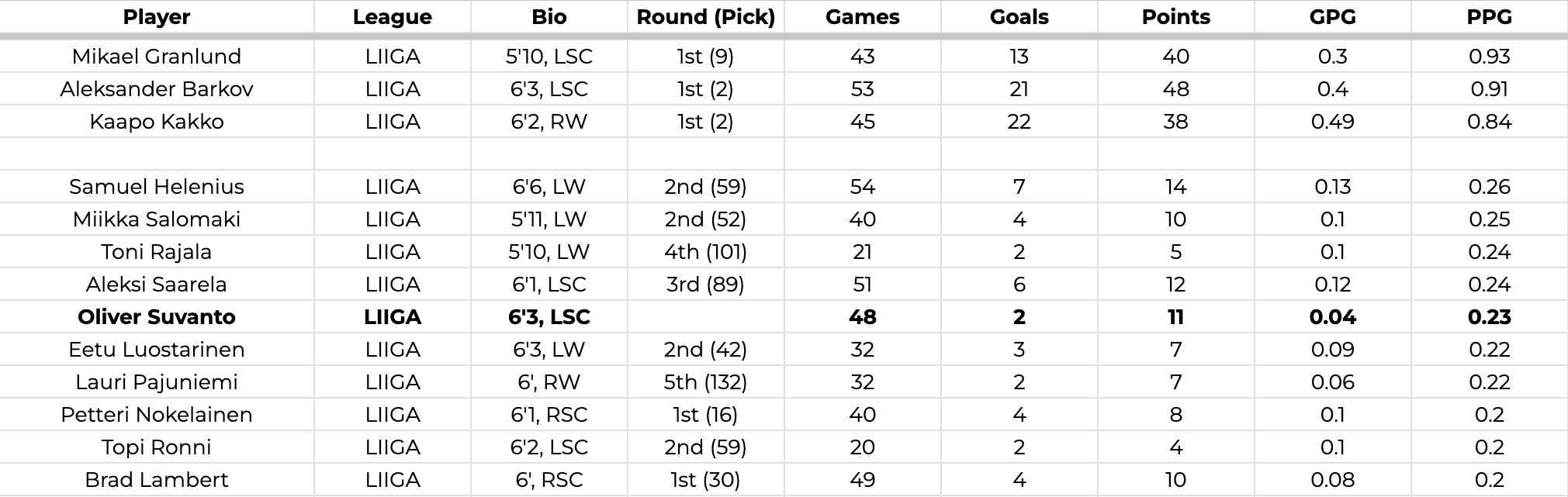
Oliver Suvanto: One of the youngest players in the draft, Suvanto is viewed as a steady-eddy, defensive-minded centre at the NHL level. And with Finnish players like Samuel Helenius and Eetu Luostarinen in his scoring range, that aligns. Loustarinen is likely the scoring profile best suited for Suvanto.
Defencemen
Here are the two LIIGA defensive prospects we studied:

And their point-per-game comparables:
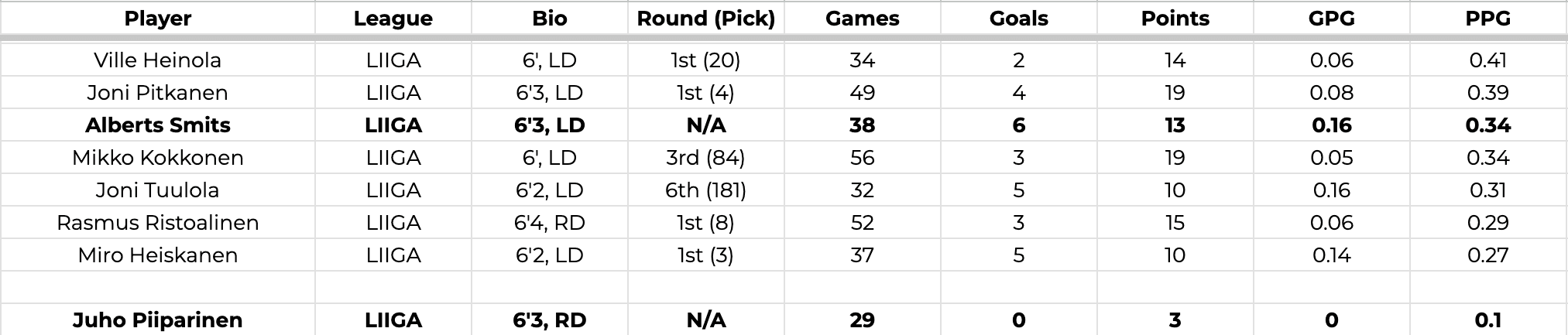
Alberts Smits: Smits is widely regarded as one of the most NHL-ready players in the class. He played in LIIGA against men this season, and for his nation at the 2026 Winter Olympics, all as an 18-year-old. What was interesting to see was that his scoring production was decently ahead of Miro Heiskanen, one of the best defensive prospects to come out of the Finnish league. It may not ever hit the ceiling of a Heiskanen, but that should be the bar, considering he was above his scoring profile.
Juho Piiparinen: Surprisingly, Piiparinen did not have a great comparable to use for this study, but for the opposite reason of Carels and Bleyl.
MHL
Forward
Here is the lone MHL forward prospect we studied:

And his point-per-game comparables:
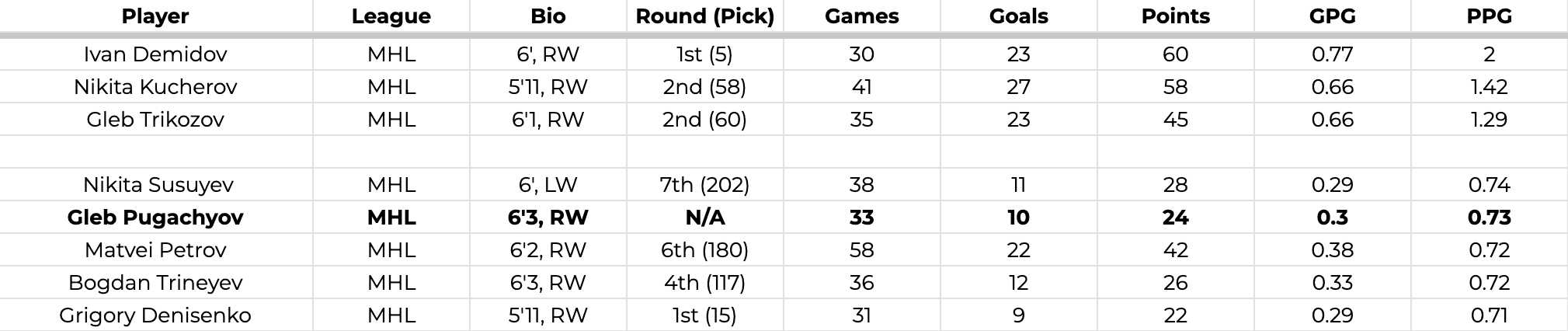
Gleb Pugachyov: Viewed as a power forward, Pugachyov’s point totals were never going to be among the elite in his league. His closest comparable would be Nikita Susuyev, who was a seventh-round pick. However, Pugachyov’s value is found in the physical game, which should see him go a lot higher than his comparable.
After doing this study, my opinion on this draft class has kind of soured. There is some undeniable talent at the top of the draft. However, once we get into the second half of the first round, we start losing those high-end scoring talents. That’s when you start to see the scoring profiles that would surely find themselves in the second round rather than a first-round talent. Which makes me kind of understand why we’re seeing so many trades involving first-round picks this offseason.
Sorry, this was a long one. But I put a lot of work into this long project, so hopefully you all enjoyed it and got a better look into the scoring profiles of some, if not most, of the names we’ll hear get called in tonight’s draft.
Join Tyson Cole, Jake Fraser, special guests, and Dave from the Draft in Buffalo for Blackfish LIVE! Chat with us and your fellow fans as we watch every pick unfold, break down the prospects, and follow all the action from the 2026 NHL Draft.


Breaking News
- How the Canucks can fix their early-season defensive breakdowns
- ‘Glad to be somewhere I’m wanted’: Jacob Quillan excited for new opportunity with Canucks
- Canucks: What kind of reception will Quinn Hughes get when he returns on Sunday?
- The Canucks are one of the smallest teams in the NHL, but can they change that?
- NHL Notebook: Jets trade Hellebuyck to Devils for package of four players and two draft picks

Vancouver CanucksTeam Cap Summary

Cap Summary
2026-27
2027-28
Projected Cap Hit
$87,295,050
$71,329,167
Projected Cap Space
$16,704,950
$42,170,833
Current Cap Space
$19,063,296
$42,170,833
Active Players
23/23
13/23
Draft Picks
Round
'27
'28
1
1
1
2
2
2
3
1
1