


"loui eriksson has been reinvented"

CanucksArmy has no direct affiliation to the Vancouver Canucks, Canucks Sports & Entertainment, NHL, or NHLPA
The Support Line: Building a Goal-Controlling Bottom Six

Photo credit: © William Purnell-USA TODAY Sports
There’s been a lot of talk surrounding the 2019-20 Vancouver Canucks regarding their need to transition away from a traditional scoring top six and shutdown bottom six towards a forward group that can produce offensively across the top three lines. I’ve already explore why the Canucks need three scoring lines, but today I’ll be entertaining the possibility of rolling an offensive fourth line and shutdown third line, as opposed to the offensive top-nine approach.
The Canucks have plenty of competition in their top six. Bo Horvat and Elias Pettersson’s potential linemates will likely be decided as we make our way through training camp and preseason games, but we can safely assume that they will be the top two centres. The next two centre positions are where things get interesting, as some combination of Brandon Sutter, Jay Beagle, Adam Gaudette or even J.T. Miller could all possibly slot in down the middle in the team’s bottom six.
With the way the team’s roster is constructed, there’s reason to believe their best bet would be to assemble a shutdown third line and an all-out young offensive fourth line that could potentially help develop their younger players with high offensive upside. In this scenario, the third line would have to be a group that is comfortable getting a high percentage of their zone starts coming in the defensive zone likely consisting of Loui Eriksson, Jay Beagle, and Brandon Sutter.
Those three players would also get the bulk of the penalty killing time and be the matchup line that Travis Green would use if he isn’t matching the Bo Horvat line against the opponents’ top scorers. Ideally, that line would play somewhere in the range of 14-17 minutes of ice time a game, including special teams time.
Last season Brandon Sutter and Jay Beagle were the top two players on the team when it came to defensive zone start percentage. Sutter began 69% of his draws in the defensive zone and Beagle started 81.5% of the time in the defensive zone. Loui Eriksson was not far behind these two as he was seventh on the team, beginning 62% of draws in the defensive zone.
These three players were added to the team for very different reasons, but bringing them together on a defensive shutdown line would give a renewed sense of purpose to the trio of maligned forwards. The three haven’t spent much time together as a line in the past but Eriksson did spend significant time with Jay Beagle last season, and also with Brandon Sutter when he was healthy.
When Loui played alongside one of these two centres, he started a high percentage of his shifts in the defensive zone, while when he was away from these two centres he starteda much higher 47.7% of his shifts in the offensive zone.

Line Tool provided by Natural Stat Trick
Line Tool provided by Natural Stat Trick
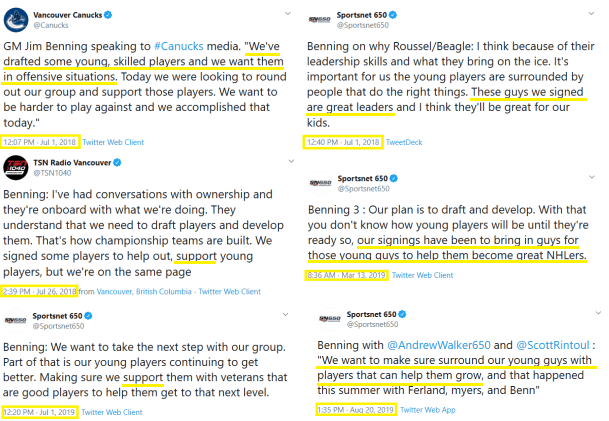
An Eriksson-Sutter-Beagle trio would be far from sexy, but would give the Canucks a solid veteran presence that can slow the game down and offer a change of pace from the other three lines. GM Jim Benning has said multiple times when talking about these veterans that he views players like Sutter and Beagle as foundational pieces that can help support the younger players, and keeping the three together in a specific role would give them the best chance to do that.
So, there we have it: Eriksson-Beagle-Sutter will now become “The Support Line”.
These three will give the Canucks the opportunity to run a modern, offensive-minded fourth line with players who can score goals and develop in the NHL while they get to play with a top-six mentality against weaker matchups that aren’t as likely to exploit the defensive holes in their game.
Building A Modern Fourth Line
It’s no secret that the Vancouver Canucks have a plethora of possible top six options, and arguably not enough spots to accommodate them; but in this scenario, the 7th, 8th, and 9th best options for the top six could come together on a fourth line to play somewhere in the neighbourhood of 10-13 minutes a game against easier line matchups. With these easier matchups, this line could potentially find success in the opponents offensive zone and will have the chance to control the goal share, which would be a major improvement for a bottom-six forward group that was the league’s wort in 2018-19, according to Harman Dayal of the Athletic.
Here’s an example of what the lineup might look like if the Canucks were to take this approach:
LW | C | RW | Time On Ice (Minutes) |
Ferland | Pettersson | Boeser | 17-19 |
Pearson | Horvat | Miller | 18-20 |
Eriksson | Beagle | Sutter | 12-15 |
Baertschi | Gaudette | Virtanen | 10-13 |
Nikolay Goldobin and Josh Levio would be the two forwards on the outside looking in in this scenario, but with injuries and roster fluidity at the beginning of the season Travis Green would likely be able to get both of these players plenty of game action. Goldobin’s playmaking ability would make him a fit on the 1st, 2nd or 4th line and Leivo is versatile enough to slot in on any of the four forward lines.
If this line were properly sheltered, starting most of their shifts in the offensive zone, they would probably fall somewhere in the 55-60% zone start range, which should be more than comfortable for the players on the bubble based on how they were deployed last season.
Name | Percentage of Faceoffs Started in Offensive Zone (2018-19, 5on5) |
Adam Gaudette | 59.2% |
Sven Baertschi | 65.6% |
Jake Virtanen | 44.4% |
Nikolay Goldobin | 62.7% |
Josh Leivo | 60.9% w/Canucks (35.6% w/Leafs) |
One of the major benefits to this plan is that it would give some of the team’s younger players a chance to develop in a controlled environment. The five players listed above have not fully established themselves at the NHL level, and playing on a fourth line that allows them to take risks offensively would provide an ideal audition for when spots in the top six inevitably open up over the course of the season. Goldobin could work his way up to the Pettersson line, Baertschi or Virtanen could push to play with Bo Horvat, and Leivo can fill in wherever needed provided he can continue to flash the promise he showed after landing in Vancouver partway through last season.
Splitting the bottom-six into offensive and defensive specialists isn’t without precedent. We are already beginning to see a trend develop as teams like the Nashville Predators, Columbus Blue Jackets, and New York Islanders have adopted the practice of having a line dedicated to taking the bulk of the defensive zone starts.
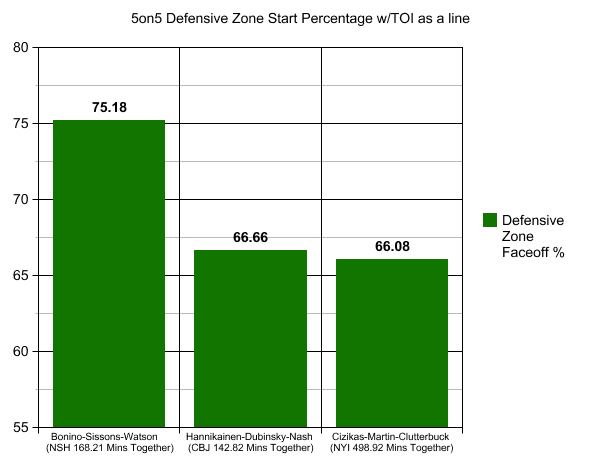
That time together has proven beneficial as each of these three lines have a goals against per 60 minutes under 1.7 and even though the Hannikainen-Dubinsky-Nash line was not able to score in over 142 minutes of ice time together, the other two sample lines were able to contribute offensively as well.
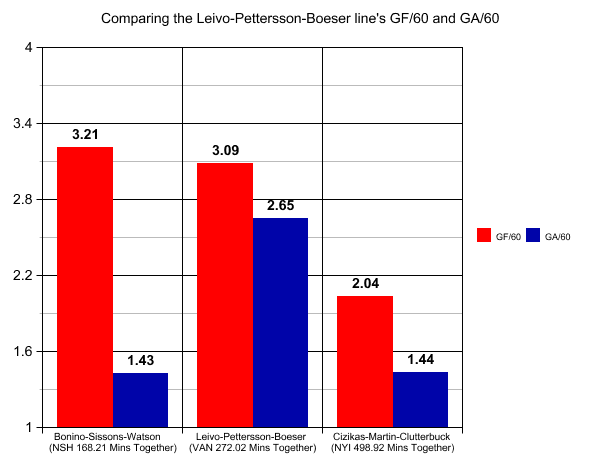
Obviously it’s not ideal to have 13.375 million dollars sunk into a line that doesn’t score goals, but if the Canucks have exhausted all their options with regards to ridding themselves of dead cap space, this could be the best option to get the most out of the three players, who would also bring value on the penalty kill. While Beagle, Sutter, and Eriksson in particular have disappointed relative to their salary, it’s important to remember that all three are still NHL contributors. They may be overpaid, but there’s plenty of evidence to suggest they’re still capable of bringing serious value to an NHL team in the right role.
This idea would require the team to use 14 forwards, 7 defencemen and 2 goalies for their 23 man roster, likely being forced to send down Oscar Fantenberg, Tim Schaller and Tyler Motte while placing Antoine Roussel on LTIR. Sending down Tyler Motte isn’t ideal as he is a solid contributor to the penalty kill and the Canucks like the energy he brings. Depending on how things shake out, he could turn out to be very useful on this “Support Line” and could push to make Loui Eriksson the player who actually gets sent down to Utica. Waiving Tyler Motte also has some risk as he could feasibly get snagged off the waiver wire, but the likelihood of Nikolay Goldobin being picked up is probably higher.
Coaches love these type of players, they do the little things right, know where to be on the ice, and can fill up the shooting and passing lanes. These three players would support what the team is trying to do as they look to the future of the NHL and what an offensive fourth line can bring to a playoff contender.
Adam Gaudette looks to be ready enough in his development to become a sheltered fourth line centre who plays with some top nine wingers and can try to do some damage against other team’s inferior lines. Virtanen, Goldobin, Leivo and Baertschi have something to prove after the Canucks added top six wingers during the offseason with JT Miller and Micheal Ferland.
Ferland and Miller have both received substantial time alongside Elias Pettersson and Bo Horvat this preseason and with the return of Brock Boeser and success that Tanner Pearson had alongside Bo Horvat, you can start to see the top six take shape. As that picture grows clearer, more focus will be placed on how the bottom six shakes down and what type of team the Canucks want to be this season. Assembling “The Support Line” gives the team three lines with high offensive potential, gives Travis Green his much desired shutdown line, and creates the chance for offensive top nine wingers to play alongside a better offensive centre in Adam Gaudette.
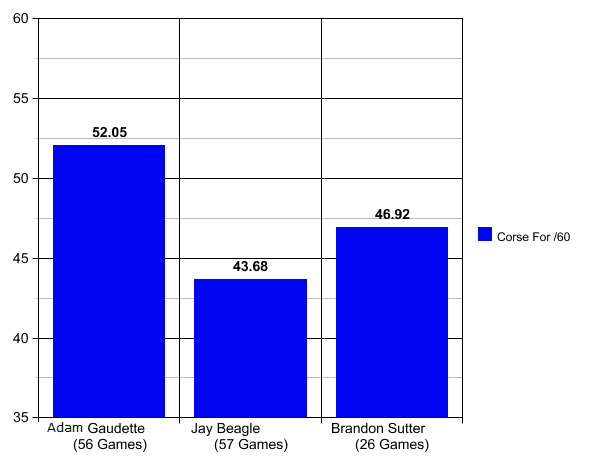
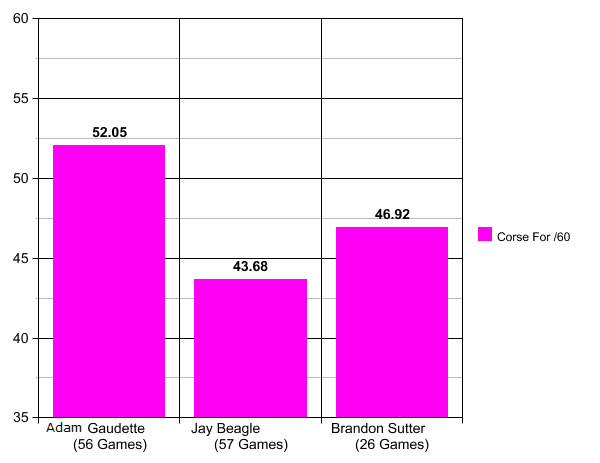
Adam Gaudette has acquitted himself pretty well so far in the preseason and is making a case for himself to be on the opening night roster. He will need to continue to work his way onto the roster as the Canucks organization has an easy out, given that he is still waivers exempt. Gaudette needs to continue to show offensive upside at the NHL level and having the support of borderline top six talent will hopefully give him the boost that he needs.
“The Support Line” definitely doesn’t fix all the team’s problems, but it does open up more offensive opportunities for young players to grow. If Eriksson, Beagle, and Sutter are going to be with the team for the length of their contracts, the organization needs to find a spot where they can be contributors. Beagle and Sutter have been used with Loui Eriksson as a winger for this type of deployment already, and if these three can combine to be a shutdown line with the ability to contribute the odd goal it will make the Canucks team more well-rounded as the league moves further and further away from having a pure shutdown bottom-six.


Breaking News
- Canucks’ Jack Thompson clears NHL waivers, will report to AHL Abbotsford
- JPat’s Monday Mailbag: Canucks chemistry lessons, a hot dog feast and press box bingo
- The Statsies: Canucks overwhelmed at 5v5 in Hughes’ return after a strong first period
- The Stanchies: Boo birds rain on Hughes in return to Vancouver; Canucks lose 4-2 to Wild
- Instant Reaction: Canucks start strong but fall 4-2 to Wild in Hughes’ return to Vancouver

Vancouver CanucksTeam Cap Summary

Cap Summary
2026-27
2027-28
Projected Cap Hit
$87,295,050
$71,329,167
Projected Cap Space
$16,704,950
$42,170,833
Current Cap Space
$19,290,240
$42,170,833
Active Players
23/23
13/23
Draft Picks
Round
'27
'28
1
1
1
2
2
2
3
1
1