
CanucksArmy has no direct affiliation to the Vancouver Canucks, Canucks Sports & Entertainment, NHL, or NHLPA
Should the Canucks continue to stack PP1 in 2025-26, or switch to a more even approach?
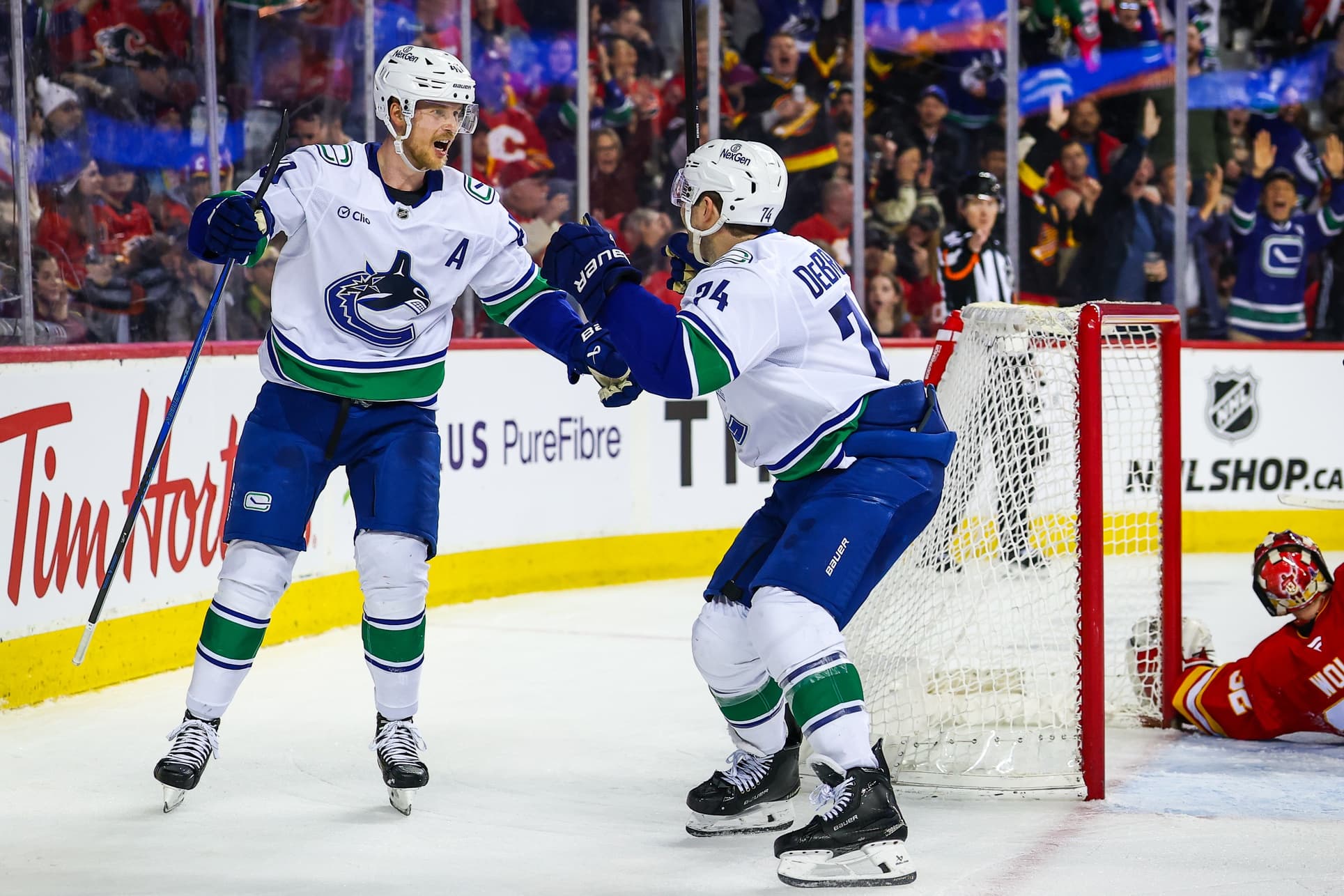
Photo credit: © Sergei Belski-Imagn Images

Aug 14, 2025, 09:00 EDTUpdated: Aug 15, 2025, 18:33 EDT


If one were to list the things that went wrong for the 2024-25 Vancouver Canucks, it would take a while before arriving at special teams. That’s because, if not an outright strength, special teams were not much of a problem last year.
The penalty kill started off a bit slow, but really rounded out, allowing the Canucks to finish with an 82.6% efficiency rate, third-best in the NHL.
The power play was a little bit more middling, with a 22.5% rate good for 15th place in the NHL. But 15th overall ain’t all that bad for a team that traded one of its top centres, had the other one suffer through the least productive season of their career, and had just about everything else go wrong that could go wrong in a season.
Truthfully, the PP and PK seem like two areas where new head coach Adam Foote and his staff could mostly stick to the existing plan and structure and expect better results just from improved individual performances.
That said, this is hockey, and changes are inevitable. So, is there a different way that the Canucks’ power play units could be arranged for 2025-26 to make the man-advantage more consistently advantageous?
As it stands, the Canucks are a team that tends to stack up and then lean heavily upon their PP1 unit. The PP ice-time chart for 2024-25 reflects this quite plainly:
2024-25 | Avg. PP Time per Game | PP Points |
Quinn Hughes | 3:42 | 29 |
Brock Boeser | 3:15 | 20 |
Elias Pettersson | 3:09 | 16 |
JT Miller | 3:07 | 14 |
Conor Garland | 2:55 | 16 |
Jake DeBrusk | 2:33 | 19 |
Filip Chytil | 2:21 | 2 |
Daniel Sprong | 1:56 | 1 |
Jonathan Lekkerimäki | 1:54 | 2 |
Filip Hronek | 1:47 | 7 |
Pius Suter | 1:21 | 5 |
Linus Karlsson | 0:52 | 2 |
Quinn Hughes tends to play most of any given power play. The Canucks received 222 power play opportunities in 2024-25, or an average of 2.7 per game. And Hughes’ 3:42 of ice time takes up most of those two whole power plays the team is averaging. In fact, if you factor in that at least 29 of those PPs ended early due to the Canucks scoring and Hughes having a direct hand, you’ll find that Hughes spent very little time on the bench during any power play.
The rest of the PP1 unit usually switched eventually if the power play went a full two minutes, but often only at the tail-end of those two minutes.
As such, certain forwards dominated the PP ice time. Brock Boeser was stuck on that unit for most of the year and wasn’t all that far behind Hughes’ average minutes. A full 20 of Boeser’s 50 points came on the man-advantage.
There was that awkward portion where Elias Pettersson and JT Miller were not playing on the power play together, and that brings each of their average ice times down below Boeser. There was also a time, during the slumpiest portion of his slump, that Pettersson was taken off PP1 entirely. Still, on average, he was out there for far more than half of each power play.
The newly arrived Jake DeBrusk proved to be a bit of a power play specialist, with 14 of his 28 goals coming on the PP. He had to wait for the Miller trade to open up a more consistent spot on PP1 for himself, but once he was there, it was hard to make an argument to remove him.
And speaking of specialists, Conor Garland continued to develop as a great net-front/back-door presence on the power play and put up fairly consistent production there throughout the entirety of the season.
Beyond that crew, the ice times were either low or circumstantial. Filip Chytil got some looks on the power play after being acquired and before his injury. Daniel Sprong got time there because it was supposed to be a strength of his, but it wasn’t, so he got dealt. Jonathan Lekkerimäki got some reps filling in for an injured Boeser. Pius Suter got time there during that brief period as 1C near the end of the year.
But after a season and offseason of personnel changes, we’re left with this: just five players who averaged 2:30 of power play ice time per game in 2024-25, with those five being Hughes, Boeser, Pettersson, DeBrusk, and Garland.
The next on the list is Chytil at 2:21, and then no one else even cracks two minutes.
So, if the Canucks are going to stick with their ‘all eggs in one basket’ approach, those are probably the five. Hughes on the point, Pettersson at centre and the half-wall, and Boeser, DeBrusk, and Garland arranged however works best.
One downside of his quintet, however, is a bit of a redundancy in talent. All three of Boeser, DeBrusk, and Garland tend to do their best work close to the net. Either DeBrusk or Boeser can always play more of a shooting role if need be – but perhaps there is a way to spread out their talents a little more evenly.
Another downside is that it leaves Chytil – who almost has to be the centre on PP2 by default – without much to work with on his unit.
Leave the top five together, and Chytil gets the likes of Nils Höglander, Evander Kane, and Kiefer Sherwood on his power play. Which probably just encourages the coaching staff to leave the PP1 unit out there as long as possible, which is the way it’s typically gone.
So, how could the Canucks balance their units better and start to approach a system where each unit splits the power play roughly in half? It’s something they probably have the personnel to accomplish; it’s just a matter of arrangement.
Up front, Pettersson pretty much has to remain the centrepiece of PP1. The team’s success lives and dies on his ability to bounce back this season.
Let’s say we leave DeBrusk and Garland with Pettersson on PP1, along with Hughes, who is going to be out there as much as possible, regardless. And then we add a different forward as the fifth member. Maybe it’s Höglander, whose job will be to fish pucks out of corners and distribute them. Perhaps it’s a premium shooter in Lekkerimäki if he makes the team. Maybe it’s a big body with good hands in Linus Karlsson, or a shifty puckhandler like Arshdeep Bains. Or perhaps it’s Aatu Räty, who can help Pettersson on the faceoff dot.
Either way, the goal is to put together a PP1 that is good enough, but still leaves some proven talent on the table for PP2.
For that unit, we’ve now got Chytil and Boeser as main components. Hughes probably stays out there, but maybe now he’s joined by regular partner Filip Hronek on the blueline, making for an easier transition back to five-on-five. If Hughes gets tired, someone like Marcus Pettersson can always swap in.
To match with Chytil and Boeser up front, we like the option of Evander Kane. Traditionally, Kane hasn’t been much of a power play producer, generally putting up no more than a fifth of his overall points that way. But we enjoy the idea of Chytil’s ability to carry the puck and make plays paired with two lethal shooters. Boeser could play the net-front, Kane could cause chaos and hang back looking for opportunities, while Hughes and Hronek control from the blueline.
With two units set up this way, the Canucks could feel a lot more confident taking the PP1 unit off after the first minute had passed, and getting PP2 out there with fresh legs.
Or, they could choose to remain with their stacked PP1 and an imbalance in opportunity. In the end, that’s worked out just fine in recent years and has never risen to the point of being a problem.
The Canucks have power play options, in other words. And options are always good to have.
Sponsored by bet365


Breaking News
- Vancouver Canucks practice in Tampa Bay; Abbotsford signs defenceman to PTO
- Why did Canucks fans rate Aatu Räty higher than the rest of the league?
- What the Canucks are getting in new trade acquisitions Jacob Quillan and Brandon Buhr
- The Statsies: Tom Willander leads Canucks in xGF in overtime loss to Panthers
- The Stanchies: Brady Tkachuk’s natural hat trick extends Canucks losing streak to 6 in OT loss to Panthers

Vancouver CanucksTeam Cap Summary

Cap Summary
2026-27
2027-28
Projected Cap Hit
$87,295,050
$71,329,167
Projected Cap Space
$16,704,950
$42,170,833
Current Cap Space
$18,309,380
$42,170,833
Active Players
23/23
13/23
Draft Picks
Round
'27
'28
1
1
1
2
2
2
3
1
1