
CanucksArmy has no direct affiliation to the Vancouver Canucks, Canucks Sports & Entertainment, NHL, or NHLPA
The risks and rewards of a Kiefer Sherwood extension for the Canucks
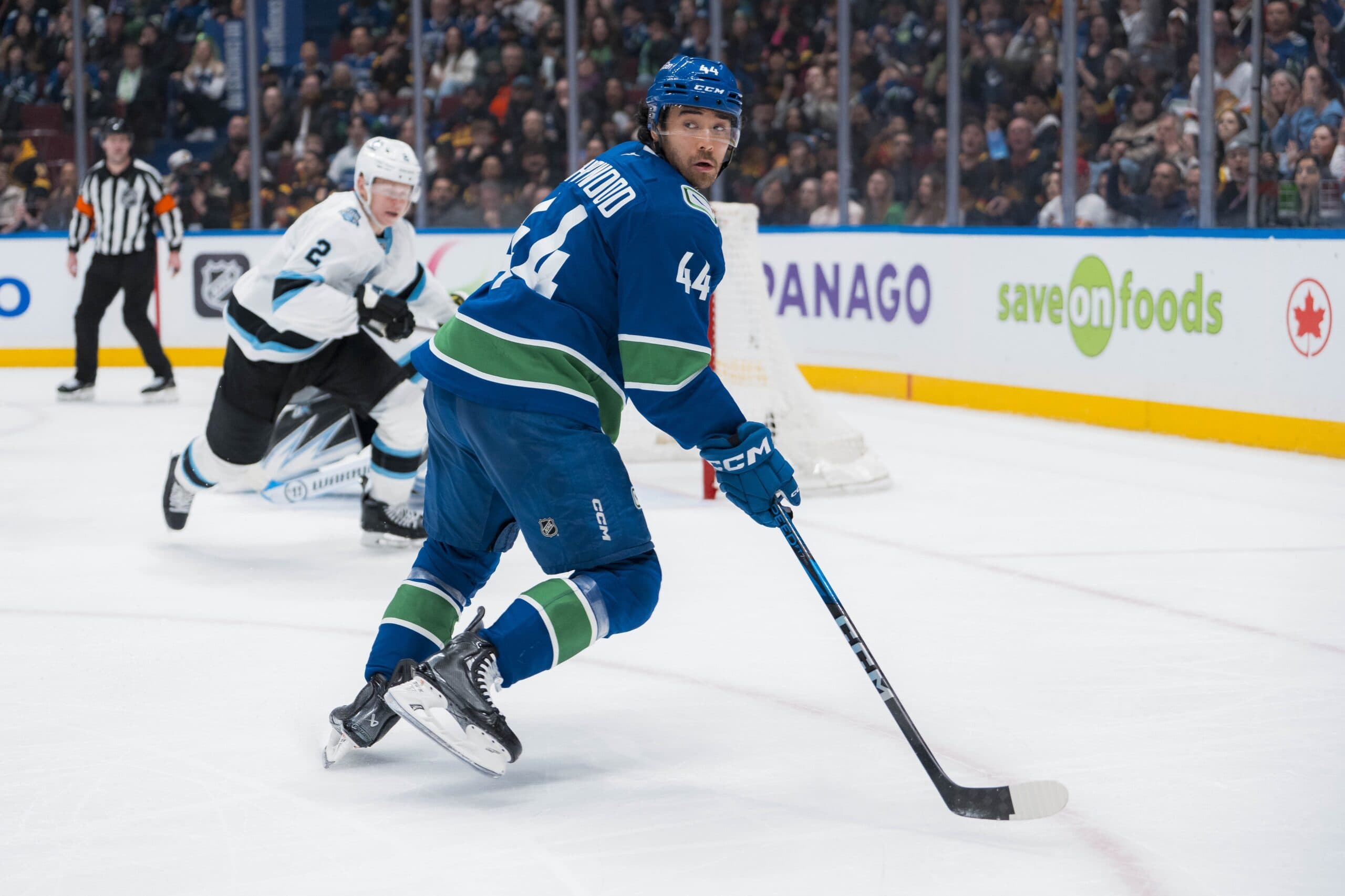
Photo credit: © Bob Frid-Imagn Images

Aug 18, 2025, 16:00 EDTUpdated: Aug 19, 2025, 10:42 EDT


The term ‘fan favourite’ gets thrown around a lot these days. But it’s as true as it gets when applied to Kiefer Sherwood – someone who throws himself around a lot these days.
Few free agent signings have arrived in Vancouver and made the same immediate impact as Sherwood did in 2024-25. And if we’re talking dollar value, then it’s probably fair to say that no one has ever delivered such instant bang-for-buck as did Sherwood at his $1.5 million cap hit.
He posted career highs across the board with 78 games played, 19 goals, 21 assists, and 40 points. He also broke the single-season record for hits with 462 – an absolutely preposterous number that was 156 hits ahead of the player in second place.
Realistically, there wasn’t anything more the Vancouver Canucks could have asked of Sherwood last season. And the best thing about it all? That contract he signed in the summer of 2024 was for two seasons, meaning the Canucks are going to get another year out of him at that same $1.5 million rate.
But what about beyond that?
Sherwood became eligible for a contract extension as of July 1, 2025. That was the exact same point that Conor Garland and Thatcher Demko became eligible for their own extensions, and they signed on that day – but not Sherwood. Why not? Probably because any contract extension for him at this exact moment in time carries with it a high amount of risk/reward.
Were the Canucks to enter into negotiations with Sherwood now, they’d be basing a lot of the talks on his most recent season, and those aren’t exactly ‘team-friendly’ talks. Sherwood had an amazing campaign that, were he to have hit free agency this year instead, would have made him one of the most highly-sought-after UFAs on the market.
But how likely is it that Sherwood repeats such a season in consecutive years?
It’s a tougher call than it is with most. On the one hand, Sherwood broke out into 40 points after topping out with 27 the year before. And he did so with a 13.5% shooting percentage, which is more than three percentage points higher than his previous high. All this, in the year he turned 30.
That has all the markings of a one-time breakout or an anomalous season of production. It wouldn’t be at all surprising for Sherwood’s numbers to take a step back in 2025-26. Nor would it be particularly surprising if he were to have a less fortunate run of health. Few players in this league put their body on the line more than Sherwood does, and it was fairly lucky for him to only miss four games last year in total. Any injury this year will seriously hamper his ability to replicate his numbers.
So, one can imagine what GM Patrik Allvin and Co. might be thinking. Sign Sherwood to an extension now, and you’re paying for what is very likely the single-best season of work in his career. Wait for a step-back in 2025-26, and they’d instead be negotiating based on an average of two seasons in Vancouver, and that could lead to a more reasonable ask from Sherwood’s camp.
But that’s only the reward side of the risk/reward equation, and there is plenty of risks to consider, too. Was the 2024-25 a breakout campaign for Sherwood? There’s no doubt about that. But when it comes to predicting its sustainability, we must admit that Sherwood is anything but a typical case. He only arrived full-time in the NHL as of 2023-24. This past 2024-25 campaign with the Canucks was the first time he’d ever been deployed with any regularity above the fourth line. On the one hand, it might look like Sherwood’s play took a massive step forward this season. But on the other hand, maybe he’s had this ability in him all along, and was just waiting for the opportunity to show it.
In a sense, that’s kind of exactly his story with the Canucks. They saw him playing guts-out against them in the 2024 playoffs for Nashville, and they signed him while presumably asking, “Hey, could you do that for a whole regular season?” And then, against all odds, it turned out that he could.
So, perhaps the step-back in production and quality of play is not as guaranteed as they might be with a player with a longer track record.
But then what happens if Sherwood repeats, or even comes close to repeating, his success in 2025-26, and the Canucks still don’t have him under contract?
Well, at that point, they either commit to an even more expensive extension or they lose him to free agency. Probably the latter.
Imagine the hype that would be placed on a UFA coming off two consecutive seasons of 20ish goals, 40ish points, and 400ish hits. With the cap going up and the team’s proclivity to sign their own UFAs resulting in a limited supply of quality free agents, one has to think that a more established Sherwood would receive some truly eye-popping numbers. And at that point, like with most UFAs, one will have to wonder how much more value they’re going to get out of someone who just hit age 31.
Really, it’s a bit of a backwards risk/reward situation for the Canucks when it comes to extending Sherwood, in that the ‘reward’ is that he comes back down to Earth a bit in 2025-26 and is signable for a little cheaper, and the ‘risk’ is that he doesn’t and prices himself out of Vancouver. Even within that ‘risk’ side of the scenario, however, the Canucks would get one more year out of Sherwood at his current $1.5 million rate, and no one could complain about that.
This late in the summer, with Training Camp 2025 just weeks away, it seems as though the Canucks are going to embrace this risk/reward and ‘wait and see’ on a Sherwood extension.
Good thing, then, that fortune always favours the Vancouver Canucks!
READ NEXT: What would a Kiefer Sherwood extension look like with the Canucks?
Sponsored by bet365


Recent articles from Stephan Roget
Breaking News
- The Stanchies: Jonathan Lekkerimäki notches a goal and an assist, and that’s all we’ll say
- ‘It’s embarrassing’: Brock Boeser brutally honest following Canucks’ ninth straight loss
- Instant Reaction: Canucks go nearly 40 minutes without a shot in 5-2 loss to Red Wings
- What’s behind ex-Canuck Conor Garland’s struggles in Columbus?
- NHL Notebook: Senators fans ruthless and creative in Brady Tkachuk’s return to Ottawa

Vancouver CanucksTeam Cap Summary

Cap Summary
2026-27
2027-28
Projected Cap Hit
$87,295,050
$71,329,167
Projected Cap Space
$16,704,950
$42,170,833
Current Cap Space
$18,951,815
$42,170,833
Active Players
23/23
13/23
Draft Picks
Round
'27
'28
1
1
1
2
2
2
3
1
1