
CanucksArmy has no direct affiliation to the Vancouver Canucks, Canucks Sports & Entertainment, NHL, or NHLPA
A pre-camp projection of the Canucks’ 2026-27 opening night roster
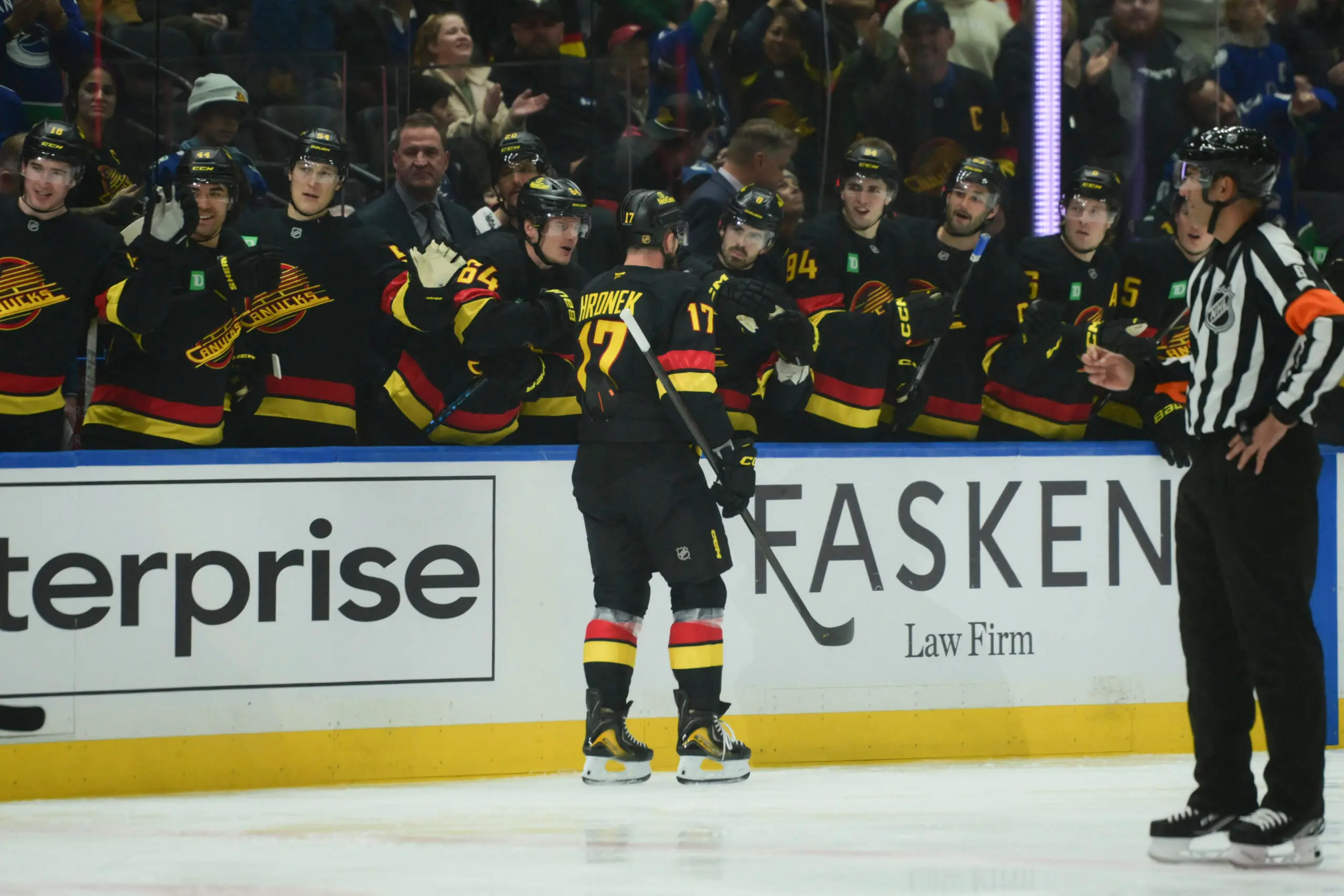
Photo credit: Simon Fearn for IMAGN IMAGES via Reuters Connect

Sep 13, 2026, 16:00 EDTUpdated: Sep 14, 2026, 15:22 EDT


The Vancouver Canucks’ 2026 Training Camp gets started this upcoming week on September 17 in Penticton, British Columbia. After that, it’s a matter of just 12 days until the puck drops for opening night on September 29.
Before all that, we wanted to make one last projection of what the Canucks’ roster might be for that opening night. But before we get to that, a quick digression on the difference between “opening night” and “opening day” rosters.
An opening night roster is just whatever the roster happens to be when a team plays its first game of the season. An opening day roster, on the other hand, is the roster that is ‘captured’ on the first official day of an NHL regular season for the purposes of setting a team’s start-of-year salary cap. In previous years, this was a big focus for the Canucks, as they attempted to either maximize their allowable relief space via LTIR, maximize their allowable performance-bonus cushion, or both. However, with more than $17 million in cap space heading into the season, the Canucks already have more than enough space to cover call-ups for any injuries they might encounter this season, and more than enough to accommodate each and every one of their ELC players hitting their max bonuses (a total of about $3.5 million).
That, and the fact that “opening day” and “opening night” occur on the same calendar date for the Canucks this year, essentially ensures that there’ll be no roster-related shenanigans or ‘papering’ prospects down to Abbotsford this year. No need to worry about setting the “perfect” opening day roster.
In other words, the Canucks’ opening day roster and opening night roster should be exactly the same this year. And with that, let’s get to the projection.
Forwards
Jake DeBrusk – Elias Pettersson – Linus KarlssonLiam Öhgren – Marco Rossi – Brock BoeserFilip Chytil – Aatu Räty – Drew O’ConnorPaul Cotter – Ty Mueller – Brendan GallagherMax Sasson – Jonathan Lekkerimäki
At this point, it’s almost a coin toss as to who ends up being the Canucks’ top centre between Elias Pettersson and Marco Rossi. While we’re bullish on Rossi’s potential for growth here, it’s also clear that the organization is placing some faith in Pettersson restoring at least a little of his own game.
Part of that is confidence, and to facilitate that, it’s hard to imagine Pettersson starting the season as anything but the 1C in name – even if he and Rossi are receiving relatively equal ice time.
Elsewhere at centre, we still like the option of Braeden Cootes starting in Abbotsford and Filip Chytil converting mostly to the wing, which leaves Aatu Räty as the default 3C. Which is good, as many folks wanted to see Räty receive a more consistent opportunity this season.
Previously, we had the incoming Ilya Safonov as the odds-on favourite to score the 4C role. But with him starting prospect camp on Cootes’ wing, instead of at centre, we’re moving Ty Mueller into the lead instead. Mueller has spent the last two seasons building up trust with head coach Manny Malhotra, and has progressed fairly quickly in that time. Now’s his chance.
On the wings, as much as we’d like to see Jonathan Lekkerimäki get a chance in the top-six right away, it might take an injury to get him there. With the goal of resurrecting Pettersson on the table, it’s hard to imagine him starting the season with anything but his two best wingers, which, according to history, should be Jake DeBrusk and Linus Karlsson.
And then it’s hard to imagine the team not at least trying out the BRÖ line of Liam Öhgren, Marco Rossi, and Brock Boeser again, which found some success last season.
That leaves a fairly random third line of Räty between Chytil and Drew O’Connor, although the wings could really shuffle around within this bottom-six.
For now, the fourth line would be Mueller between Paul Cotter and Brendan Gallagher, which sure has the makings of a traditional energy line.
That would have Lekkerimäki and Max Sasson as the extras. And as much as we’d like to have both of them in the opening night roster, it’s hard to imagine any of the aforementioned eight wingers sitting in favour of them, barring an injury or two. Lekkerimäki and Sasson will receive their opportunities, but they might not come right away.
If we’re predicting final cuts, too, we’ll say Cootes, Safonov, Akil Thomas, and Matthew Stienburg, with Cootes potentially sent down earlier so as to give him a fuller camp with Abbotsford.
Defence
Zeev Buium – Filip HronekJamie Oleksiak – Tom WillanderElias Pettersson – Luke SchennVictor Mancini
The blueline is relatively set one-through-seven, and, really, one-through-eight.
For the time being, Filip Hronek is still the leading man. One somewhat likes the idea, then, of placing Zeev Buium on his own pairing, perhaps with fellow sophomore Tom Willander, to see if he can drive more solo. At the same time, however, Buium and Hronek are the only real top pairing the Canucks have at the moment, and the best way to maximize ice time for Buium is probably to just keep him up top with Hronek, at least to start.
That makes for three ‘youth-veteran’ pairings, which is sort of how the Canucks have designed it for this year. Jamie Oleksiak probably starts in the top-four alongside Willander, offering some defensive coaching along the way, and Elias Pettersson and Luke Schenn form a tough-as-nails bottom pairing where, ideally, Pettersson can learn to play more like Schenn used to in his own prime.
There has been plenty of mention of Schenn not being an every-night player this season, and that remains true. But when you bring back a player this popular, you don’t scratch him on opening night. That’s almost a given.
Victor Mancini makes the most sense to start as the seventh D, though he’ll receive plenty of competition from Kirill Kudryavtsev. In the end, either Kudryavtsev or Lekkerimäki are eligible to be sent down to Abbotsford without waivers. We think the team will see Lekkerimäki ‘making’ the team as more important, and so they’ll probably go with 14 forwards and seven D, leaving Kudryavtsev as the final cut and first defensive call-up.
Goaltending
Thatcher DemkoKevin Lankinen
This is an admittedly optimistic projection. But until we hear directly from Thatcher Demko that he won’t be ready for Training Camp or preseason, we’ll believe he will be, as he has aimed for all along. Projecting anything else seems unfair to someone working as hard as possible to return to the lineup.
If Demko is healthy, he won’t be starting nearly as much as he has in the past, and might outright split starts with Kevin Lankinen. But make no mistake, if Demko is healthy and good-to-go for opening night, he’ll be getting that start. You just can’t ask a guy to make a comeback and then sit him on the bench for his first game.
Until Demko really gets his feet under him, Lankinen exists as more of a 1B than a backup.
In this scenario, the team will be strategic about when it waives Nikita Tolopilo and hope he makes it down to Abbotsford as a convenient, perhaps much-needed, call-up option. The three-goalie option also remains on the table, and is easy enough to achieve through demoting the waiver-exempt Lekkerimäki.
Of course, if Demko isn’t ready, this position is even easier to project. Demko goes on IR, and it’d be Lankinen getting that first start, and Tolopilo in place as his backup until a point at which Demko returns.
Sponsored by bet365


Recent articles from Stephan Roget
Breaking News
- Manny Malhotra and Brock Boeser offer up slightly different theories for Canucks’ struggles
- The Stanchies: Jonathan Lekkerimäki notches a goal and an assist, and that’s all we’ll say
- ‘It’s embarrassing’: Brock Boeser brutally honest following Canucks’ ninth straight loss
- Instant Reaction: Canucks go nearly 40 minutes without a shot in 5-2 loss to Red Wings
- What’s behind ex-Canuck Conor Garland’s struggles in Columbus?

Vancouver CanucksTeam Cap Summary

Cap Summary
2026-27
2027-28
Projected Cap Hit
$87,295,050
$71,329,167
Projected Cap Space
$16,704,950
$42,170,833
Current Cap Space
$18,951,815
$42,170,833
Active Players
23/23
13/23
Draft Picks
Round
'27
'28
1
1
1
2
2
2
3
1
1