
CanucksArmy has no direct affiliation to the Vancouver Canucks, Canucks Sports & Entertainment, NHL, or NHLPA
The NHL standings are as tight as ever, but is that a trap for the Vancouver Canucks?
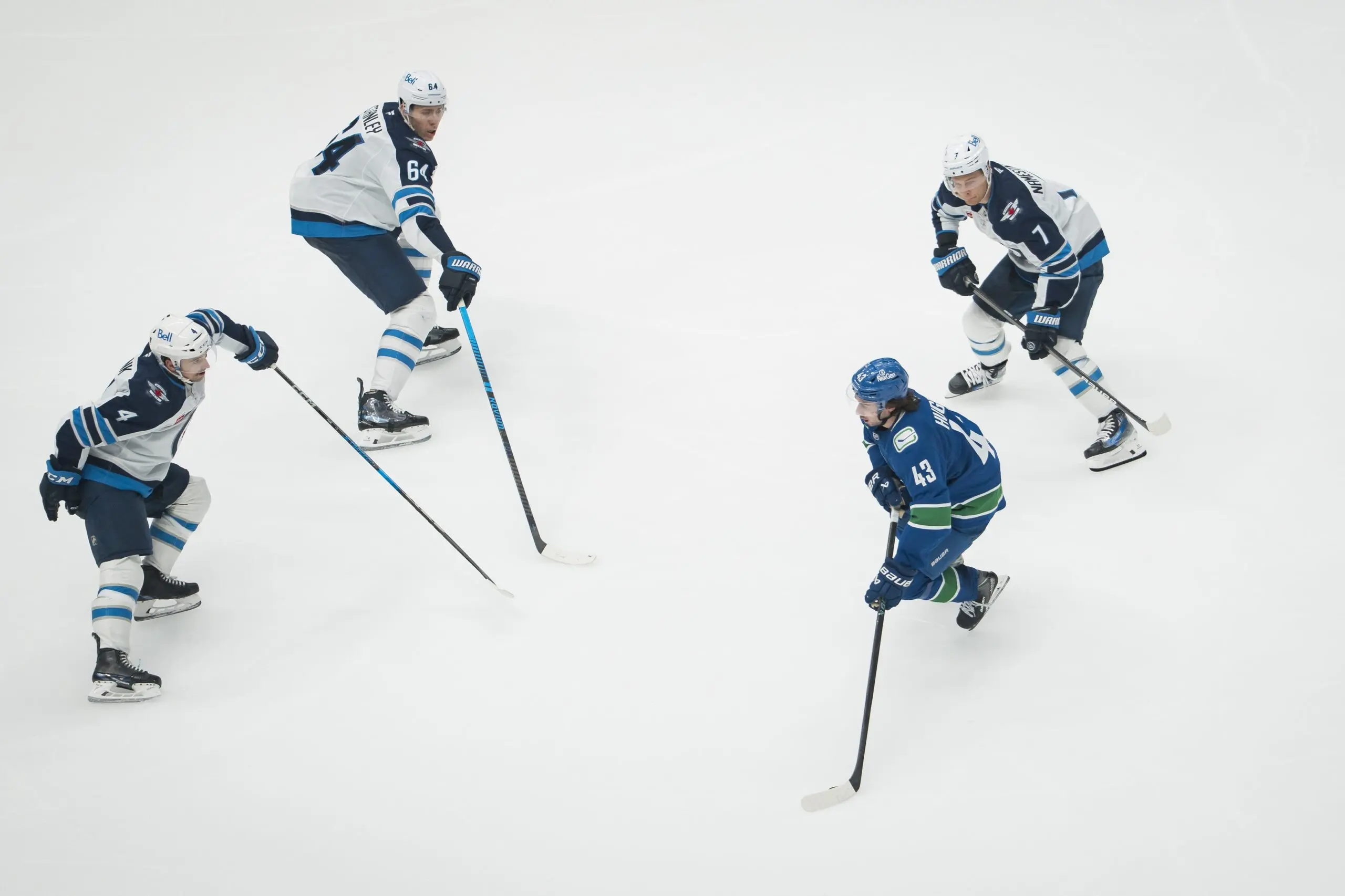
Photo credit: © Bob Frid-Imagn Images

Nov 14, 2025, 09:00 ESTUpdated: Nov 14, 2025, 02:36 EST


When the NHL introduced the salary cap back in 2005, one of its stated goals was to bring more parity to the league. Now, two decades later, it seems like that was largely a mission accomplished.
A month-and-change into the 2025-26 season, the NHL standings are as tightly-packed as they have been in recent memory. As of this Friday morning, we have three teams far ahead of the Vancouver Canucks and everybody else with .700-ish records: the Colorado Avalanche, the New Jersey Devils, and the Dallas Stars. Also up there in the Elite Four with a surprising 23 points in 17 games: the Anaheim Ducks.
And then we start to get into an incredibly mushy middle.
Right now, the fifth-ranked team (the Carolina Hurricanes with 22 points) and the 28th-ranked team (your Vancouver Canucks! with 17) are separated by just five points. That’s quite a thin spread for a range that currently includes the bulk of the league.
A full 24 of the league’s 32 teams fall within that 17-22 point range right now. Included in that list are last year’s champions (the Florida Panthers, 19 points), the other finalist (the Edmonton Oilers, 20 points), but also the two teams that finished with the worst records (the Chicago Blackhawks, 20 points, and the San Jose Sharks, 19).
In other words, in this present moment, it’s hard to separate the good teams from the so-so teams, and maybe even from the outright bad teams. With 24 teams in that mushy middle, one has to think there are at least a few clubs of each category in the mix.
Now, with the different amounts of games played amongst these various teams, it’s not actually as close as it looks. The range in points-percentages here goes from .688 (the Hurricanes) to .472 (your Vancouver Canucks!), which is certainly a more obvious gap than the five points.
And there are some signs to be found that, within that mix, Vancouver is (currently, at least) one of the outright bad teams. They have the lowest point percentage in the group because they are tied for the most games played in the group at 18. Of all the 24 teams in the mushy middle, the Canucks have the worst goal differential at a minus-10, with only the Oilers (-9) and the Minnesota Wild even close (-8).
The Canucks no longer have the worst power play in that group, but they do have the worst penalty kill at 66.7%. No surprise there – it’s (tied for) the worst PK in the entire league.
But with all that said, the Canucks’ inclusion in this mushy middle could be seen as a trap.
Despite all the injuries, despite the general early-season troubles, despite almost no one on the team playing at their best, the Canucks are still just three points back of being in a playoff position. That’s what the basic, raw numbers say.
More so than that, the Canucks are technically just five points back of being a top-five team in the NHL.
Had that one OT loss to Colorado gone the other way, and had just two of those regulation losses been a win instead, the Canucks would be tied with the Hurricanes and four other teams with 22 points. With just the OT win and one of those extra regulation wins, they’d be in a playoff position. Sure, three-to-five extra points is easier said than done. But it does sound doable.
That seems like a fact that might just bring the wrong people (Canucks management) to the wrong conclusions (spending valuable assets to push this roster a step or two ahead).
The Canucks’ schedule stays fairly busy right through from now until February, only slowing down a bit after the Olympic break. That means that the current ‘mirage’ effect – where the Canucks are only a few points back despite being way behind in points-percentage – could continue to be the case for some time.
It’s not hard to see how a front office that has placed an awful lot of chips on doing well in this particular season could easily convince itself that the right move or two is all it takes to get back into the playoff picture. After all, we’re talking about a matter of just a few points here, and there have been so many other complicating factors, like injuries, at play.
For fans already worried that the team will give up first-round picks or some of its most talented prospects for quick fixes, this sounds like a nightmare. But it’s a pretty realistic nightmare, and one that this fanbase has seen play out before.
That’s the trap of the mushy middle created by NHL parity, and it’s one the Canucks seem prone to fall into. But they really shouldn’t be. The truth of the matter is that the mushy middle is nothing worth chasing after. Just barely making it to the playoffs – or, more accurately, being somewhat close to a playoff position for the bulk of the regular season – is not a goal that should be pursued.
The Canucks should not be looking at this conglomeration of 24 teams in the middle of the league and thinking, “Why not us?” They should be looking at the true contenders in the league – the Avalanches, the Devils, the Stars, the Hurricanes – and measuring themselves against those standards. Contending is, after all, the real goal. And it doesn’t take much of an objective view to look at those rosters, and then look at the Canucks, and see that the gap is far larger than any reasonable in-season acquisition can bridge.
The Canucks might actually be better served by looking downward. There are just four teams below them in the standings right now. The same three points that separate the Canucks from a playoff berth are also the distance between them and second-last place in the NHL. Wondering how low they can go is probably a more realistic endeavour than dreaming about that climb into the top-10.
We’re just not sure that is an outlook GM Patrik Allvin and Co. can — or will — take.
What fans might want to hope for instead is that this next slate of difficult games – which will now be played minus Thatcher Demko – creates a more obvious separation between the wheat and the chaff of the league, and that when it’s over, the Canucks are more obviously in the chaff category.
If that short-term pain can prevent the long-term pain of another fruitless asset expenditure and avoid the Canucks falling into the trap of the mushy middle, it will have been worth it.
Sponsored by bet365


Breaking News
- The Stanchies: Prime Lankinen returns, Canucks still go winless on road trip with 4-2 loss to Lightning
- Instant Reaction: Canucks give up four unanswered goals in 4-2 loss to Lightning
- Canucks: D Elias Pettersson’s impressive start is more than just passing the eye test
- What’s behind Marco Rossi’s seven-game scoring drought for the Canucks?
- Canucks Game Day: Looking to close out lengthy road trip with a win vs. Lightning

Vancouver CanucksTeam Cap Summary

Cap Summary
2026-27
2027-28
Projected Cap Hit
$87,295,050
$71,329,167
Projected Cap Space
$16,704,950
$42,170,833
Current Cap Space
$18,413,411
$42,170,833
Active Players
23/23
13/23
Draft Picks
Round
'27
'28
1
1
1
2
2
2
3
1
1