


Dhaliwal said as of today he's pretty confident Canucks would take Malhotra at 3rd overall. @DonnieandDhali

CanucksArmy has no direct affiliation to the Vancouver Canucks, Canucks Sports & Entertainment, NHL, or NHLPA
Lessons from previous drafts to help the Canucks choose right if they fall to third overall
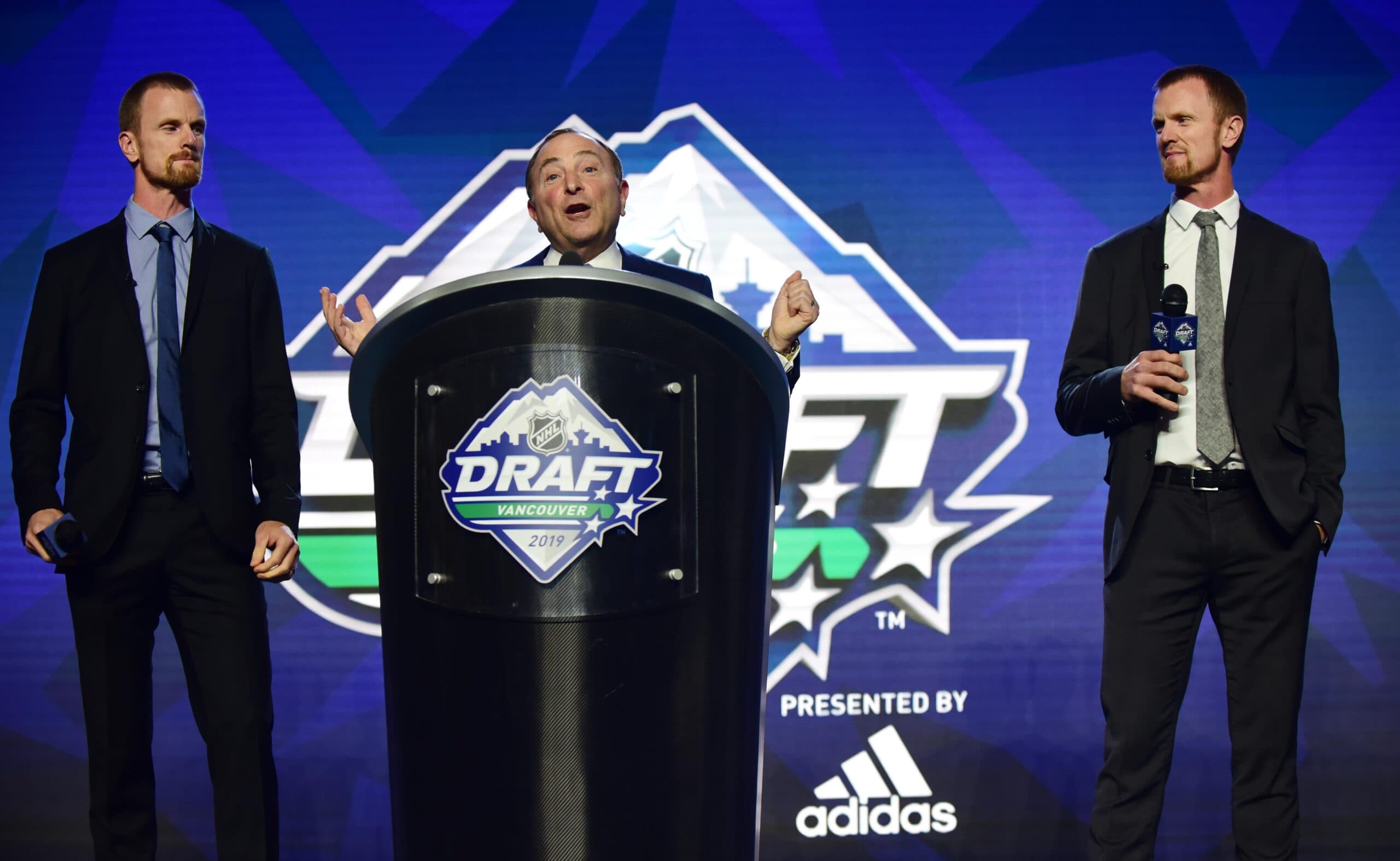
Photo credit: Anne-Marie Sorvin-USA TODAY Sports

By Tyson Cole
May 2, 2026, 11:30 EDTUpdated: May 4, 2026, 13:46 EDT
We are under one week away from the lottery balls delivering the fate of many upcoming prospects and where they will begin their NHL careers. And more importantly for most readers here, finally found out if the Vancouver Canucks can finally land that impactful superstar at the top of the NHL Draft board that will change the franchise around.
But as mentioned, it all comes down to the lottery balls and if the Canucks get lucky to maintain their position at the top of the draft. Not only have the Canucks never selected first overall, but they’ve never even moved up in the NHL Draft Lottery before. Currently holding the best odds at landing the first overall pick (25.5%), they can’t move up, but they can certainly buck the trend and select first overall for the first time in franchise history.
At the top of most draft boards, you’ll find some sort of combination for Gavin McKenna and Ivar Stenberg. The consensus seems to be shifting back into McKenna’s favour, but there are still some teams that have Stenberg higher. Either way, those are the two highly regarded prospects that should hear their names one after another.
But after that, there’s a drop off. Not a big one, but one worth noting. And heading into the draft lottery, there really doesn’t seem to be a consensus as to who should be that third overall pick. There is a crop of defencemen in Keaton Verhoeff, Chase Reid, Carson Carels and Alberts Smits, but there’s also a surging centre in Caleb Malhotra, who are all in the mix to follow McKenna and Stenberg.
As many Canucks fans are aware from their former lottery luck, their best odds are to finish with the third overall pick, at 55.7%. So, if that is the case, what should the Canucks do at third overall becomes the biggest question.
Organizationally, the Canucks are more in need of a centre than a defenceman. However, this is considered a weak centre class. Malhotra is emerging as the clear and away best centre in the class, but there are also players such as Viggo Björck, Tynan Lawrence, and that’s about it. Later on in the first round, there are some players like Oliver Suvanto, Yegor Shilov, Wyatt Cullen, Ilia Morozov, Maddox Degenais, Mathis Preston, and Markus Ruck.
The Canucks may be strongest depth-wise along the blueline. In the organization, they have Zeev Buium, Tom Willander, Elias Pettersson (D), Victor Mancini, Kirill Kudryavtsev, and Sawyer Mynio as defencemen under 24 years old.
This isn’t necessarily the greatest prospect pool when looking at the options at three, considering that the next best few players available are all defencemen. Typically, it’s best practice to draft the best player available over an organizational need, but that hasn’t stopped teams in the past.
Let’s look back at the 2018 NHL Draft, where the Montreal Canadiens selected Jesperi Kotkaniemi third overall, and the Arizona Coyotes drafted Barrett Hayton fifth overall because they needed centremen. That resulted in stud defencemen such as Quinn Hughes, Evan Bouchard, and Noah Dobson falling in the draft. Those three have become elite players at their position, while the centres taken before them have been serviceable NHL players, but looking back, neither should have gone over those defencemen.
But in that scenario, it was the Canucks who benefited from teams above them reaching for the centre that allowed the stud defenceman to fall in their lap later in the draft. And unfortunately, the Canucks find themselves in a similar situation at this upcoming draft, except they could be the team that might reach for a centre.
So, let’s imagine a world where the lottery balls don’t fall in the Canucks favour on Tuesday, and they fall to third overall. McKenna and Stenberg are the first two players selected ahead of them, and left on their board are Verhoeff, Reid, Carels, Smits and Malhotra. For the majority of the draft year, that crop of four defencemen has undoubtedly been perceived as the best players available. Malhotra has been the hot name that has shot up draft boards lately, and rightfully so, considering his playoff production (13 goals and 25 points in 13 games).
However, my draft philosophy is to avoid overreacting to recency bias and to not lose sight of what we thought of these prospects heading into the year.
Daily Faceoff’s prospect guru, Steven Ellis, did not have Malhotra in his top-32. And FloHockey’s prospect expert, Chris Peters, released his top-10 way-too-early 2026 draft rankings two days after the 2025 NHL Draft.
Peters’ top-10 went: Gavin McKenna, Keaton Verhoeff, Ivar Stenberg, Ryan Roobroeck, Ethan Belchetz, Tynan Lawrence, Mathis Preston, Viggo Björck, Ryan Lin, and Chase Reid. Peters lists 10 more players to keep an eye on this year: Daxon Rudolph, Niklas Aaram-Olsen, Adam Valentini, Mikey Berchild, Adam Novotný, Viktor Fyodorov, Xavier Villeneuve, Carson Carels, Olivers Murnieks, and Elton Hermansson.
Of course, things change during the draft year, and players rise and fall. However, it’s a more promising sign to see a player ranked highly at the beginning of the year remain high as we inch toward the draft. Those who fit that profile include McKenna, Verhoeff, Stenberg, Björck, Reid, Rudolph, and Carels.
There will always be risers and fallers, and after a season in which Malhotra scored 29 goals and 55 assists for 84 points, he certainly deserves to move up in the draft board. But what is concerning is that he was not even ranked as a first-round pick coming into the year, let alone a top-10 or top-20 prospect.
That isn’t really surprising, though, when you look at his draft-minus-one season. Malhotra played that season in the BCHL with the Chilliwack Chiefs, and his production did not scream top NHL prospect. Malhotra scored just eight goals and 18 assists for 26 points in 44 games. And then, of course, shot up draft boards in his draft year.
We aren’t taking away anything from his fantastic season. Jumping from the BCHL to the OHL is tough, and having a breakout season like this while doing so is impressive. But let’s not pretend the OHL is as prestigious a league as it once was. The entire CHL is losing players to the NCAA.
Since the start of 2024, there have been 55 OHLers who have left for the NCAA. This significantly affects the league’s player pool, making the competition weaker and thus making scoring easier.
And it’s not like he alone carried his team in the regular season. The Brantford Bulldogs are littered with talent. They have 11 NHL-drafted players, five of whom were first-round picks (Jett Luchanko, Jake O’Brien, Marek Vanacker, Adam Jiricek, and Ben Danford). That’s second only to the Kitchener Rangers (12) in the entire OHL. But the difference is, the Rangers have just two first-round picks (Sam O’Reilly and Cameron Reid).
All of this to say that while Malhotra’s numbers are impressive, he did so while surrounded by first-round NHL talent, and in a weaker league than some may think.
In fairness to him, there are a pair of recent examples of centres who had one strong draft season, were drafted high, and are either succeeding at the NHL level or projected to do so.

Ostlund per McKeens 2022 preseason rankings, and Iginla per Daily Faceoff’s Steven Ellis 2024 preseason rankings.
While there are good examples of draft risers, we also have examples of risers who did not work out as well. While digging through previous NHL drafts, we found one year with uncanny similarities to the 2026 NHL Draft. A draft in what is considered weak at the centre position, but has a late-riser that is pushing him above some of the long-time highly-ranked defencemen in his class.
The 2016 NHL Draft.
Heading into the year, centre Auston Matthews was the consensus prized possession of the class. But outside of that, there really wasn’t much else down the middle of the ice. According to hockeyprospect.com, Logan Brown was the next-best centre, ranked eighth, followed by Dmitri Sokolov, Sam Steel, and Pierre-Luc Dubois; that was it for centres in the top-30.
However, there was a BCHLer, coming off a decent draft-minus-one year with the Penticton Vees, where he scored 23 goals and 22 assists for 45 points in 46 games. These were fine numbers, but nothing to write home about.
Then, the player found his stride offensively the following season. He scored 42 goals and 62 assists for 104 points in 48 games for the Vees. These totals had this player shooting up draft rankings because of the scarcity of talent at the top of the draft for his position – even ahead of a pair of defencemen who were both in the top-six of hockeyprospects.com preseason rankings. As a result, the centre went 10th overall to the Colorado Avalanche.
The two defencemen were regarded as the two best in the class coming into the season. One was projected to go second overall, and the other sixth.
Defenceman number one had a solid draft-minus-one season, posting 16 goals and 17 assists for 33 points in 42 games. And he followed that up with an even better draft campaign, where he posted 11 goals and 38 assists for 49 points in 62 games in the OHL.
The second defenceman scored seven goals and 33 assists for 40 points in 63 games with the USNTDP. Once he made the jump to the NCAA for his draft season, the defenceman tallied three goals and 22 assists for 25 points.
However, those numbers were not good enough for either blueliner to maintain their preseason draft ranking, as the first defenceman fell to 16 to the Arizona Coyotes, while the second fell to the Boston Bruins at 14.
But looking back now, 10 years later, the Avalanche would clearly want to do that selection all over again, and not take the rising centre over the steady, highly-ranked defencemen.
The centre the Avalanche drafted was Tyson Jost. The two defencemen they passed on were Jakob Chychrun and Charlie McAvoy.
Fast forward to the present day, where Jost now plays in the bottom six for the Nashville Predators, with a career stat line of 69 goals and 96 assists for 165 points in 564 games. Whereas you look at the two defencemen taken after him, and Chychrun has 122 goals and 201 assists for 323 points in 621 games, and McAvoy has 71 goals and 290 assists for 361 points in 573 games. Both blueliners set career-highs in points this season, averaged over 23 minutes per game, and are signed to long-term deals worth $9 million (or more) per season, while Jost is looking for another NHL deal after completing his third straight one-year contract.
We find ourselves with a similar predicament in 2026, with Malhotra and the defencemen, Verhoeff in particular.
The criticism of Verhoeff is fair, but may have gone a little too far. After having a strong draft-minus-one season with the Victoria Royals, scoring 21 goals and 24 assists in 45 points, Verhoeff decided to test himself against tougher competition at the NCAA level at the University of North Dakota. While he still posted respectable numbers, six goals and 14 assists for 20 points, critics became wary of his boots, marking his skating against tougher competition as not up to NHL standards. Tack that on top of some questionable defensive decisions, and Verhoeff started to fall down the draft board.
In EliteProspects’ latest draft rankings, Verhoeff fell all the way to 11th, while they had Malhotra rising to fifth in their rankings. But it’s important to remember that Verhoeff is just 17 years old, and he’s playing against players upwards of 25 years old. Since he has yet to fully develop, he is naturally going to look slower when against this type of competition.
Why should he be punished like this by going to test himself against tougher opponents? There have only been 11 17-year-old defencemen to have ever played in the NCAA. And Verhoeff is one of four of that group to tally 20 points. The other three are AJ Thelen, Zach Werenski and Noah Hanifin. Thelen would never play in the NHL, but Werenski and Hanifin have combined for 818 points in 1,471 games, and are both 2026 Winter Olympic Gold Medalists. Pretty elite company to be a part of.
Even when looking at Malhotra and Verhoeff’s draft-minus-one and draft year numbers compared to Jost, Chychrun and McAvoy’s side-by-side, you can see how similar a situation we find ourselves in today.

This exercise focused solely on Verhoeff. We haven’t even considered Reid or Carels as other options for the Canucks at third overall.
Reid finished 12th in defensive scoring in the OHL with 18 goals and 30 assists for 48 points, but played just 45 games. His 1.07 points-per-game finished third in the entire league, trailing only Kashawn Aitcheson and Adam Jiricek, who are NHL-drafted defencemen. Carels finished second in WHL defenceman scoring, with 20 goals and 53 assists for 73 points. He trailed only Daxon Rudolph, another top prospect in the 2026 draft, but Carels’ 1.26 points-per-game were first among draft-eligible blueliners.
Regardless, the name of the defencemen doesn’t really matter. What matters is that the Canucks don’t overlook these players, because, organizationally, they need a centre more. However, that doesn’t look to be the case, as according to Donnie & Dhali’s Rick Dhaliwal, he’s fairly confident the Canucks would take Malhotra if they fall to third overall.
All of this is not to say that Malhotra will be a bad player. I believe he’s going to be a productive NHL player. However, when you’re in the position that the Vancouver Canucks find themselves, where they need just able everything, you cannot afford to pass the best player available. And if they believe that Malhotra is undoubtedly the best player available after McKenna and Stenberg, and they select him at third overall over the crop of defencemen we’ve highlighted, then that’s their decision.
However, we’ve seen how this has played out. Just 10 years ago, we saw a centre rise up the draft boards because of one good draft season in what was a weak centre class and get selected over defencemen who were ranked highly coming into the year, and maintained that position throughout their draft year. And looking back now, the team that reached on the centre and overlooked the defencemen are the ones who are regretting that decision today.
As they head into the biggest draft in franchise history, the Canucks cannot afford to make the same mistake.
Sponsored by bet365


Breaking News
- The Stanchies: Kevin Lankinen takes the loss after playing for five minutes of Canucks’ 4-1 loss to New Jersey
- Instant Reaction: Special teams the story as Canucks lose 4-1 to Devils
- Meet the three men reviving beloved ‘Sports Page’ in an all-new format
- Canucks Game Day: Dealing with the Devils in early Saturday start in New Jersey
- The Canucks have every reason to give Leevi Meriläinen a run of starts

Vancouver CanucksTeam Cap Summary

Cap Summary
2026-27
2027-28
Projected Cap Hit
$88,074,947
$71,329,167
Projected Cap Space
$15,925,053
$42,170,833
Current Cap Space
$16,790,545
$42,170,833
Active Players
23/23
13/23
Draft Picks
Round
'27
'28
1
1
1
2
2
2
3
1
1