
CanucksArmy has no direct affiliation to the Vancouver Canucks, Canucks Sports & Entertainment, NHL, or NHLPA
With their later picks now placed, what are the odds of the Canucks trading up in the 2026 Draft?
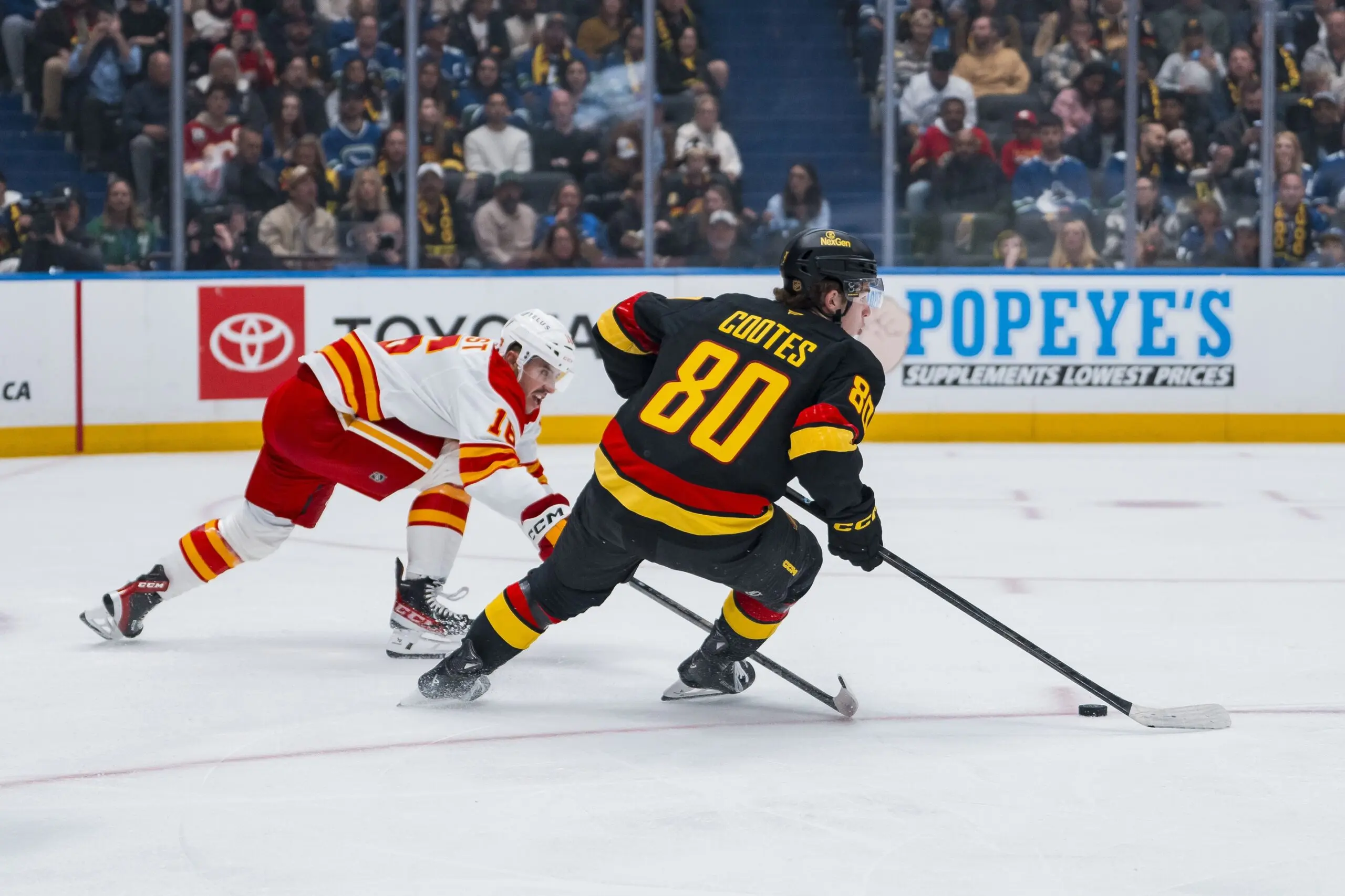
Photo credit: © Bob Frid-Imagn Images

Apr 14, 2026, 13:15 EDTUpdated: Apr 14, 2026, 15:36 EDT


We are still most of a month away from the 2026 NHL Draft Lottery, set for May 5, 2026. That’s the date on which the Vancouver Canucks will find out whether they’re drafting first, second, or third overall in the 2026 NHL Entry Draft. And it’s going to be an anxious wait until then.
But as the 2025-26 regular season wraps up, the Canucks are at least getting a little certainty on the rest of their draft picks and the order in which they will be made.
The Canucks own the Minnesota Wild’s first round pick this year, one part of the return for Quinn Hughes. The Wild’s season isn’t done yet, but their place in the standings is solidified. They’re guaranteed to finish third in the Central Division and seventh in the NHL overall, no matter how their final game goes.
That means that the Wild’s pick, which is now belongs to the Canucks, will slot in at 24th overall in the first round. Only picks from teams that miss the playoffs go into the lottery, so it won’t move as a result of that. The only thing that can change it’s placement is if the Wild make it to Western Conference Final (in which case it will be either 28th or 29th overall) or if they make it to the Stanley Cup Finals (in which case it will be either 30th or 31st). Other than that, it’s staying at 24th.
The Canucks also own two second round picks, and those have been more-or-less slotted, too. The Canucks’ own second rounder requires no lottery; it will come first in the round regardless of where any ping pong balls fall. For a minute there, the Canucks were set to receive the 32nd overall pick, as the Ottawa Senators were set to have their own first round pick rescinded over some trade clause shenanigans from years ago. However, the NHL predictably went back on this punishment and instead awarded the Senators the 32nd overall pick.
So, the Canucks come in at 33rd overall to start off the second round.
The Canucks also own the San Jose Sharks’ second rounder this year, one half of the return for Kiefer Sherwood. The Sharks have been eliminated from the playoffs, and are currently in 23rd overall in the NHL (also known as tenth-last). That would give them, by which we mean the Canucks, the tenth selection in the second round, which would be the 42nd overall pick.
The Sharks’ spot is not quite set in stone, however. Over the course of the last week of regular season action, they could rise as high as 21st overall, or sink down to 26th overall, depending on how they and other teams finish. That means the Sharks’ second rounder could fall anywhere between 39th and 44th overall.
So, without any trades, and without the Minnesota Wild doing the unexpected and beating both the Dallas Stars and the Colorado Avalanche, the Canucks are set to draft at 1-3rd overall, 24th overall, 33rd overall, and 39-44th overall in the first two rounds of the 2026 NHL Draft.
But that’s without any trades. One has to wonder, with an abundance of picks on hand, is there a possibility of the Canucks bundling two or more to move higher in the order?
We would say there’s a very good possibility of that.
Trades like this happen every year. A late first and a second get packaged for a higher first. Two seconds get packaged for a late first. We’ve all seen this sort of trade before.
Our friends over at PuckPedia have a tool that can help set our expectations for this kind of transaction, and it’s known as the Perri Pick Value Calculator. In short, the calculator, created by Matt Perri, crunches down the long-term average value of a draft slot – both in terms of who has been picked there, and also what other picks that pick has been traded for – and assigns a numerical value to that draft slot.
According to the Perri Calculator, for example, the Canucks’ 24th overall and 33rd overall picks have a combined value of 25.13 Perri Units. That’s roughly equivalent to the value of the 15th overall pick – the exact same slot where the Canucks’ selected Braeden Cootes last year.
It’s not a perfect science, and every trade negotiation is unique, but this suggests that if the Canucks were to package the Minnesota first and their own second rounder, they’d be able to trade up into somewhere in that 15-ish range.
If we package up the Minnesota first with the San Jose second (we’ll leave that one at 42nd overall for now), we get a Perri value of 21.97. That’s roughly the same value as the 18th overall pick.
And if we leave the Minnesota first out of it altogether, and just package up the two seconds, we get a Perri value of 16.68. That’s a noticeable drop from the previous combinations, but it’s about the same value as the average 22nd overall pick.
The calculator gets a little bit wonky once you go past two draft picks at a time, as such trades rarely happen in actuality. But just for fun, we punched in the Minnesota first, the Vancouver second, and the San Jose second all together in one big package, and we got a value of 31.89, or roughly equivalent to the value of the 11th overall. But don’t get too caught up on that, as such quantity-for-quality deals are unlikely to be accepted in the real world.
So, history, and the Perri Pick Value Calculator, tells us that, if they wish, the Canucks should be able to move up in the 2026 NHL Entry Draft. They should be able to combine their late Minnesota first and one of their seconds into a more mid-round first. Or, alternatively, they should be able to combine both of their seconds into a late first.
Whether they actually do or not is something that will probably be decided on the draft floor itself, and will probably be highly dependent on who’s still on the board – and who’s not. But suffice it to say that the Canucks have options at the draft, and that several of those options involve moving on up, if they so choose.
PRESENTED BY PACIFIC TOYOTA DEALERS

Need performance without compromise? Check out the Toyota Prius Plug-In Hybrid. Enjoy up to 72 km of electric range on battery alone. Heading farther for an away game? It seamlessly switches to gas for a combined 962 km range. It’s a total power play on the road with a sleek design and sophisticated, tech-loaded interior. Plus, you can recharge easily at home or utilize over 2,000 public charging stations in BC. Experience range, style, and versatility. Visit your local Pacific Toyota dealer during Red Tag Days for limited-time offers.


Recent articles from Stephan Roget
Breaking News
- What’s behind ex-Canuck Conor Garland’s struggles in Columbus?
- NHL Notebook: Senators fans ruthless and creative in Brady Tkachuk’s return to Ottawa
- Scenes from morning skate: Signs point to Öhgren as a possible scratch for Canucks vs. Red Wings
- 3 ways the Canucks can get more out of their power play
- WDYTT: How do you want to see the Canucks handle their goaltending moving forward?

Vancouver CanucksTeam Cap Summary

Cap Summary
2026-27
2027-28
Projected Cap Hit
$87,295,050
$71,329,167
Projected Cap Space
$16,704,950
$42,170,833
Current Cap Space
$18,841,630
$42,170,833
Active Players
23/23
13/23
Draft Picks
Round
'27
'28
1
1
1
2
2
2
3
1
1