


Two lower mainland natives, Connor Bedard and Kent Johnson, in attendance for game 5 of the Calder Cup Final in Abbotsford.

CanucksArmy has no direct affiliation to the Vancouver Canucks, Canucks Sports & Entertainment, NHL, or NHLPA
How long might the Canucks have to wait to make a play on Connor Bedard?
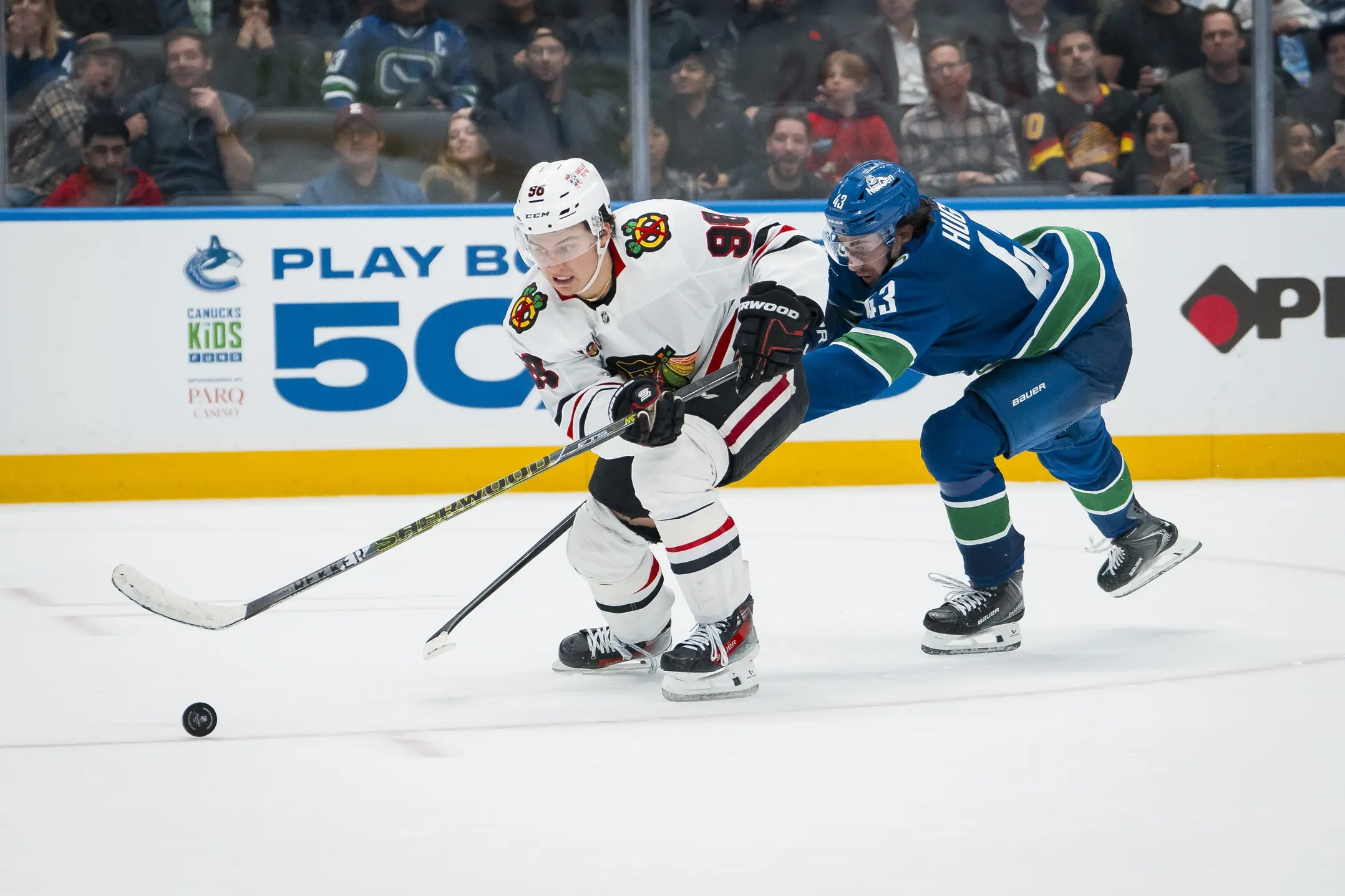
Photo credit: © Bob Frid-Imagn Images

Nov 6, 2025, 14:00 ESTUpdated: Nov 7, 2025, 02:48 EST
It was a big night for Connor Bedard on Wednesday, as he led his current NHL team, the Chicago Blackhawks, to victory against his favourite NHL team, the Vancouver Canucks. Bedard posted a goal – his first in Vancouver – and an assist on the way to a 5-2 win.
And we’re only barely kidding about the ‘favourite NHL team’ thing. Bedard’s lifelong admiration of the Canucks is a known and well-reported quantity at this point, with the most recent evidence being that last summer, he and fellow BC product Kent Johnson made the trip to cheer on the Abbotsford Canucks in Game 5 of the Calder Cup Finals. Now that’s dedication!
The feeling appears to be mutual, at least as far as the Vancouver fanbase is concerned. On Wednesday, multiple custom ‘#98 Bedard’ Canucks jerseys were spotted in the crowd. Now that’s manifestation!
Of course, there’s a difference between wishing for a Bedard homecoming in Vancouver, and that actually coming to pass. Which leads fairly naturally to the question in our headline: How long might the Canucks have to wait to even make a play on Connor Bedard?
The short answer is ‘only until this offseason.’ Technically speaking, Bedard’s current and first contract with the Blackhawks runs out as of July 1, 2026, and he has yet to sign an extension.
Bedard will become an RFA at that point – assuming that the Blackhawks make him a qualifying offer, which they absolutely will. But until he actually signs that next contract, Bedard will be eligible for an offer sheet, as he will have completed three years of NHL service. That will mark the Canucks first real opportunity to acquire Bedard. But not their first realistic opportunity to acquire Bedard.
Given the sorts of contracts being handed out to young star forwards right now, and given that Bedard seems to have finally broken out in his third season with 18 points in his first 14 games, it’s safe to say that the asking price on any extension starts at about $10 million per season. And that’s if he signs that contract with the Blackhawks. In order to ‘steal’ Bedard via offer sheet, a team would need to make him an offer so large that the Blackhawks are willing to walk away from it, and take the compensatory draft picks instead.
Suffice it to say, then, that any Bedard offer sheet would automatically have to fall into that top tier of compensation, meaning a contract with an AAV over $11.7 million. We suspect the real ‘walk away’ number to be much higher than that. Such an offer sheet would entail compensation of four first round draft picks.
Which, in the end, might be a fine price to pay for Bedard to return to Vancouver. But keep in mind, that’s both four first round picks and a contract offer so disgusting that it convinces Chicago to bail on their franchise forward. Given some of the contracts the Canucks already have on the books, and some of the extensions they hope to sign in the near future, it’s hard to see them being able to truly overpay a player on this scale.
Offer sheets aside, when might Bedard become an unrestricted free agent – the kind the Canucks could pursue freely, without any worry about compensation?
That’s a much, much longer wait. NHL players are not typically eligible for UFA status until they’ve hit age 27 or completed seven NHL seasons. Thankfully, when it comes to Bedard, he started his career as early as possible, so that clock has already been ticking.
Bedard will have completed his seventh NHL season with four more after this one, meaning the conclusion of the 2029/30 season. In other words, he won’t be a UFA until the next decade.
Still, there are some steps that Bedard and his representatives could take if becoming a UFA on this earliest possible date is his goal. Were he to sign a four-year extension coming off his ELC contract, Bedard would essentially ‘walk’ himself to free agency. He could also seek out a three-year ‘bridge’ deal, which would then place him in the position of taking that automatic one-year qualifying offer in 2029 – or, even better, filing for arbitration – which would more indirectly lead him to becoming a UFA in the summer of 2030.
But there’s really no way to accelerate it any more than that. The year 2030 is still the first point at which Bedard can be a UFA, and have the free and open choice to return to Vancouver.
Until then, the only real option for an earlier homecoming is via a trade, and that’s not particularly realistic. The Blackhawks are surely not looking to sell Bedard – not now that he’s finally returning a full investment on their first overall selection – and if they were, the asking price would almost certainly be something the Canucks could not afford with their current slate of players, picks, and prospects. Bedard may not be a better player than Quinn Hughes, but at this point – with Hughes a year-and-a-half away from his own UFA status – it could be argued that Bedard is the more valuable asset, what with his four-and-a-half seasons’ worth of team control remaining. And, simply put, there is no feasible way for the Canucks to trade for someone worth as much or more than Hughes.
So, what’s it going to take to make those #98 jerseys a reality in Vancouver? Patience, if anything at all. How much patience? A lot of it. The most realistic date at which it even becomes a strong possibility is 2030. And were Bedard to sign an extension longer than four years, then that date gets pushed back even further.
If there’s an optimistic note to end on, it’s that Bedard is still just 20 years old, and will remain that age for the entire 2025-26 season. On July 1, 2026, he’ll be 25. That means that if he does hit UFA status as early as possible, he will do so with plenty of peak and prime years left in him. And that might be something well worth waiting for.
Sponsored by bet365


Breaking News
- The Canucks are one of the smallest teams in the NHL, but can they change that?
- NHL Notebook: Jets trade Hellebuyck to Devils for package of four players and two draft picks
- The Statsies: Where the Canucks got dominated at 5v5 again is loss to Red Wings
- Manny Malhotra and Brock Boeser offer up slightly different theories for Canucks’ struggles
- The Stanchies: Jonathan Lekkerimäki notches a goal and an assist, and that’s all we’ll say

Vancouver CanucksTeam Cap Summary

Cap Summary
2026-27
2027-28
Projected Cap Hit
$87,295,050
$71,329,167
Projected Cap Space
$16,704,950
$42,170,833
Current Cap Space
$18,951,815
$42,170,833
Active Players
23/23
13/23
Draft Picks
Round
'27
'28
1
1
1
2
2
2
3
1
1