
CanucksArmy has no direct affiliation to the Vancouver Canucks, Canucks Sports & Entertainment, NHL, or NHLPA
Game Tape: How the Canucks can help Leevi Meriläinen reach a new level
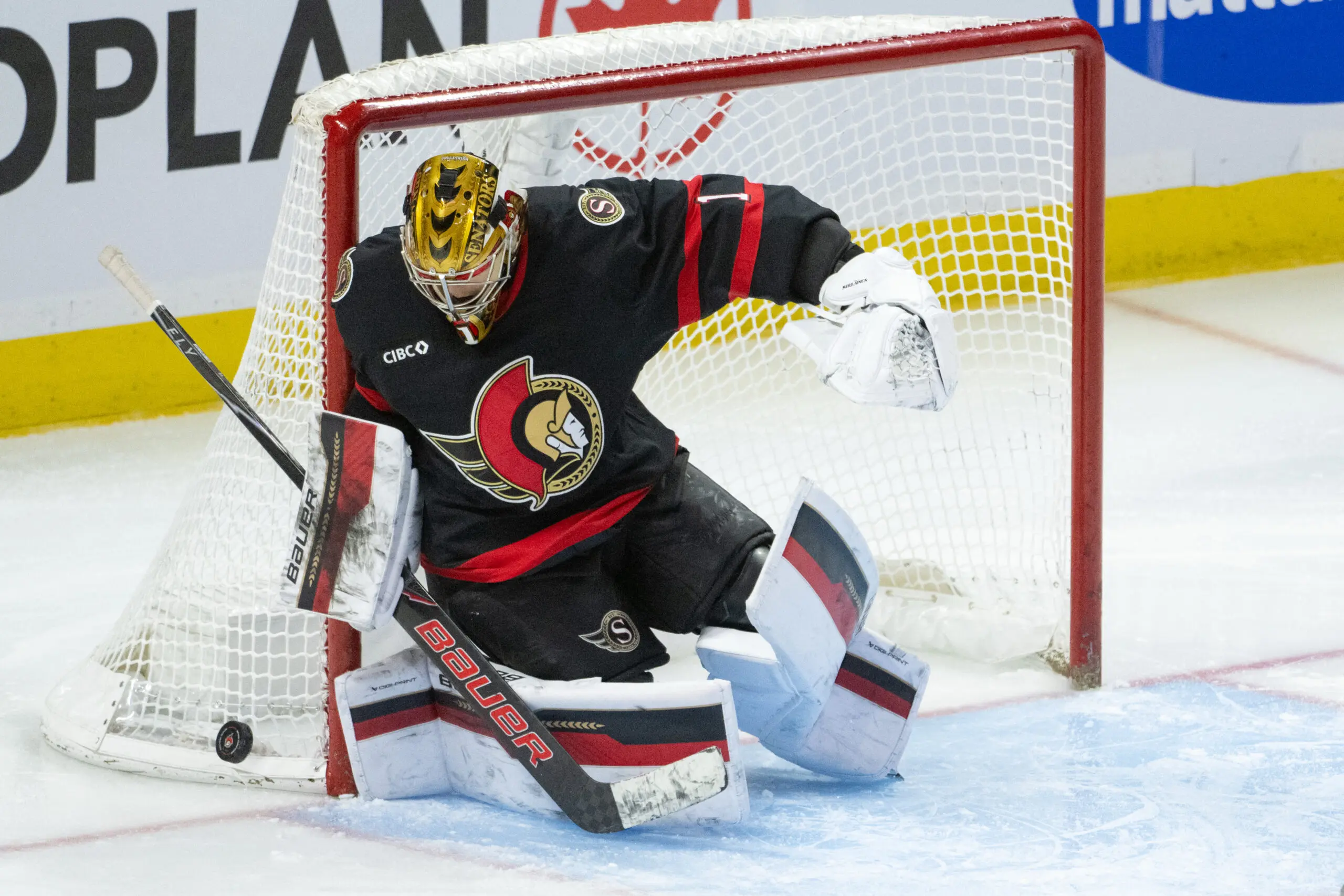
Photo credit: Marc DesRosiers-IMAGN Images

Sep 27, 2026, 12:00 EDTUpdated: Sep 27, 2026, 00:58 EDT


Leevi Meriläinen is at a major crossroads in his NHL career.
After a heroic start with the Ottawa Senators three years ago, his stock fell enough in the nation’s capital for him to end up on the waiver wire, and the Vancouver Canucks claimed him on Friday. But this moment could end up being the best possible thing to happen to the 24-year-old goaltender.
The Canucks’ decision to claim Meriläinen came as little surprise. With Thatcher Demko’s status still a mystery and Nikita Tolopilo unable to impress in his pair of preseason outings, claiming an extra goaltender made sense. And Meriläinen has shown flashes of a goaltender who can not just meet NHL standards, but exceed them.
In his first stint with the Senators, he started 11 games and won eight, posting a .925 save percentage. But last season Meriläinen hit a speed bump, winning just eight of 19 starts as his save percentage dropped to an .860. The Sens quickly lost faith, giving his backup spot to offseason acquisition Sam Ersson and attempting to return him to the minors.
Vancouver believes they’re getting a diamond in the rough whose first NHL stint was more indicative of his overall skill set. So what are the Canucks getting in Meriläinen?
Watching Meriläinen play, his upright stance looks well in line with all the goaltenders in the Canucks’ system already. Meriläinen also has a more selective approach to the Reverse VH, saving it for close plays instead of over-relying on it to seal off the post on any sharp angle. It’s a pitfall that a lot of young goalies fall into, but he’s managed to avoid it.
But that doesn’t mean he doesn’t use RVH when it’s called for, like on this Brock Boeser shot.
A fundamental difference in his play compared to peers like Lankinen and Demko is just how aggressively he challenges out of the crease. It’s not unusual to see Meriläinen squaring up to a shooter entering the zone near the faceoff circles.
His 6-foot-2 length allows him the ability to track back into the blue paint with one push, but sometimes that aggressiveness can cost him precious seconds between a save and a goal, like on this two-on-one against the Sabres.
The Canucks absolutely don’t want to eliminate what’s gotten Meriläinen to the big leagues in the first place. But they might fine-tune this aspect of his style and attempt to tether him a little closer to the crease, shaving down those extra moments spent tracking back to the blue paint.
Where Meriläinen is less aggressive is with his goal stick. Consider this in-close play from earlier this week against the Leafs, where a well-timed poke check could’ve made a difference in the puck ending up behind him. It’s a pattern I’ve noticed rather consistently in similar situations, where his stick is simply there to take away the five-hole rather than provide any additional deterrents for shooters on the doorstep.
Talking with Sportsnet’s Iain Macintyre, longtime friend and new teammate Aatu Räty mentioned his “really good glove”, and Räty’s onto something. Meriläinen shows a wicked read and reaction here against the Bruins’ Matthew Poitras.
If there’s a fault to find in Meriläinen’s game, he struggles most on shots through traffic, in some cases looking unaware of where the puck is until it’s too late. In spots where he tends to get more compact looking through skaters, the Canucks might suggest he’ll find more success standing up taller and looking over the players in his way.
Fundamentally speaking, there’s little wrong with how Meriläinen plays when he’s at his best. But as is often the case with goaltenders, a cold stretch can snowball into a lack of personal confidence, and that seems to have made the biggest difference for him in the last calendar year. In the earlier Toronto clip, Meriläinen ends up on his behind as the Leafs attempt to jam the puck in. That implies that when a goalie is playing back on their heels rather than forward onto their toes, it is one of the clearest indicators of a netminder fighting the puck.
There’s also the “quiet feet” indicator to consider. A goalie playing with confidence is moving with purpose and fluidity. Compare that to Meriläinen’s last preseason start, when his feet were making micro-adjustments at any given moment.
What Meriläinen simply needs is some refinement and renewed faith in his toolkit. On a Canucks team focused fully on the future, Meriläinen will get all the runway he needs to recapture his best form and build on it. And if the Canucks’ track record with developing goalies is any indicator, the move out West could be a crucial turning point in Meriläinen’s NHL longevity.
The Future is Daily Faceoff Vancouver

The future of hockey coverage is bigger than one team, one market, or one platform. By bringing our local hockey brands together under Daily Faceoff, we’re creating a more complete hockey experience — one that gives fans the best of local passion and league-wide expertise, all in one place. The community remains at the centre. The experience is simply expanding as part of the next evolution of how we cover the game.
Welcome to Daily Faceoff Vancouver – Driven by hockey.


Recent articles from Lachlan Irvine
Breaking News
- Vancouver Canucks practice in Tampa Bay; Abbotsford signs defenceman to PTO
- Why did Canucks fans rate Aatu Räty higher than the rest of the league?
- What the Canucks are getting in new trade acquisitions Jacob Quillan and Brandon Buhr
- The Statsies: Tom Willander leads Canucks in xGF in overtime loss to Panthers
- The Stanchies: Brady Tkachuk’s natural hat trick extends Canucks losing streak to 6 in OT loss to Panthers

Vancouver CanucksTeam Cap Summary

Cap Summary
2026-27
2027-28
Projected Cap Hit
$87,295,050
$71,329,167
Projected Cap Space
$16,704,950
$42,170,833
Current Cap Space
$18,309,380
$42,170,833
Active Players
23/23
13/23
Draft Picks
Round
'27
'28
1
1
1
2
2
2
3
1
1