
CanucksArmy has no direct affiliation to the Vancouver Canucks, Canucks Sports & Entertainment, NHL, or NHLPA
Charting the Development of the Canucks Top Defense Prospects


By money puck
Jun 5, 2015, 14:18 EDTUpdated:


If you’ve been following along at Canucks Army (or our friends at Jets Nation) you may have noticed a number of posts recently on two new metrics we’ve developed to help assess prospect development called Prospect Cohort Success % (PCS%) and PCS points per game (PCS p/GM). For primer on these new stats see the piece Josh Weissbock published recently.
The PCS system finds the closest matches for a particular player in terms of age, league, height, and points, then calculates the percentage of that player’s peers who play over 200 NHL games (PCS%) and the NHL points per game of those peers who successfully made the NHL (PCS p/GM). Think of PCS% as a metric to estimate the risk a prospect may or may not become an NHL regular, while PCS p/GM gives you a sense as to what the players potential may be if they make it.
Last week, I profiled the Canucks top forward prospects, so now I’ll look at the top prospects on defense.
Short Term Development Goal – NHL Regular
Frank Corrado – Utica (AHL)

Corrado has been a key cog on the Comets backend this season, and didn’t look out of place in his 10 games with the Canucks this year. He’s been impressive throughout this Calder Cup run, despite logging big minutes on his weak side. His PCS% has improved significantly the past two seasons, since establishing him as a top-four defensemen on one of the AHL’s best teams. It’s time for the Canucks to see what Corrado can provide at the NHL level, but that could prove to be a challenge with 5 NHL defensemen currently under contract for next season and a glut of right-handers in the system.
Adam Clendening – Utica (AHL)/Vancouver (NHL)

The Canucks acquired Clendening mid season for 2014 Canucks draftee, Gustav Forsling. His PCS% has steadily improved each year, and he played well in 17 games for the Canucks this year. Like Corrado, Clendening will be in tough trying to earn a spot on the Canucks, but it does look like there’s a pretty good chance Benning found a future NHL defender.
Andrey Pedan – Utica (AHL)
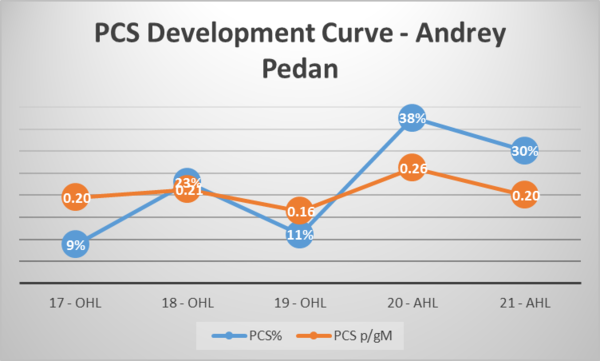
Pedan doesn’t have the same offensive upside as Clendening, but in securing his position, but establishing himself as an AHL regular at his age shows promise which is reflected in his PCS%. Like Clendening and Corrado, the focus for Pedan will be to push for NHL minutes this year.
Short Term Development Goal – AHL Regular
Jordan Subban – Belleville (OHL)
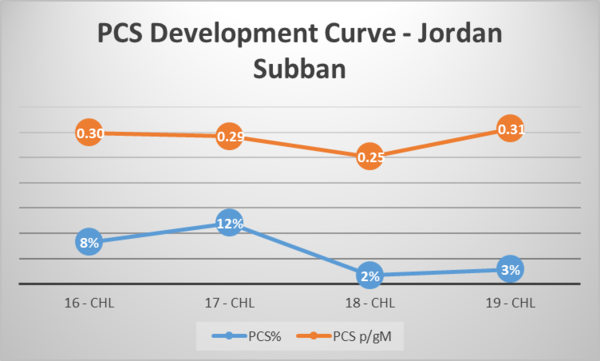
Subban’s 19 year old OHL season was impressive, with him leading Belleville Bulls in both goals and points, and was the highest ranked defender in the OHL.
His PCS% numbers raise a legitimate concern though, as there have been very few 5’9 defensemen who have ever gone on to successful careers in the NHL. That being said, those that have made it have been quite successful and effective.
Ben Hutton – Maine (NCAA)
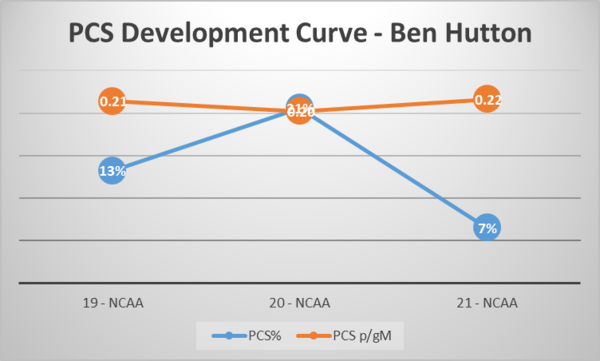
Hutton signed his entry level contract with the Canucks back in March, luring him away from Maine, where he had been the team’s highest scoring defensemen for the past three seasons. His scoring dipped from 0.82 pts/GM in his 20 year-old season to 0.53 pts/GM in his 21 year-old season, which is driving the dip in PCS% this season. After a recent stint in Utica, Hutton was sent home for offseason training. His next goal should be to establish himself as an AHL regular.
Evan McEneny – Kingston (OHL)
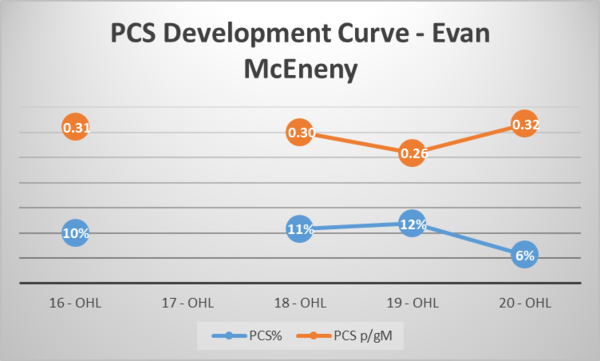
Similar to Subban, McEneny was the highest scoring defensemen on a very low scoring team, so part of his 6% PCS% should probably be attributed to team effects. That said, he’s shown offensive capabilities each season, contributing to 24% of the Frontenacs total points, which is ranks him within the top 10 of OHL defensemen in that category.
Short Term Development Goal – ECHL Regular
Mackenze Stewart – Prince Albert (WHL)

Only 6% of Stewart’s close comparables have played over 200 NHL games, but those who did make it only average 11 points per 82 game seasons. He’s a long-shot with a low ceiling. The Canucks will try converting Stewart to a winger, so I’d expect he’ll likely spend much of next year in the ECHL.
Anton Cederholm – Portland (WHL)

Like Stewart, Cederholm appears to be a long-shot with low upside. According to chlstats.com, Cederholm led Winterhawk defenders in ice time, but only managed 19 points on what was one of the highest scoring teams in the WHL last year.
Ashton Sautner – Edmonton (WHL)
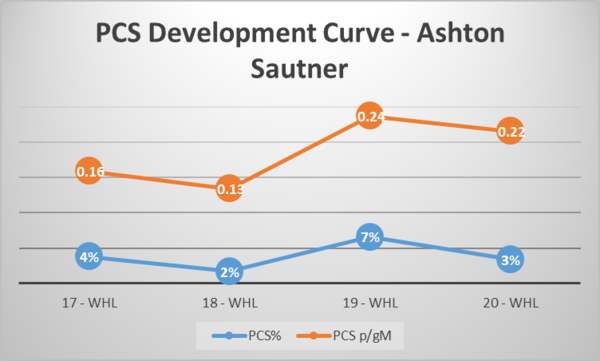
Like McEneny and Subban, Sautner was the highest scoring defensemen, on a team that really struggled to score last year, which is reflected in his low PCS%. According to CHLStats.com, he led Oil King defenders in TOI, and was in the WHL’s top 10 in terms of team point percentage, at 23.72%. Establishing himself at an ECHL regular is a reasonable expectation for Sautner for next year.
Conclusion
There are a number of limitations with the model in its current form, and in future iterations we plan to address important factors such as scoring in different eras, quality of team and linemates, shooting percentage regression, and primary to secondary assists.
While there is clearly a lot of refinement required to the PCS model, especially taking into account quality of teammates in the examples of Sautner, Subban, and McEneny, we see these curves as a useful tool in helping to visualize prospect development over time.


Breaking News
- Ex-Canucks defenceman Derek Forbort signs AHL PTO with Calgary Wranglers
- Scenes from morning skate: Canucks rolling with winning lineup for home-opening rematch vs. Oilers
- The Canucks are a rebuilding team without a rookie on the roster…is this a problem?
- Brock Boeser has a chance to become something even bigger than a Canucks star
- WDYTT: Make a random prediction about the 2026-27 Vancouver Canucks season

Vancouver CanucksTeam Cap Summary

Cap Summary
2026-27
2027-28
Projected Cap Hit
$88,074,947
$71,329,167
Projected Cap Space
$15,925,053
$42,170,833
Current Cap Space
$16,007,566
$42,170,833
Active Players
23/23
13/23
Draft Picks
Round
'27
'28
1
1
1
2
2
2
3
1
1