
CanucksArmy has no direct affiliation to the Vancouver Canucks, Canucks Sports & Entertainment, NHL, or NHLPA
CanucksArmy’s complete midseason ranking of the Canucks’ top 15 prospects
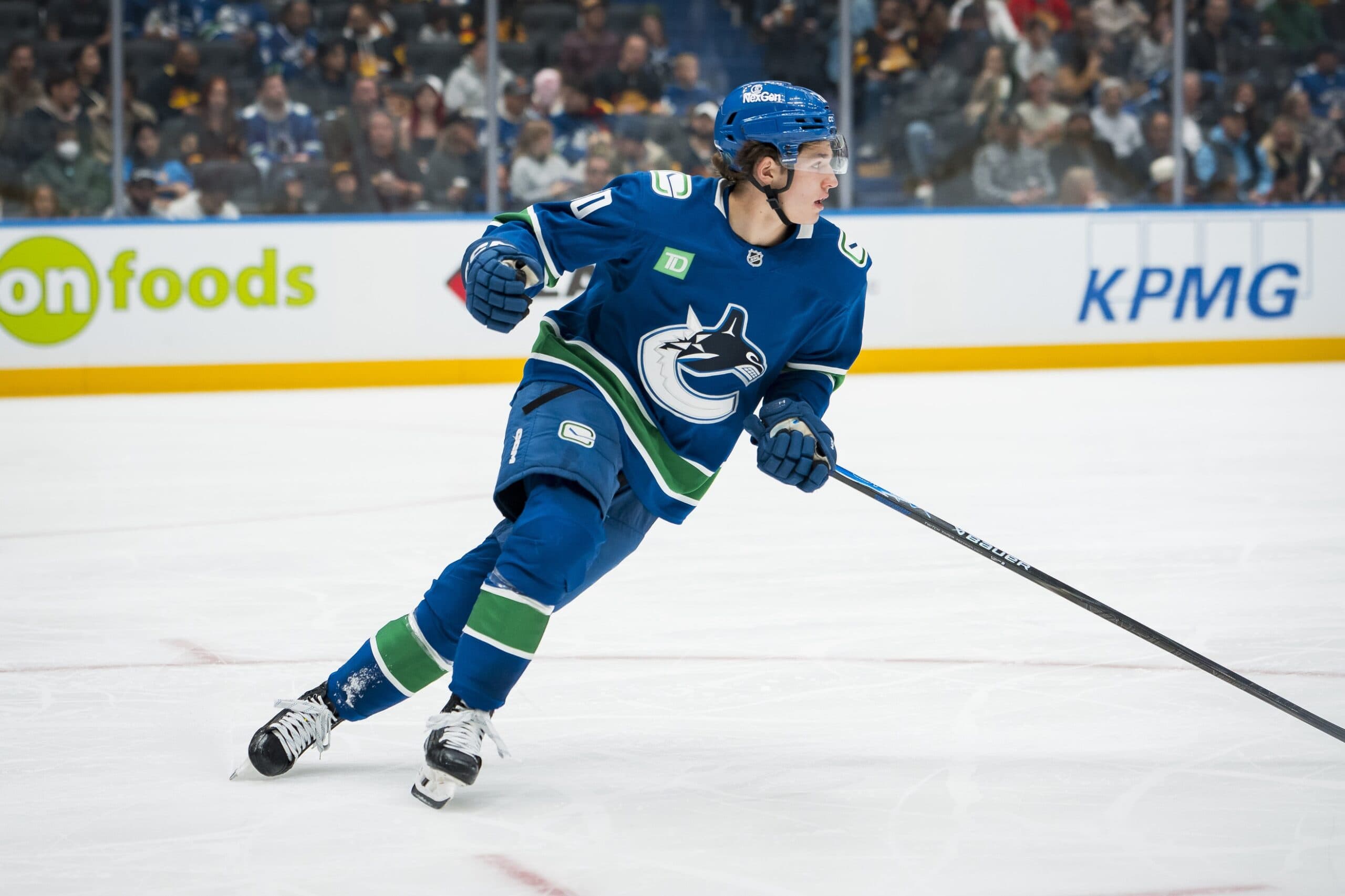
Photo credit: © Bob Frid-Imagn Images

Feb 23, 2026, 16:00 ESTUpdated: Feb 23, 2026, 15:50 EST


On Friday, CanucksArmy’s prospect expert Dave Hall put the finishing touches on our midseason countdown of the top 15 prospects in the Vancouver Canucks‘ organization. Unsurprisingly, 2025 15th overall pick Braeden Cootes came in as the number one prospect, as players like Tom Willander, Elias Pettersson, and Jonathan Lekkerimäki have all played too many NHL games to be considered “prospects”.
To qualify for our rankings at CanucksArmy, a prospect must:
- Be under the age of 25
- Have played fewer than 25 NHL games (regular season + playoffs).
With that in mind, let’s take a look at Dave’s complete list, with an excerpt from each!
15 – Parker Alcos
Considered a mobile defender with an encouraging 6-foot-4 frame, there have always been elements in Alcos’ game that brought intrigue. He moves the puck efficiently out of his own end, can be used as a go-to penalty killer, and shoots from the premium side. Those traits alone give him a baseline profile and projection worth tracking. At his core, Alcos projects best as a shutdown-leaning defender. He thrives through fluid footwork and an active stick and long reach, allowing him to play tight gaps and limit space through the neutral zone. Despite his tall frame, he’s not a punishing presence at the net front and doesn’t regularly overpower opponents physically. One area that stands out positively is his transition game. Using above-average mobility, Alcos is comfortable carrying the puck to initiate breakouts, but he’s equally effective making quick, composed outlets under pressure. He plays with his head up, scans well, and rarely panics when forechecked. Read the full write up here!
14 – Wilson Björck
If you’ve ever heard the term “honey badger” thrown around in hockey circles, Björck fits it to a tee. His motor never stops. Despite sitting on the lighter side of the scale, he attacks traffic with little hesitation, darts into dirty areas, and makes nights a constant headache for his opposition. Watching his shifts, you get the sense that he’s more than likely one of the opponent’s most hated opponents for the simple fact that he just won’t go away. So why does he land at No. 14? The answer lies less in effort and more in projection. Björck carries a lighter frame and is already 20 years old as a re-entry draft pick. While he earned a spot at Sweden’s World Junior camp, he wasn’t able to crack the final roster despite being the oldest player in the mix. The tools are there, but the question now is how effectively they translate as the competition stiffens. Read more here!
13- Basile Sansonnens
He isn’t flawless, as he can occasionally pull himself out of structure in an effort to separate his man from the puck, but more often than not, the result is still positive. The appeal here is straightforward, and there really isn’t much to think about. Nearly all of his impact comes in the defensive zone, and he’s a defensive defenceman through and through. If there were even a modest ability to consistently move pucks or generate offence, he’d likely be ranked considerably higher. His physical tools already appear AHL-ready. The question is whether the puck skills and the limits in his game can keep up and allow him to be effective. The hope is that decision-making can be refined enough to earn him opportunities in North America, and he can fall back on being a brute in penalty killing and defensive situations. Read more by clicking here!
12 – Gabe Chiarot
The offensive profile is modest and unlikely to be highly projectable as a high-pedigree producer. What is translatable, however, is the way he plays and the attitude he brings toward the game. Chiarot brings an honest, abrasive style that keeps him involved even when the puck isn’t finding him. It’s the type of game that can influence the game in many more ways than his numbers may suggest. After showing encouraging early-season production with the Brampton Steelheads, a trade-deadline move to the Kitchener Rangers has hindered his overall point totals. Even with the dip, Chiarot remains on pace to set new career highs, sitting at 30 points through 47 games in his third OHL season. Read the full write-up by clicking here.
11 – Kieren Dervin
At his core, Dervin profiles as a versatile, two-way forward capable of contributing in all situations. He’s trusted in the defensive zone, used on the penalty kill, and sees time as a bumper option on the power play. Averaging just over 19 minutes per night, he has quickly become one of Kingston’s most relied-upon forwards despite playing in his first true season in the OHL. Dervin currently sits second on the Frontenacs in scoring with 30 points in 39 games, despite missing nearly a full month with an upper-body injury. Kingston has struggled to generate offence as a team, ranking among the bottom five in goals scored league-wide. In that environment, Dervin’s ability to produce at age 18 holds a little more weight than the raw totals suggest. The full report can be found here.
10 – Aku Koskenvuo
After officially signing his entry-level contract last spring, the Finnish netminder finally received his opportunity to establish himself in pro hockey. He opened the 2025-26 season in Kalamazoo, splitting his first two starts with a win and a loss, before the goalie carousel within the Vancouver system benefited his usage. That movement quickly landed him in Abbotsford, where he picked up a win in his AHL debut. What stands out most is how quickly he’s earned trust. He doesn’t appear to give out a ton of rebounds, his post play is stabilized, and he looks increasingly composed when sequences break down. He shows a calmness that mirrors what we’ve seen from Nikita Tolopilo at the same level. Read the full report here!
9 – Ty Young
Young fits the exact mould of goaltenders teams target with Ian Clark’s influence: big, mobile, technically sound. He naturally seals the lower portion of the net well and has already shown improvement in crease movement and post integration, all of which are traits that remain translatable regardless of short-term results. That underlying skill set is why his long-term outlook hasn’t cratered, even as the sophomore season hasn’t been met with flowers. Read the full report here.
8 – Anthony Romani
On a stacked Michigan State roster, Romani has spent much of the season in a supporting role. Outside of a brief two-game stretch during the holiday break — when several teammates were away at the World Juniors — he has been glued to the team’s third line while seeing secondary power-play time. In that short window, however, Romani was given over 20 minutes per night and responded, posting four points (two goals, two assists) in two games. His defining trait has remained consistent across every level: an elite release. Romani is a pure shooter. Whether it’s a catch-and-release opportunity or a curl-and-drag that buys him space, he beats goaltenders with precision and deception. His ability to slow the game down and make subtle reads allows his shot to play up, particularly on the rush, where much of his damage comes from. His shot and offensive awareness both translate to the professional game. The full report can be found by clicking here!
7 – Vilmer Alriksson
let’s just bring up the elephant in the room here: he’s on pace for roughly 14 points, and some will label his rookie campaign as underwhelming. But context does matter here. Abbotsford has not exactly been an offensive engine this season. With the team’s leading scorer sitting at just 23 points, there simply isn’t enough production to go around as the league’s third-lowest goal-scoring team. Outside of Jonathan Lekkerimäki, offence has been scarce across the board. Despite being just 20 years old, Alriksson has seen solid usage, including stints on the top line and consistent time at the net front on the power play. Injuries and call-ups have certainly created openings, but he worked his way into those roles and has not looked out of place. The full report can be found here.
6 – Ty Mueller
Since arriving in 2024–25, Mueller has quietly become one of the most dependable players in the organization’s system. And that has very little to do with point totals. After all, it wasn’t by accident that he took home Abbotsford’s “Unsung Hero” Award during their Calder Cup Championship season last year. Coaches just tend to trust and lean on him. If you’re searching for a stylistic comparison, Pius Suter is a reasonable template. Mueller doesn’t dominate games with flash or gaudy numbers, but he impacts them everywhere. Read the full write-up here.
5 – Riley Patterson
Through just 46 games, Patterson has already blown past his previous career highs, sitting at 31 goals and 69 points and pushing over a 90-point pace. That’s not just team-leading production, but league-relevant production. Despite playing in fewer games than anyone above him, he is currently sixth among OHL scorers and just seven points from the top. That production has now boosted him over a point-per-game (1.07) throughout his 178 OHL career. It’s not just the sheer point totals that are impressive, either. It’s how he’s doing it that makes his season so interesting. The offence isn’t inflated by power-play padding. In fact, only 18 of his points have come with the man advantage. The bulk of his damage is happening at even strength, which matters far more when projecting to the pro game. Read the full report by clicking here!
4 – Sawyer Mynio
The five-on-five production hasn’t yet translated the way it did in junior, but that was to be expected. The pace is quicker, the windows are tighter, and the time and space evaporate at the pro level. But the tools are there. His vision from the blue line is sound. He walks the line confidently. His shot remains one of his top offensive assets. And most importantly for his game, his skating is a strong point. Ironically, it seemed his original focal point, and the reason the Canucks drafted him, was more for his defensive reliability and penalty-killing acumen. Over time, it’s the offensive elements that have become more prominent in his game. But it’s not as if he’s a slouch in that department. Although he hasn’t been used much on the PK as of late, we tie it to him playing heavy minutes at the other strengths. We expect him to be a prominent participant for both special teams as he matures and gets stronger. Read the full write-up here!
3 – Kirill Kudryavtsev
Last spring, during Abbotsford’s Calder Cup Championship run, Kudryavtsev quietly established himself as one of the team’s most important players. He finished tied for third among defencemen in playoff scoring with 10 points and led the entire AHL postseason field at plus–18. More impressively, he was on the ice for just three five-on-five goals against over 21 playoff games while playing legitimate top-four minutes. Despite standing 5’11″, he carries a strong, compact frame at over 200 pounds. He’s not a bruiser, and he’s not running people through the glass. But his defensive game is built on disruption, and his stick work is elite at this level. Using an incredibly active stick, he times his swipes perfectly and closes lanes early to force hesitation. Whether it’s knocking pucks off sticks in transition, blocking pucks out of play or breaking up cycles with subtle positioning, he consistently makes plays die from a simple stick play. Read the full write-up here!
2 – Aleksei Medvedev
Medvedev is extremely athletic for a 6’3 goaltender. He uses his long frame and flexibility to recover on second chances and make highlight-level saves that most assume to be a finished deal. His lateral pushes are explosive, and his ability to seal the lower portion of the net is impressive. Aleksei Medvedev deserves to be in the discussion as one of the Canucks’ top prospects, and although his season has taken a bit of a tough stretch, his tools and upside are still very legitimate and projectable. Read the full write-up here!
1 – Braeden Cootes
What separates Cootes from many prospects with similar statistical profiles is not merely his point production, but the consistency of his impact. We often talk about a “B game,” and this kid brings that in spades. He is relentless on the forecheck, constantly pressuring puck carriers and forcing turnovers that don’t always translate directly to the scoresheet, but do frequently tilt the possession balance. His ability to recover pucks in contested areas stands out even among high-end junior forwards. There are repeated instances in which opposing players appear poised to exit their zone cleanly, only for Cootes to close the gap from behind, establish body position, and regain control. He’s an opponent’s nightmare. Read the full report here!
Honourable mentions: Lansing, Gardner, Perkins, Klimovich, Ravinskis, Stillman, Bloom, Celebrini, Safonov.
Sponsored by bet365


Breaking News
- 3 Canucks Stars of the Week: Jonathan Lekkerimäki a bright spot amid losing streak
- Abbotsford Weekly: Hats fly for newcomer Jacob Quillan as Canucks sweep Wranglers
- Scenes from practice: Malhotra hauls out line blender in attempt to help Canucks snap 10-game losing skid
- Canucks’ Jack Thompson clears NHL waivers, will report to AHL Abbotsford
- JPat’s Monday Mailbag: Canucks chemistry lessons, a hot dog feast and press box bingo

Vancouver CanucksTeam Cap Summary

Cap Summary
2026-27
2027-28
Projected Cap Hit
$87,295,050
$71,329,167
Projected Cap Space
$16,704,950
$42,170,833
Current Cap Space
$19,405,750
$42,170,833
Active Players
23/23
13/23
Draft Picks
Round
'27
'28
1
1
1
2
2
2
3
1
1