
CanucksArmy has no direct affiliation to the Vancouver Canucks, Canucks Sports & Entertainment, NHL, or NHLPA
CA’s top 15 Canucks mid-season prospect rankings: #5 Riley Patterson
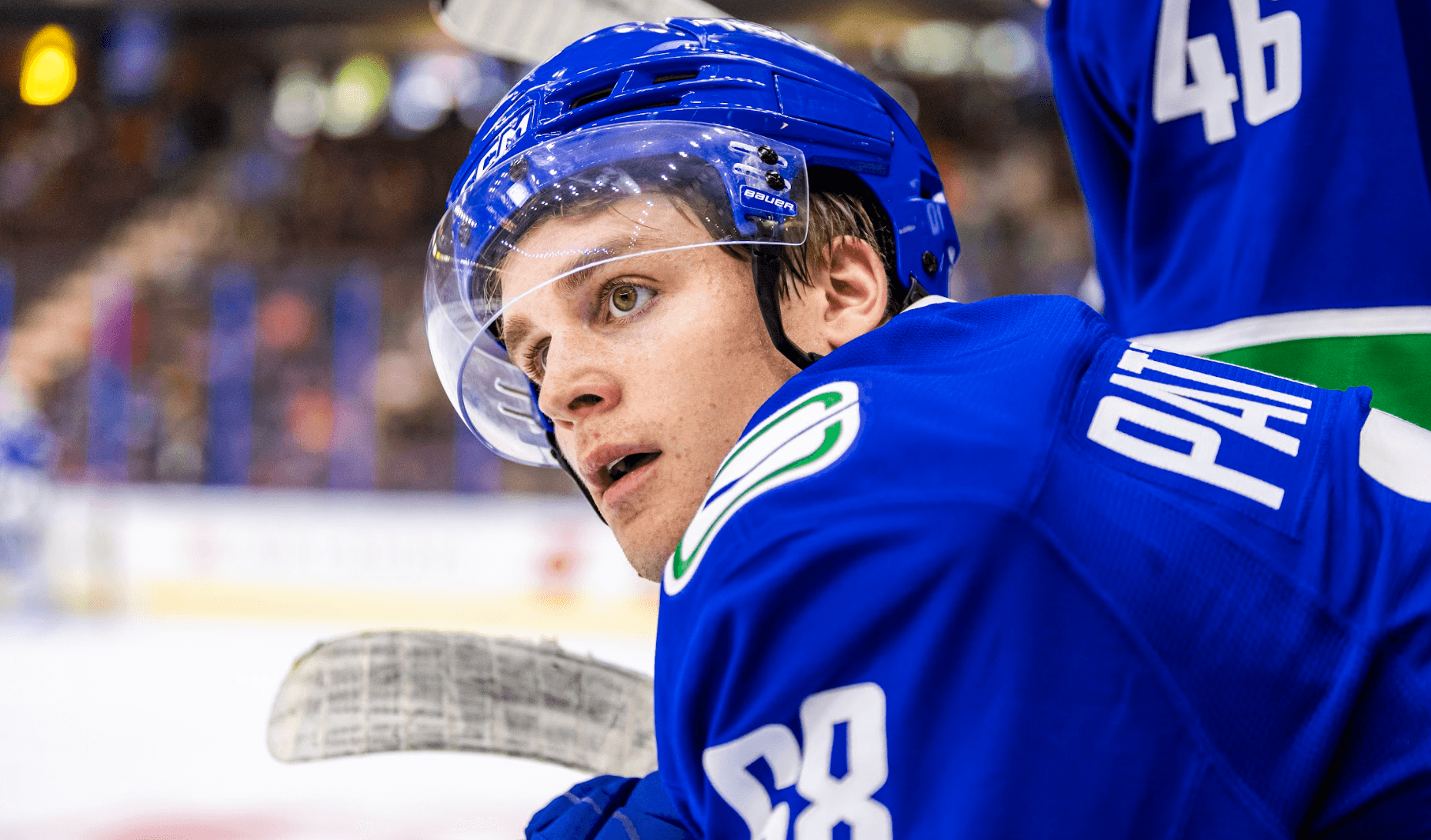
Photo credit: © Tav Morisson-CanucksArmy


We continue on with our 2026 mid-season Vancouver Canucks prospect rankings here at CanucksArmy.
Today, we bring you the system’s highest scorer, who has thrived in a new role in the Ontario Hockey League. If you’re looking for a refresher on our ranking criteria, be sure to check out our Honourable Mentions installment before diving in.
Riley Patterson
Team: Niagara IceDogs (OHL) | Age: 19 | Position: Centre/Wing | Height: 6’1| Weight: 192 lbs | Shoots: Right | Drafted: Fourth round, 125 overall, 2024 | Summer rank: 12
The move from Barrie to the Niagara IceDogs has benefited Riley Patterson in many ways. So much so that he jumps all the way to our fifth-ranked prospect as the system’s top point producer.
Naturally, higher expectations are going to be set on a 19-year-old prospect who has exploded in the junior ranks. And now, we’re forced to ask a legitimate question: are we looking at a fourth-round gem quietly climbing the system, or a junior scorer benefitting from the perfect environment?
Because the point production is absolutely real.
Through just 46 games, Patterson has already blown past his previous career highs, sitting at 31 goals and 69 points and pushing over a 90-point pace. That’s not just team-leading production, but league-relevant production. Despite playing in fewer games than anyone above him, he is currently sixth among OHL scorers and just seven points from the top. That production has now boosted him over a point-per-game (1.07) throughout his 178 OHL career.
It’s not just the sheer point totals that are impressive, either. It’s how he’s doing it that makes his season so interesting. The offence isn’t inflated by power-play padding. In fact, only 18 of his points have come with the man advantage. The bulk of his damage is happening at even strength, which matters far more when projecting to the pro game.
His heavy and accurate shot remains his true calling card. But he’s also shown the ability to provide in a variety of ways — off the rush, curling into space, one-timing from the flank, or cleaning up around the net with soft hands in tight. It’s a mixed bag of production, which has led to a compelling and busy shot chart.
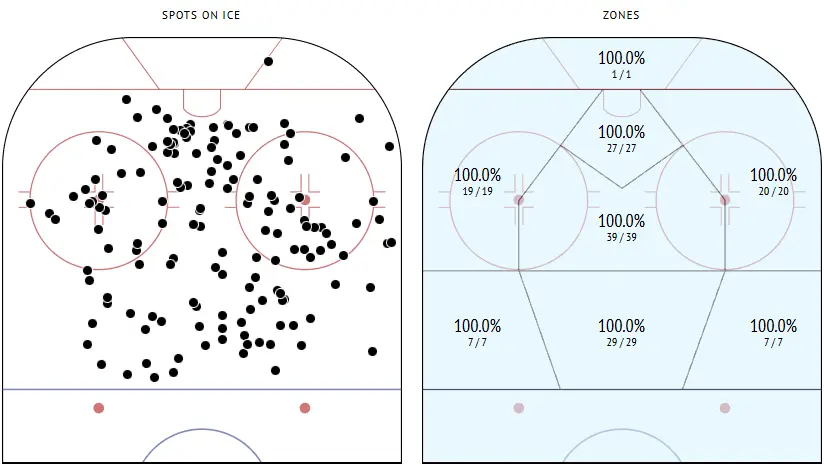
Charts courtesy of InStat Hockey.
We’ve been impressed with his IQ and play-driving flashes, too. He doesn’t play a pacey game with the puck on his stick, but he slows things down and uses crafty hands and cerebral play to make things happen. He reads plays well and quickly finds the open seams, providing quick-touch passes to the open man. Impressively, 24 of his 38 assists have been primary.
So what’s been the biggest change? Aside from just your typical year-over-year growth, has anything been different with his season? Well, the big change that has benefited his game is his move to the middle. While he had seen stints throughout his OHL career in past seasons, he’s now moved to the middle on a full-time basis. This year, he’s taking draws in every zone and winning just over 52 percent of them. Given the current state of the Vancouver Canucks’ centre depth, that should be music to the ears of fans.
Another benefit of that switch has been his usage. Jumping from around 18 minutes last season with the Barrie Colts, Patterson is now averaging north of 23 minutes per game. He’s playing in every scenario imaginable, is their leading penalty killer and has been relied on heavily this season as a go-to player on a middling Niagara team.
The contextual layer also matters. As most will know by now, the OHL environment has shifted. More high-end talent is heading to the NCAA, and the league is not what it was, even by last season’s standards. That doesn’t invalidate what Patterson is doing, but it adds nuance. So, is he dominating because he’s taken a leap, or because the talent curve has flattened? The answer is probably somewhere in between.
In previous seasons, there were stretches when his defensive engagement wavered. He could cheat for offence or disengage when plays moved away from him. This year, we find him to be more dialled in and appear more involved, which likely happens from the simple move to the middle. He’s supporting lower in the zone and getting back into structure quicker.
Is it finished? No. There are still moments where the defensive intensity fades, and he doesn’t consistently impose himself physically, despite carrying nearly 200 pounds on a solid frame. One-on-one battles at the next level will be a good measuring stick.
His skating is not particularly explosive, either. His skating isn’t a negative by any means, and he can build speed through the neutral zone and even beat flatfooted defenders outright, but he doesn’t separate at an elite level. At the NHL pace, space disappears quickly. If he can’t consistently create separation, he’ll have to win with timing and anticipation rather than pure speed.
But overall, the trend is encouraging and upward.
What truly elevates his stock in this Canucks system is the combination of skill and opportunity. Vancouver doesn’t have a surplus of offensive centre prospects pushing through, and Patterson has inserted himself into that conversation. The offensive mind is there. The shot is NHL-calibre. The question is whether the rest of the toolkit rounds into something that can handle pro pressure.
For a fourth-round pick, this is already a win in terms of development trajectory. Now, we enjoy what we hope will be a solid spring run in Niagara, followed by a likely move to the next chapter.
Projection
Ceiling: A middle-six scoring forward with power play potential. Whether that’s ultimately at centre or on the wing remains to be seen, but the offensive tools and instincts suggest legitimate NHL upside.
Floor: An AHL scorer. At the very least, he represents solid depth for this Canucks system and should provide a middle-six future in Abbotsford.
ETA: Already signed to his entry-level contract, Patterson’s NCAA option is off the table. With his 20th birthday approaching, he has likely proven what he can at the OHL level. The expectation is a full AHL season next year, with the possibility of moving toward NHL consideration within two seasons if the transition goes smoothly.
- #15 – Parker Alcos
- #14 – Wilson Björck
- #13 – Basile Sansonnens
- #12 – Gabriel Chiarot
- #11 – Kieren Dervin
- #10 – Aku Koskenvuo
- #9 – Ty Young
- #8 – Anthony Romani
- #7 – Vilmer Alriksson
- #6 – Ty Mueller
That’s our #5 spot. Stay tuned for another installment later today here at CanucksArmy.
PRESENTED BY PACIFIC BLUE CROSS
Win the Ultimate #Canucks Road Trip! Get* Pacific Blue Cross Travel Insurance for your chance to see the Canucks take on the Kings in Los Angeles – complete with flights, hotel, lower-bowl tickets, and more!
*No purchase necessary. Contest ends February 28, 2026.
ENTER NOW | pac.bluecross.ca/canucks
*No purchase necessary. Contest ends February 28, 2026.
ENTER NOW | pac.bluecross.ca/canucks



Breaking News
- Canucks Game Day: Looking to close out lengthy road trip with a win vs. Lightning
- Vancouver Canucks practice in Tampa Bay; Abbotsford signs defenceman to PTO
- Why did Canucks fans rate Aatu Räty higher than the rest of the league?
- What the Canucks are getting in new trade acquisitions Jacob Quillan and Brandon Buhr
- The Statsies: Tom Willander leads Canucks in xGF in overtime loss to Panthers

Vancouver CanucksTeam Cap Summary

Cap Summary
2026-27
2027-28
Projected Cap Hit
$87,295,050
$71,329,167
Projected Cap Space
$16,704,950
$42,170,833
Current Cap Space
$18,309,380
$42,170,833
Active Players
23/23
13/23
Draft Picks
Round
'27
'28
1
1
1
2
2
2
3
1
1