
CanucksArmy has no direct affiliation to the Vancouver Canucks, Canucks Sports & Entertainment, NHL, or NHLPA
31 days, 31 questions: What should the Canucks feel good about heading into 2026-27?
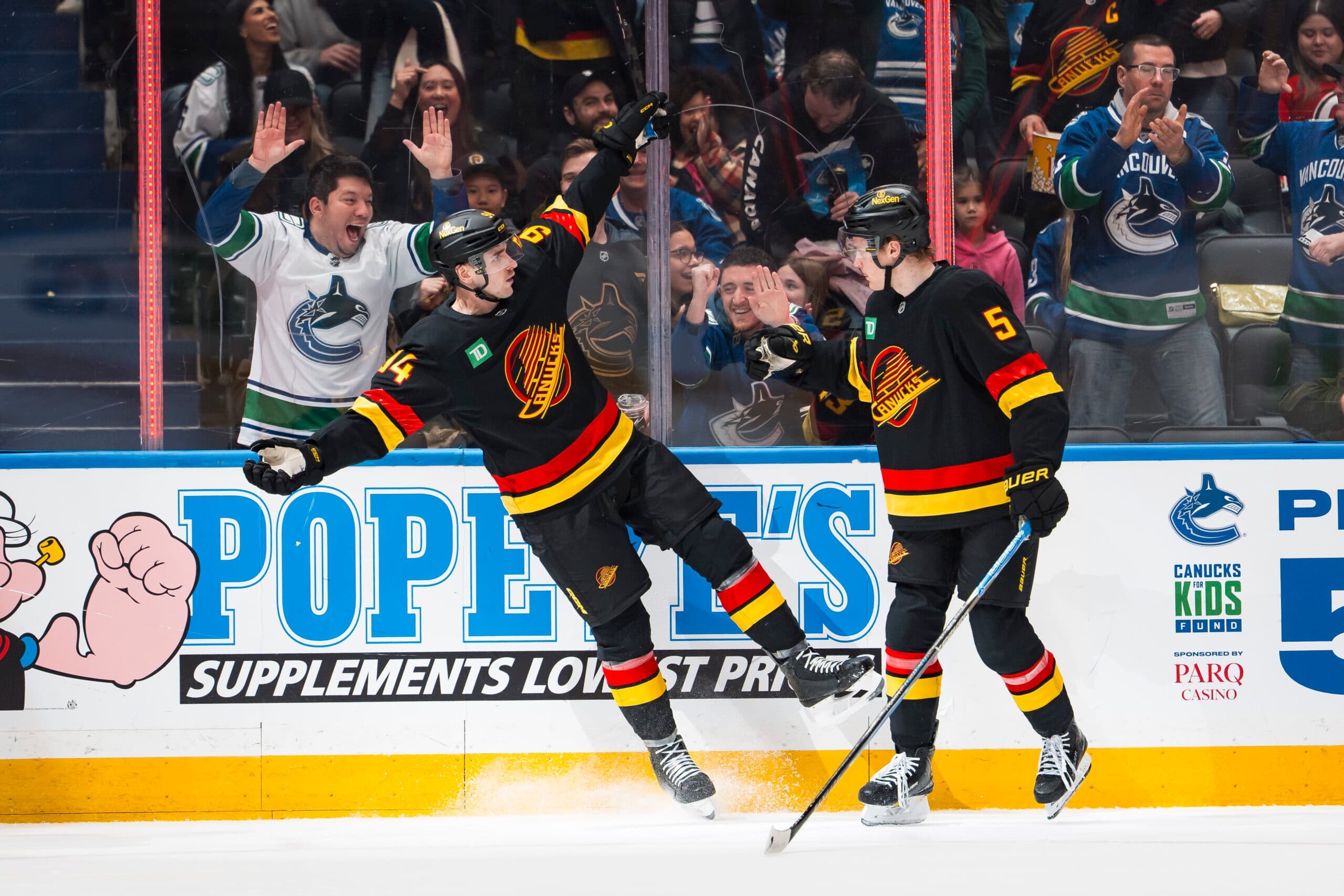
Photo credit: © Bob Frid-Imagn Images

Aug 22, 2026, 14:00 EDTUpdated: Aug 21, 2026, 18:41 EDT


Welcome to a new series here at CanucksArmy, where over the month of August we’ll ask a new question each day about the Vancouver Canucks. We’re calling it “31 days, 31 questions”. Today, we’re looking into what the Canucks should feel good about heading into next season.
When the curtain closed on the Vancouver Canucks’ 2025-26 season, there was rightfully not much to celebrate.
The captain was traded in December, the head coach and general manager were immediately replaced, and several veterans followed Quinn Hughes out the door after a 25-49-8 season that landed them at the bottom of the NHL standings.
There are obviously still holes on the roster heading into 2026-27, but for a team at the beginning of a rebuild, progress will not always show up in clear, measurable ways. It can come through young players gaining experience, management keeping its options open, and finding organizational pieces worth carrying into the future.
Based on those fronts, the Canucks have a handful of reasons for optimism in 2026-27:
Finally, a clear direction
Daniel and Henrik Sedin now hold full autonomy over hockey operations as co-presidents, Ryan Johnson is the general manager, and Manny Malhotra is behind the bench. But more importantly, the message from all three has remained consistent.
Johnson said in May that the Canucks would approach the rebuild “step by step” and not race through it. The club’s moves since then have largely matched the GM’s words.
Vancouver traded Marcus Pettersson and the five years remaining on his contract to the New York Rangers for a conditional 2030 first-round pick, and then added Luke Schenn, Paul Cotter, and Jamie Oleksiak on short-term contracts rather than making a long-term bet to get back into the playoff race.
There is no guarantee the new regime will get the rebuild right. But there is considerably less ambiguity about what the Canucks are trying to accomplish than in recent history.
After years spent hovering between competing and retooling, having management, coaching and ownership publicly committed to the same direction is a positive start.
Rossi and the power play
Very little worked offensively for the Canucks last season; however, the power play was a notable exception.
Over the final 25 games, Vancouver converted 19 of 58 opportunities for a 32.8% success rate. Only the eventual Stanley Cup champion Carolina Hurricanes were better over that stretch.
The encouraging part heading into 2026-27 is that the five players responsible for most of that production will likely get another shot at keeping the momentum rolling to start the season. Marco Rossi operated from the left flank, Elias Pettersson was on the right side, Filip Hronek ran the point, Brock Boeser occupied the bumper, and Jake DeBrusk did all the work around the crease.
Rossi’s finish and playmaking provided elements the Canucks’ power play had been missing on the left-half wall since JT Miller’s departure. The man-advantage suddenly had a second capable distributor, to go along with a shooting threat in Boeser and a credible net-front player in Debrusk.
After battling injuries and producing just two points through his first eight games with Vancouver, the Austrian centre recorded seven goals and 13 assists over his final 22 appearances.
Expecting Vancouver to convert at 32.8% for an entire season would be unreasonable, but the important part is that the Canucks already have a five-man combination on their roster that has shown it can carry a unit.
For a team that will likely struggle to create offence at five-on-five again, an above-average power play would at least make games watchable.
The vision on defence
No single player was going to replace Hughes, and Vancouver’s young blue line had plenty of ugly nights after his departure. But Filip Hronek at least showed he could handle the increased workload.
On a blueline consisting of Zeev Buium, Tom Willander and Elias Pettersson — who are all expected to play prominent roles this season — that kind of insulation, along with the leadership of Schenn and Oleksiak, should help keep Vancouver’s young core from growing overly frustrated.
Those three young defenders also enter camp with something they lacked a year ago: NHL experience. Buium played 45 games for Vancouver after the trade, while Willander and Pettersson each appeared in 70.
Their results were mixed, and at times poor, but hopefully taking some early lumps was just part of the learning curve. At the same time, Hronek gives Malhotra somebody capable of taking the hardest assignments while that group continues figuring things out.
Coach-player familiarity
Nobody knows yet what Manny Malhotra will look like as an NHL head coach, although his background and relationship with Johnson make him a sensible fit for what Vancouver is trying to do in 2026-27.
In his first season behind Abbotsford’s bench, Malhotra guided the Canucks to a 44-24-2-2 record before going 16-8 in the playoffs and winning the first Calder Cup by a Vancouver affiliate. But the bigger benefit may be how many players have followed him up Highway 1.
Malhotra oversaw the development of 11 players who appeared for Vancouver last season, including Linus Karlsson, Max Sasson, Aatu Räty, Elias Pettersson, Jonathan Lekkerimäki, Victor Mancini, and Kirill Kudryavtsev.
However, it was a double-edged sword for his second season in Abbotsford. After much of its roster graduated to NHL opportunities, Malhotra’s squad finished with a 28-37-4-3 record.
Now several of those players are among the young pieces Vancouver needs to evaluate. Malhotra comes in with an advantage, having already learned many players’ individual habits, strengths, and areas that need work. The players also already know what to expect from their coach.
As a club charting a new direction, putting development ahead of immediate results should make the transition easier.
Room to be opportunistic
Vancouver enters the season with something it hasn’t had a lot of under recent management regimes: options.
PuckPedia currently projects the Canucks with roughly $17.8 million in cap space against the NHL’s $104-million ceiling, and no major decisions looming, such as a disgruntled captain on an expiring contract. That gives Vancouver the ability to take on contracts teams are desperate to move off, retain salary in deadline trades, or serve as a third-party facilitator.
The draft cupboard is also starting to fill up. Vancouver owns two second-round selections in both 2027 and 2028 and additional picks in several later rounds. The cap space only becomes valuable if Johnson uses it, just as extra picks mean little without strong drafting and development. Those will be tests for the new front office over the next several years.
For now, the Canucks head toward 2026-27 with a defined direction. There’s a power play combination that can produce, a defence that should be able to tread water without sacrificing development, and a coach familiar with much of the roster.
Coming off a 58-point season, that’s not a bad place to start.
What do you think, Canucks fans? What are you feeling good about the Vancouver Canucks heading into the 2026-27 season? Let us know in the comments below!
PRESENTED BY NATION GEAR

THE OFFSEASON SOCIAL CLUB HAS ARRIVED! The new era of Nation Gear starts here. Introducing the Nation Gear x Levelwear Offseason Social Club Collection — a limited edition collection built for the fans who know the sports lifestyle doesn’t stop. Designed for golf rounds, patio hangs, weekend trips, and every plan in between, this collection blends premium performance with everyday leisure. It’s versatile enough to dress up, comfortable enough to live in, and made for wherever the offseason takes you. Because being a sports fan isn’t a season — it’s a personality. Welcome to the club. Shop the Offseason Social Club now. nationgear.ca


Breaking News
- Canucks and their fans hit a home run honouring John Garrett on Cheech night
- What are the Canucks’ expiring UFAs worth in a trade now, and where might they be by the deadline?
- ‘Same story again’: Canucks’ Pettersson and Sasson express frustration after losing streak extends to eight
- The Stanchies: Hot dogs fall from the sky as Canucks fall 6-3 to the Hurricanes
- Instant Reaction: Canucks’ penalty kill perfect in 6-3 loss to Hurricanes

Vancouver CanucksTeam Cap Summary

Cap Summary
2026-27
2027-28
Projected Cap Hit
$87,295,050
$71,329,167
Projected Cap Space
$16,704,950
$42,170,833
Current Cap Space
$18,732,718
$42,170,833
Active Players
23/23
13/23
Draft Picks
Round
'27
'28
1
1
1
2
2
2
3
1
1