
CanucksArmy has no direct affiliation to the Vancouver Canucks, Canucks Sports & Entertainment, NHL, or NHLPA
Will the Canucks be able to trade any of their excess roster players, or just cut them in camp?
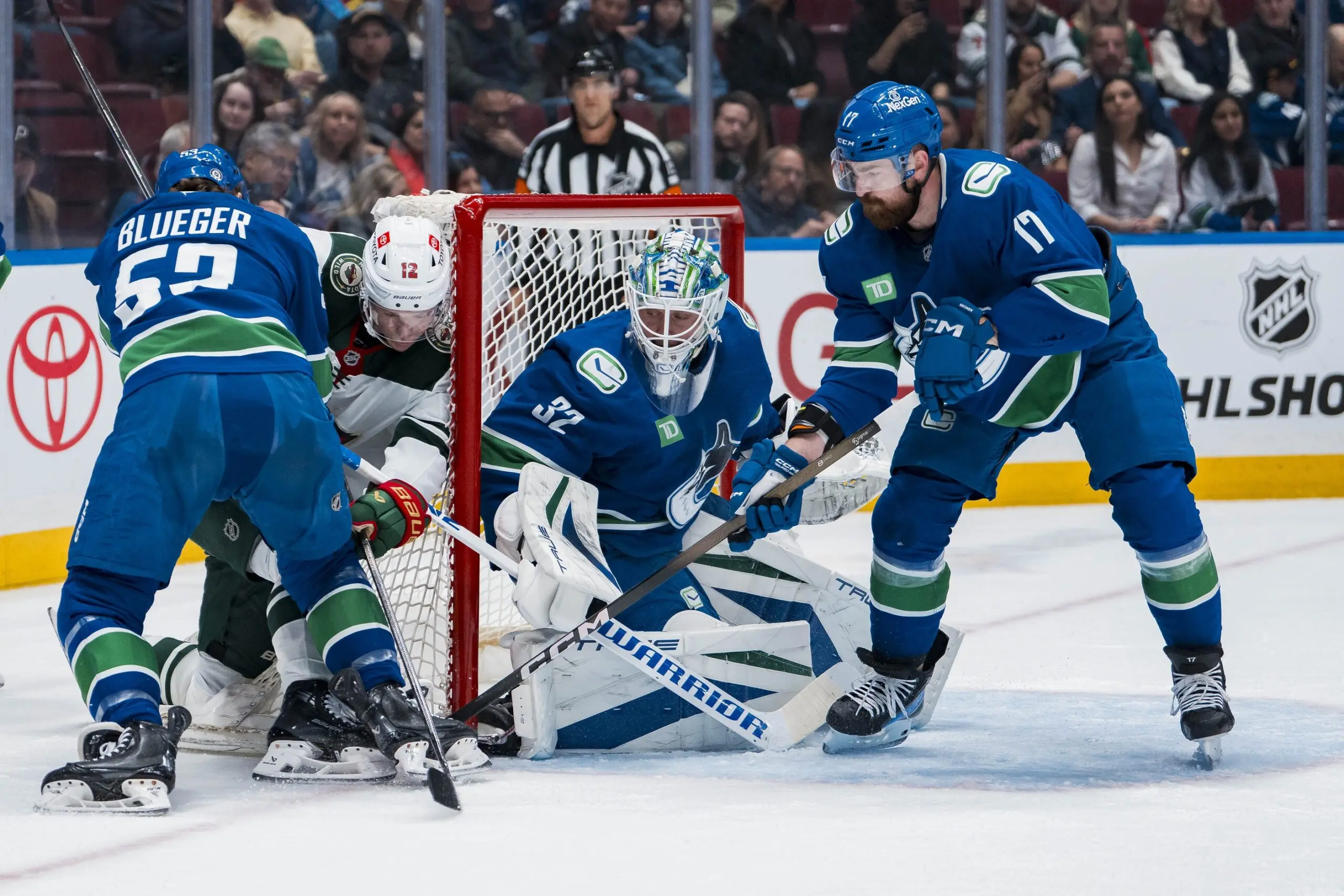
Photo credit: © Bob Frid-Imagn Images

Sep 17, 2025, 13:22 EDT


GM Patrik Allvin and Co. have been leading the Vancouver Canucks’ front office for long enough now that patterns have started to form, and their habits have started to become noticeable.
One of those habits seems to be entering any given season with a slightly oversized roster. This is something that often clashes with fan and media expectations. The way it usually plays out is for followers of the team to spend an offseason pencilling in their own depth chart, only to see the team add further depth players, leaving more bodies than spots. And this can’t help but stress out roster-projectors, who now have to project Training Camp cuts they’d rather not make.
That’s somewhat the case heading into the 2025-26 season, Allvin’s fourth at the helm. This summer – and unless we’ve got a late PTO coming in – the Canucks didn’t actually add all that many depth pieces to their existing roster. We’ve got the likes of Vitali Kravtsov up front, and PO Joseph on the backend, and that’s really it.
But the success of the Abbotsford Canucks last season still leaves the Canucks with more candidates for NHL jobs than actual NHL jobs. Which, to be clear, is not necessarily a bad thing. It hasn’t led to much in the way of consequences for the Canucks as of yet, and the added competition of camp can be a major positive.
When there’s an excess of worthy players at a Training Camp, the only real ‘consequence’ is that it’s even harder to make the team, and that sometimes players get cut who might not fully deserve it.
But that’s where we get to another habit we’ve noticed from the Allvin Regime, and that’s a habit of clearing up their own roster excesses with minor trades.
They’ve been doing this since the start of the 2023-24 season with the somewhat unexpected return of Tanner Pearson from multiple hand surgeries. Pearson’s return to the roster left the Canucks with too many forwards, which led to concerns that younger players like Vasily Podkolzin and Nils Höglander might be left without spots. But right as camp opened, Allvin took care of that by shipping Pearson to the Canadiens, clearing up cap and roster space in one fell swoop – and picking up a backup goalie in Casey DeSmith, to boot.
A month later, when the Canucks still had too many forwards on hand due to the acquisition of Sam Lafferty (another of those seemingly excess depth adds) and Ilya Mikheyev’s return to the lineup, the Canucks dumped Anthony Beauvillier to the Chicago Blackhawks just to make space.
Then, for the 2024-25 season, Allvin really got into the swing of selling extra pieces. First, it was the aforementioned Podkolzin, who wasn’t looking likely to make the team out of camp over incoming players like Daniel Sprong and Kiefer Sherwood, and was sent to the Edmonton Oilers for a fourth-round pick. Now, this was not a popular trade at the time, and Podkolzin’s success with the Oilers makes it a little worse in retrospect. But it’s still an example of the trend of Allvin looking to trade – even for a minuscule return – rather than cut.
A month into the season, when it became clear that one of those depth adds in Sprong was not going to be a permanent addition, Allvin allowed Sprong to return to his previous team in Seattle via a trade for future considerations. The team would have gotten the same return – nothing – had they simply waived Sprong. But they chose otherwise.
Later on in the 2024-25 campaign, it was Mark Friedman’s turn to go. He’d actually already cleared waivers and been assigned to the minors. But the arrival of Marcus Pettersson and Victor Mancini via trade, along with the ascension of Elias Pettersson the Second, made it extremely unlikely that Friedman would get another chance at NHL minutes with the Canucks. So, the Canucks sent him to the Nashville Predators, where he would get some minutes, for more future considerations.
Now, heading into Training Camp 2025, we can’t help but wonder at the potential for more trades made for little reason other than to clear roster space.
The most obvious candidates here are those players who might be most at risk of being claimed through waivers, and there are more of those than usual this year. Linus Karlsson and Arshdeep Bains fall into this category, as does Aatu Räty, though he’s a far less likely cut. On the backend, one could probably put P-O Joseph in this group.
Should a Karlsson-type fail to make the Canucks out of camp, the history suggests that Allvin would try to find him a new home rather than put him on waivers. Even if the return were a very late draft pick. At most, we could expect a fifth-round pick for a player like this in a quick preseason trade. But it could still happen.
A more intriguing possibility, however, is for one of those fringe players to make the roster and steal away the spot of a more established veteran.
The Abbotsford contingent will make a push for spots, as will some of the other interesting names floating around camp, like Kravtsov and such. What happens if, for example, Teddy Blueger gets plain outcompeted for a spot on the fourth line, or Derek Forbort gets cleanly beaten out for a blueline job?
That’s when we think a roster-clearing trade might become more interesting. If someone like, say, Max Sasson were to turn up gangbusters in camp and make a strong argument to start the season as a fourth line centre, management would then have the chance to shop Blueger around. Given the shortage of centres leaguewide, we imagine there’d be at least a small market for his services. At which point, maybe the Canucks are bringing back a mid-round pick, at least.
But the return is really beside the point here. What we’re really saying is that Allvin’s history of making these trades means that spots are truly up for grabs. Allvin and Co. clearly don’t mind bringing more players to camp than they need, giving the spots to those who truly earn them, and shipping the rest out of town whenever possible. There should be some comfort in seeing that, under this managerial group, extra players don’t really gum up the depth chart as much as they might otherwise.
In short, the Canucks have a habit of trading players who have lost a spot rather than holding on to depth for depth’s sake, and that’s probably going to continue with the way the roster is set up heading into 2025-26.
Sponsored by bet365


Breaking News
- 3 Canucks Stars of the Week: Jonathan Lekkerimäki a bright spot amid losing streak
- Abbotsford Weekly: Hats fly for newcomer Jacob Quillan as Canucks sweep Wranglers
- Scenes from practice: Malhotra hauls out line blender in attempt to help Canucks snap 10-game losing skid
- Canucks’ Jack Thompson clears NHL waivers, will report to AHL Abbotsford
- JPat’s Monday Mailbag: Canucks chemistry lessons, a hot dog feast and press box bingo

Vancouver CanucksTeam Cap Summary

Cap Summary
2026-27
2027-28
Projected Cap Hit
$87,295,050
$71,329,167
Projected Cap Space
$16,704,950
$42,170,833
Current Cap Space
$19,290,240
$42,170,833
Active Players
23/23
13/23
Draft Picks
Round
'27
'28
1
1
1
2
2
2
3
1
1