
CanucksArmy has no direct affiliation to the Vancouver Canucks, Canucks Sports & Entertainment, NHL, or NHLPA
Why the worries of a healthy Thatcher Demko ruining the tank are overblown
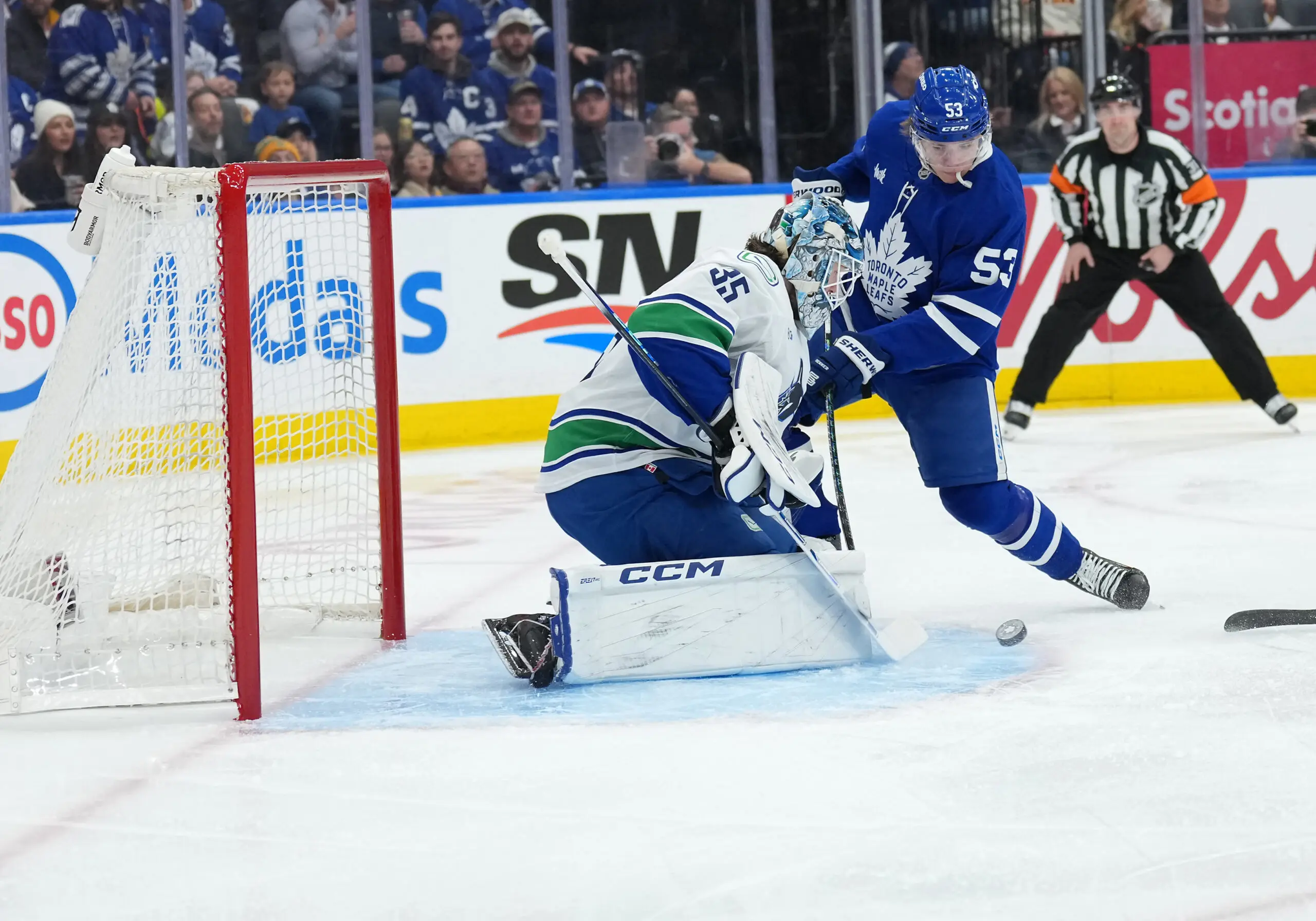
Photo credit: Nick Turchiaro for IMAGN IMAGES via Reuters Connect

Aug 24, 2026, 13:00 EDTUpdated: Aug 24, 2026, 13:09 EDT


To say that fans of the Vancouver Canucks have any real fears about the upcoming 2026-27 campaign is probably inaccurate. It’s tough to muster up any genuine terror about a season in which the goal and the odds-on most likely outcome is a bottom-three finish.
But this is a notoriously nervous fanbase, and if there aren’t any fears floating around, there are at least a few worries and apprehensions. And one of those fears, that you’ve no doubt already heard expressed a time or two, is that a healthy Thatcher Demko might return to the Canucks crease and get their unstated, but clearly accepted, plan of tanking the 2026-27 season to snag another high draft pick.
But are these Demko-related fears legitimate, or are they overblown? We tend toward the latter.
We’re not really here to discuss the likelihood of Demko returning to form, or how much he might play in the upcoming season. That’s more a medical question and will be determined by a number of factors, including how successful that offseason surgery was and how much of a difference it made. We should find out more closer to Training Camp.
Instead, for the purposes of this thought experiment, let’s imagine that Demko returns entirely to form. No lingering rust, no re-injuries, no new injuries to muscles that no one had ever heard of before. And let’s imagine that with that form comes a renewed performance. Picking out Peak Demko is pretty easy, what with his Vezina nomination in 2023-24, so let’s say he gets back to numbers like that – a save percentage of .918, to be specific. This version of Demko was able to play 51 regular season games, second-most in his career.
The question, then, is whether even a restored Prime Demko could prevent the Canucks from finishing in the lottery this season. And we think the answer is still largely ‘no.’
Our chief piece of evidence in this assertion is a fellow by the name of Igor Shesterkin. The New York Rangers goaltender has long been one of the best in the entire game, and the 2025-26 season was no exception. Shesterkin once again posted some excellent results, including a 2.50 goals against average and a .912 save percentage. It was enough to earn Shesterkin two second-place votes for the Vezina and a seventh-place finish in the vote overall.
That’s much higher than where his Rangers finished in the standings. Despite Shesterkin continuing to stand tall through 51 starts, the Rangers finished in third-to-last place in the standings and walked away with the fifth overall pick.
There are a few factors at play here. One of them is the performance of Shesterkin’s backup, Jonathan Quick, who only managed a .891 save percentage in 25 games of his own.
But Shesterkin was in the net for more than half the season, and 19 of the Rangers’ regulation losses and six of their shootout/overtime losses belonged to Shesterkin.
He made a difference, to be sure, just not enough of a difference to keep the Rangers away from the basement.
Shesterkin is the ultimate example of a great goalie on a bad team, but there are others to be found, even just within this most recent 2025-26 campaign. The second-to-last-place finishers, the Chicago Blackhawks, also got a pretty solid showing from Spencer Knight, who appeared in 55 games with a 2.82 GAA and a .902 save percentage.
If we round out the bottom-five, we’ve got to note that Calgary’s Dustin Wolf had a down year and none of Toronto’s goalies performed particularly well, so it’s not like every basement team had stellar goaltending. But some did.
Speaking of Calgary, however, their backup goalie is a fine way to introduce a different stat to our discussion. It’s a newer stat that is slowly but surely becoming central to netminding: Goals-Saved-Above-Average, or GSAA. In short, it measures the quality of shots against to estimate how many goals against a certain goaltender might have truly prevented. While inexact, it does often yield results closer to the eye test than more traditional stats.
Calgary’s backup, Devin Cooley, had a remarkable year. Not only did he outperform Wolf in his 31 appearances, but Cooley also achieved one of the highest GSAA scores in the league with 17.3 total – meaning, more or less, that he personally cut 17 goals-against off Calgary’s overall record.
Those 17ish saved goals were seventh overall in the league, with all the goalies ranked ahead of Cooley having played significantly more games.
And did it really make a difference? Cooley went 10-10-6 on the season, a record that is marginally better than the team as a whole, but nowhere near playoff quality.
If we stick with that same stat and go back to the 2023-24 season and Prime Demko, we can see that Demko has had a lot of success here before. In 2023-24, he had a GSAA of 22.0, second only to Connor Hellebuyck.
So, let’s imagine that Demko gets back to perfect form and, once again, prevents approximately 22 goals from crossing the Canucks’ red line this season.
The Canucks were -100 as a team last year. Even if Demko were to shave 22 goals-against off of that, they’d be at -78, which would still be 16 goals-against worse than the second-worst team.
It’s tempting to look at the fact that the Canucks led the league in one-goal losses last year with 43, and think that maybe more saved goals at the exact right time could have made a difference. But even if Demko was there to save 22 extra goals specifically in those one-goal losses, and if all 22 of those extra goals somehow translated into an extra point, the Canucks would still finish near the bottom of the standings and well out of the playoffs. And, of course, that’s not how it works – a goal-saved-above-average could just as easily come in a blowout victory as in a one-goal loss.
Another newer stat we could consider is Goalie Point Share, a number compiled by Hockey-Reference that purports to measure how many actual points in the standings a goalie directly contributed to. Back in 2023-24, Demko was said to have a point share of 10.7. If one were to add 10.7 points to the 2025-26 Canucks, one would still find them in last place.
The Canucks still have an incredibly young blueline, and this year they will not have a quarter-season of Quinn Hughes in the mix. They’ve still got one of the thinnest forward corps in the league. And so, even if Demko magically returns to his final form – an outcome we can all agree is pretty unlikely – it’s unlikely to make much of a dent in the Canucks’ record, for better or for worse.
Could a healthy Demko steal a game or two here and there? Absolutely. But if the Canucks are within a game or two of being out of the basement, something else has to have unexpectedly changed elsewhere on the roster already.
In other words, Demko himself won’t be the thing that stops the Canucks’ tank. At this point, we’re skeptical that anything could.
Sponsored by bet365


Recent articles from Stephan Roget
Breaking News
- Manny Malhotra and Brock Boeser offer up slightly different theories for Canucks’ struggles
- The Stanchies: Jonathan Lekkerimäki notches a goal and an assist, and that’s all we’ll say
- ‘It’s embarrassing’: Brock Boeser brutally honest following Canucks’ ninth straight loss
- Instant Reaction: Canucks go nearly 40 minutes without a shot in 5-2 loss to Red Wings
- What’s behind ex-Canuck Conor Garland’s struggles in Columbus?

Vancouver CanucksTeam Cap Summary

Cap Summary
2026-27
2027-28
Projected Cap Hit
$87,295,050
$71,329,167
Projected Cap Space
$16,704,950
$42,170,833
Current Cap Space
$18,951,815
$42,170,833
Active Players
23/23
13/23
Draft Picks
Round
'27
'28
1
1
1
2
2
2
3
1
1