
CanucksArmy has no direct affiliation to the Vancouver Canucks, Canucks Sports & Entertainment, NHL, or NHLPA
Wagner’s Weekly: Brock Boeser is keeping the Canucks’ second line afloat
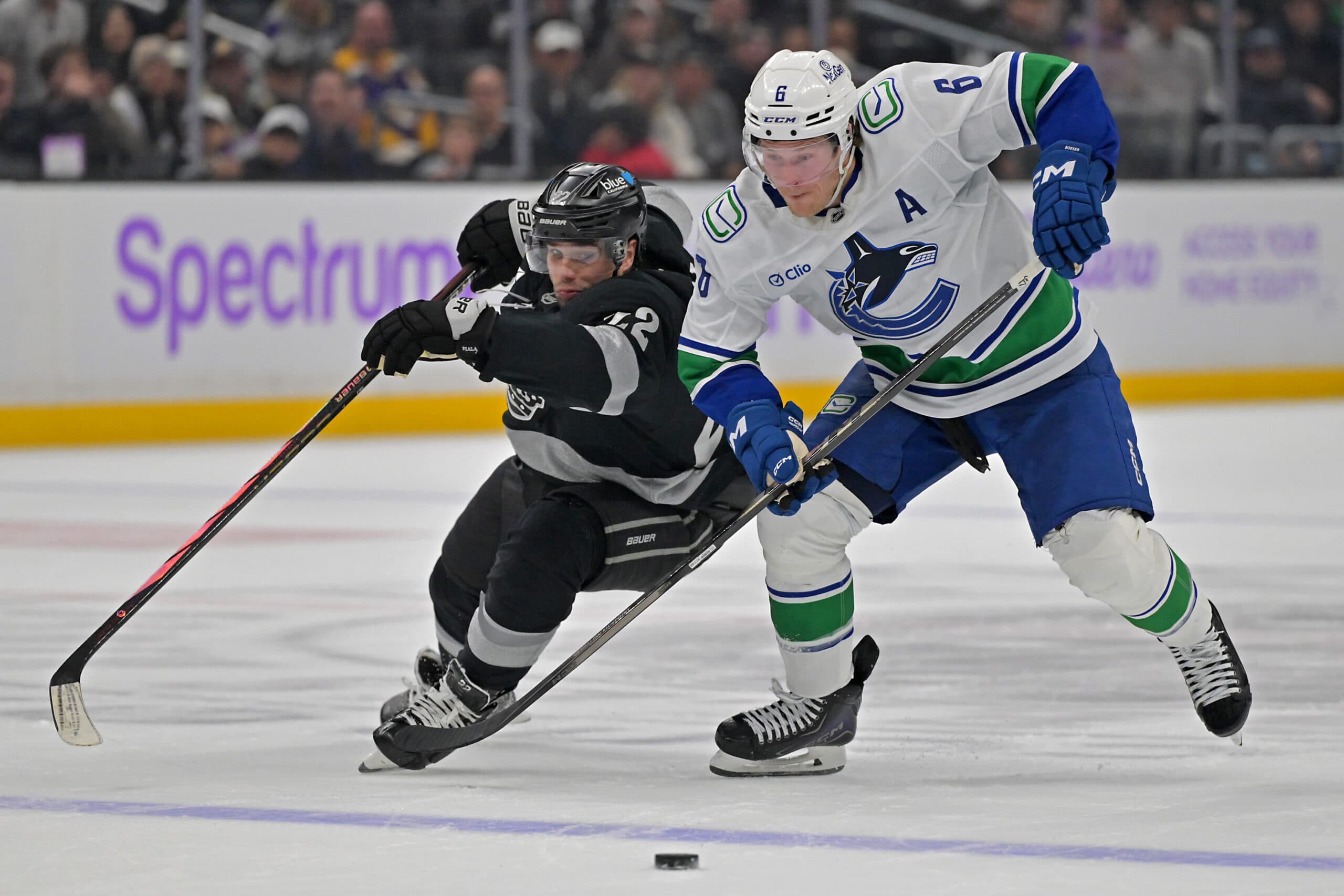
Photo credit: © Jayne Kamin-Oncea-Imagn Images

Nov 30, 2025, 16:05 EST


The Vancouver Canucks haven’t had many consistent forward lines this season.
That’s not too surprising, given all of their injuries. But even aside from the injuries, the Canucks have struggled so much at 5-on-5 that head coach Adam Foote has had to repeatedly hit the “Liquify” button on the Line Blender 3000™ that was left on the desk of his office by Rick Tocchet.
The line that has spent the most time together is that of Evander Kane, Elias Pettersson, and Conor Garland, who have played 95.6 minutes together at 5-on-5. That ranks 53rd in 5-on-5 ice time for lines around the NHL. Some top lines have over 200 minutes together at 5-on-5 by this point.
Which Canucks line combinations have been effective at 5-on-5?
The Canucks have had 15 different line combinations that have spent at least 20 minutes together. But which of those line combinations has been the most effective and deserves to spend a little more time together?
Using Evolving-Hockey’s tools to look at line combinations, I discovered something surprising: the top-three forward lines for the Canucks by expected goals percentage (xGF%) have all been second lines, with three different centres.
That’s somewhat surprising, because the Canucks’ lack of a second-line centre has been one of their major issues. Heading into the offseason, Canucks President of Hockey Operations Jim Rutherford made it clear just how badly they needed to get a second-line centre.
“It’ll be expensive, but it’ll also be very expensive not to get one,” said Rutherford. So we’re going to be open to do whatever it takes.”
The Canucks didn’t get a second-line centre, and it has proven costly, as the Canucks’ lack of centre depth has made it tough to balance the lines and likely played a factor in their defensive issues.
But these underlying numbers suggest the lack of a second-line centre hasn’t been all bad, as three different second-line combinations have been keeping their heads well above water.
Line | TOI | xGF% |
DeBrusk – Chytil – Boeser | 28.1 | 69.7 |
Boeser – Kämpf – Garland | 34.7 | 63.9 |
DeBrusk – Reichel – Boeser | 27.5 | 58.2 |
MacEachern – Räty – O’Connor | 21.4 | 56.7 |
DeBrusk – Räty – O’Connor | 49.1 | 51.2 |
Kane – Pettersson – Garland | 95.6 | 47.0 |
Bains – Sasson – Karlsson | 89.8 | 46.7 |
DeBrusk – Pettersson – Boeser | 36.9 | 45.2 |
DeBrusk – Pettersson – Garland | 45.6 | 43.4 |
O’Connor – Räty – Sherwood | 65.0 | 42.3 |
Kane – Reichel – Boeser | 28.6 | 40.0 |
Kane – Pettersson – DeBrusk | 26.4 | 35.2 |
Kane – Pettersson – Sherwood | 37.0 | 32.7 |
Boeser – Reichel – Sherwood | 32.1 | 28.4 |
Kane – Räty – Sherwood | 25.8 | 25.3 |
Or maybe it’s less about the centres, and more about the one forward who is a common factor with all three combinations: Brock Boeser.
Canucks might have something in Boeser, Kämpf, Garland line
Topping the chart at 69.7% is the line of Jake DeBrusk, Filip Chytil, and Boeser that was starting to find some chemistry before Chytil suffered a concussion on a late hit by Washington Capitals forward Tom Wilson.
Next is the recent line of Boeser, David Kämpf, and Conor Garland at 63.9%, then the line of DeBrusk, Lukas Reichel, and Boeser at 58.2%.
These statistics come with some caveats, of course. With Elias Pettersson’s top line taking most of the tough matchups, the second line has generally faced easier competition. That’s particularly true for the line centred by Reichel, who has been pretty significantly sheltered with the Canucks.
That’s less of a case for the line centred by Kämpf, however, who has taken a lot of defensive zone faceoffs since joining the Canucks: he has the highest rate of defensive zone faceoffs at 5-on-5 on the team. That line hasn’t been sheltered and has, in fact, taken some of the defensive load off of Pettersson’s shoulders.
Whatever the factors that play into these numbers, it’s still intriguing to see Boeser on each of those top-three line combinations. At the very least, it suggests the current combination of Boeser, Kämpf, and Garland should stick together for at least a little while longer.
Of course, that requires Garland to be healthy, which isn’t currently the case, as he missed Saturday’s game in Los Angeles. Foote said that he won’t know the severity of his injury “until it’s reviewed by our doctor in Vancouver.”
The numbers aren’t all golden for Boeser, of course. Other combinations, such as Boeser and Reichel with Evander Kane or Kiefer Sherwood, don’t fare as well by the underlying numbers. Also, for whatever reason — probably speed — Boeser just hasn’t meshed with Pettersson this season.
But Boeser has been able to keep the Canucks’ second line from sinking, at least with certain combinations.
Of course, there’s also the outside-the-box idea that Boeser should be the Canucks’ second-line centre. I’m not sold on that, but at least he’s helping cover up the Canucks’ lack of one.


Breaking News
- The Statsies: Brock Boeser has his best game of the year in Canucks’ loss to Islanders
- The Stanchies: Despite growing pains on defence, Canucks battle valiantly in 3-2 loss to Islanders
- Instant Reaction: Leevi Meriläinen stands out in Canucks’ 3-2 loss to Islanders
- NHL Notebook: Bedard returns for Chicago, and is Rick Tocchet on the hot seat?
- Demotion to third defensive pair for Canucks’ Buium ‘not a step backward’ according to Malhotra

Vancouver CanucksTeam Cap Summary

Cap Summary
2026-27
2027-28
Projected Cap Hit
$88,074,947
$71,329,167
Projected Cap Space
$15,925,053
$42,170,833
Current Cap Space
$17,163,668
$42,170,833
Active Players
23/23
13/23
Draft Picks
Round
'27
'28
1
1
1
2
2
2
3
1
1