
CanucksArmy has no direct affiliation to the Vancouver Canucks, Canucks Sports & Entertainment, NHL, or NHLPA
The Canucks really need to shoot the puck more next season
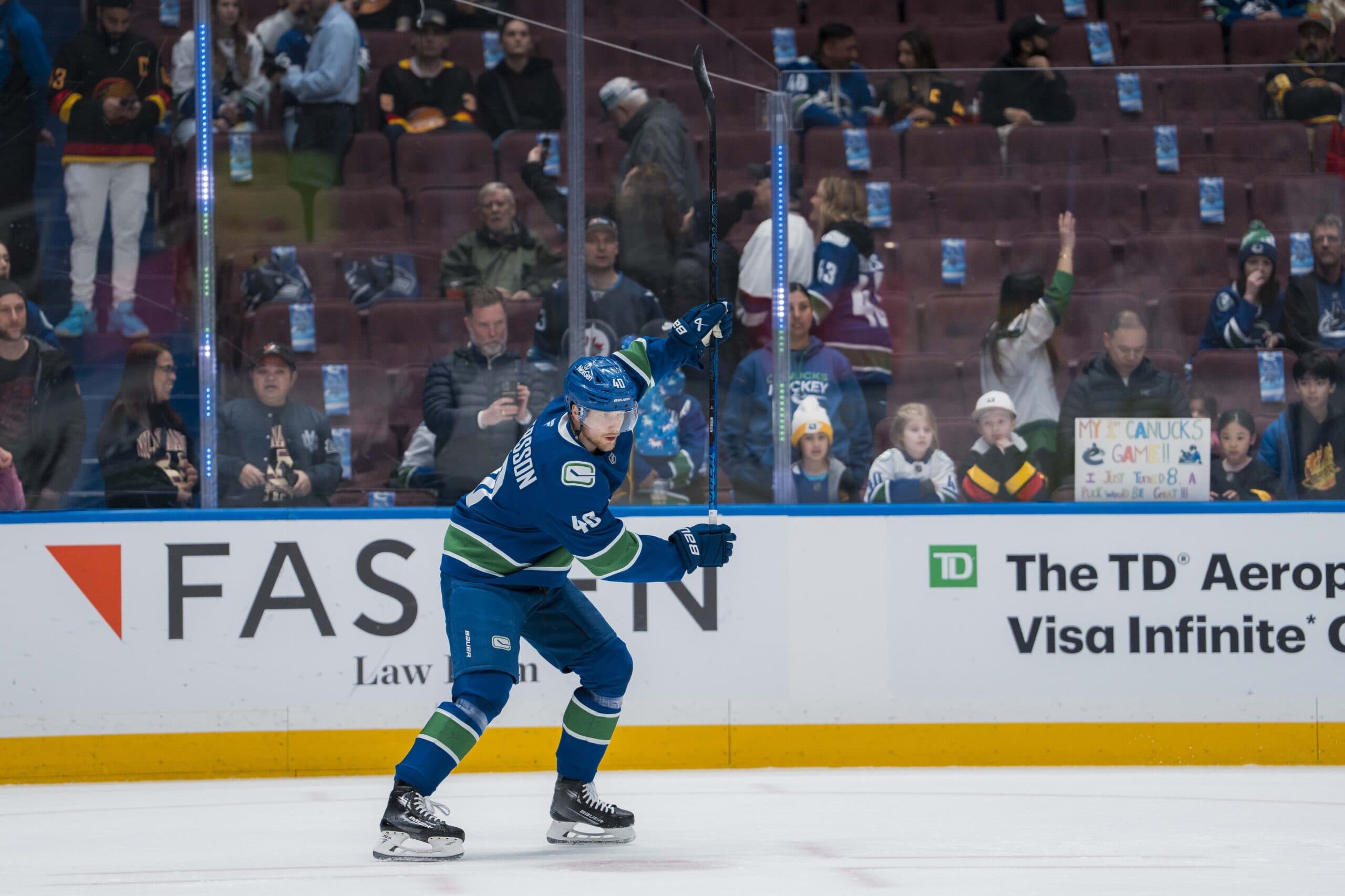
Photo credit: © Bob Frid-Imagn Images

Aug 8, 2025, 09:00 EDTUpdated: Aug 8, 2025, 14:43 EDT


Great news for the guy who yells “Shooooooot!” every time the Vancouver Canucks touch the puck on home ice.
For once, he might actually be on to something.
Now, it would be a gross oversimplification to say that the struggles of the 2024-25 Canucks were all down to a lack of shooting. Just as it would be a gross oversimplification to suggest that the 2025-26 Canucks could right the ship by simply shooting more.
But it might not be a gross overexaggeration to state that a lack of shooting was a major, team-wide issue for the Canucks last season. And it might not be a gross overexaggeration that getting more shots on the opposition net can play an important role in the Canucks having a better year this time around.
It’s something we noticed when writing a recent piece on shooting percentages: every Canuck seemed to shoot less in 2024-25, and it seemed to have a detrimental impact on each of their statlines – to say nothing of the more general, team-wide problems that arose.
But before we get to the fixing, let’s take some time to explore the depth and scope of the problem.
The low-shooting 2024-25 Canucks
We’re not breaking any news here. The Canucks finished with the second-lowest shot count in the league last year with an average of just 25.5 shots per game, ahead of only the lowly Chicago Blackhawks and their 24.5.
There is an important distinction to make here if we’re talking quality of play and quality of team. The Blackhawks also allowed 31.1 shots against per game, the second-worst rate in the league. The Canucks, meanwhile, only allowed 26.8 shots against per game – still more than they took, but also the seventh-best rate in the NHL.
It’s clear, then, that the Canucks took fewer shots – to some extent, anyway – by choice, instead choosing to focus on their own end.
A matter of coaching?
Some folks felt as though head coach Rick Tocchet had his players being a little too selective with their shots last year. But it’s tough to call this a ‘Tocchet thing’ when his other Canucks teams – late in 2022-23, and throughout all of 2023-24 – shot a lot more.
The 2023-24 Canucks shot at a rate of 28.4 per game, which is almost three shots higher than their 2024-25 rate. At the same time, that only had the Canucks ranked 26th overall in the league, which isn’t that big of a contextual jump.
Compare it to the first Bruce Boudreau campaign, which saw the Canucks shooting at a rate of 32.0 shots per game, and the difference becomes quite stark.
So, there may be an element of coaching style at play here.
An unreliable back-end?
When we see the Canucks taking lower shot totals so that they can focus more on preventing shots against, it speaks to a lack of confidence in the back-end.
Which, circa 2024-25, is fair enough. The Canucks finished with a team save percentage of 90.44%, just barely missing out on the bottom 10. For much of the early going, they were even lower than that.
A major difference between the 2023-24 team and the 2024-25 team is that one had a relatively healthy, Vezina-nomination-earning Thatcher Demko between the pipes for the majority of the season, and the other one…did not. One can see how that would lead to a reduction in the kind of risk-taking that might lead to more shots.
There’s something to be said about the blueline, too. The 2023-24 Canucks missed out on Quinn Hughes and Filip Hronek for chunks of the year, and Marcus and Elias Pettersson didn’t show up until partway through. A questionable blueline only exacerbates the need to play it safe defensively – at the cost of generating offence.
Elias Pettersson?!
Let’s not pretend that this, like most things, doesn’t largely go back to the other Elias Pettersson.
Whether it’s that lingering wrist issue, or another injury, or merely a matter of cognition, the elder Pettersson has plainly become a less confident and less eager shooter over the past couple of seasons.
Pettersson’s per-game shot and goal numbers look like this over his career:
2018-19 | 2019-20 | 2020-21 | 2021-22 | 2022-23 | 2023-24 | 2024-25 | |
Shots /Game | 2.03 | 2.38 | 2.42 | 2.40 | 3.21 | 2.52 | 1.70 |
Goals /Game | .39 | .40 | .38 | .40 | .49 | .41 | .23 |
Source: Hockey-Reference
It’s not too difficult to spot the correlation here, and in this instance, we do think the correlation points to causation, because there’s an obvious connection here. Pettersson shoots less when he plays less confidently, which causes him to score less, which causes him to play with less confidence. It feels like a bit of a vicious cycle.
It’s also something that has a compounding effect outside the bounds of Pettersson himself. It’s no secret that he’s the literal centrepiece of the Canucks’ forward corps, especially with JT Miller out the door. And one might think that Pettersson not shooting only opens up the opportunities for his teammates to shoot more, but it might be having the opposite impact.
Simply put, when Pettersson isn’t shooting, it makes it a lot easier for the opposition to suppress shots from the likes of, say, Brock Boeser and Jake DeBrusk. Indeed, both Boeser and DeBrusk’s own rate of shots fell, too.
Again, that might have a lot to do with Tocchet’s coaching style. But it also has a lot to do with Pettersson as an individual factor.
The Fixes
Of course, we wouldn’t present a problem like this without some suggested solutions. And the good news is that some of these potential fixes are already somewhat in place.
Coaching Change
If the low shot totals had anything to do with Tocchet’s coaching style, well, he’s gone, and that should take care of that.
Except, it’s a little bit tough to imagine that Adam Foote – a player who made his reputation on tough, stay-at-home defence – is going to come in and demand more shooting than his one-time 48-goal-scoring predecessor.
And it might not be great news that Foote’s most experienced assistant, Kevin Dean, is coming from those same Chicago Blackhawks who shot even less than the Canucks in 2024-25.
But Foote will no doubt make some adjustments to Tocchet’s structure and system all the same. He’s not a coaching clone. And it would be tough for him to reflect on how last year went and not find a cause for more shooting.
Elias Pettersson
You’ve read the headlines. Pettersson is back, he’s healthy, and he wants REVENGE.
We’ll understand if many Canucks supporters are in ‘believe-it-when-we-see-it’ mode on this one. But if Pettersson does return to his best form, or anything approaching it, then that alone will go a long way toward fixing the issue.
You saw the numbers. On his own, Pettersson usually shoots up to 1.5 times more per game than he did last year. That alone moves the Canucks significantly up the chart.
Then there’s that aforementioned impact on his teammates. Pettersson, being a more frequent and dangerous shooter, opens up ice for everyone else. Then, imagine if Pettersson can also start making plays the way he used to, and take advantage of that open ice…
Better Defence
If the Canucks can point at one thing as better now than it was at the outset of 2024-25, it’s their blueline.
Hughes and Hronek are healthy. Marcus Pettersson slides in as the best 3D the team has had in a while, and Tyler Myers looks far better in a more appropriate role for himself.
Then there’s all the upward potential of the younger Elias Pettersson, Victor Mancini, and the relative mystery box that is Tom Willander.
All told, the Canucks project to have a much stronger blueline throughout the year, and should lead to less cheating back defensively, and thus more shot-taking on offence.
We should also note that the blueline isn’t just better defensively, it’s more mobile and capable of moving the puck. That, too, creates more opportunities for shots.
And let’s not forget that Hughes, specifically, has put a lot of work into becoming a more dangerous shooter over the past season or so, and that should only continue into 2025-26.
Better Goaltending
This last point is a little less certain.
If Demko returns to his healthy form, that alone should shore up the Canucks all over the ice. It works much the same way as the blueline, where having Demko back there stealing saves and games allows for the offence to take greater risks, fire more shots on goal, and, ideally, score more.
And if Kevin Lankinen works out as planned, as the sort of backup that can be inserted into the crease at any point without too much drop-off in performance, that certainly helps, too. Both on the ice and off it, where a fresher and more rested Demko benefits literally everyone and everything.
It might be a little counterintuitive to end an article on shooting with a section about goaltending, but it makes sense if you think about it. Everything in hockey is built from the net out – even the shots on the net at the other end of the rink.
Sponsored by bet365


Breaking News
- The Canucks are one of the smallest teams in the NHL, but can they change that?
- NHL Notebook: Jets trade Hellebuyck to Devils for package of four players and two draft picks
- The Statsies: Where the Canucks got dominated at 5v5 again is loss to Red Wings
- Manny Malhotra and Brock Boeser offer up slightly different theories for Canucks’ struggles
- The Stanchies: Jonathan Lekkerimäki notches a goal and an assist, and that’s all we’ll say

Vancouver CanucksTeam Cap Summary

Cap Summary
2026-27
2027-28
Projected Cap Hit
$87,295,050
$71,329,167
Projected Cap Space
$16,704,950
$42,170,833
Current Cap Space
$19,063,296
$42,170,833
Active Players
23/23
13/23
Draft Picks
Round
'27
'28
1
1
1
2
2
2
3
1
1