
CanucksArmy has no direct affiliation to the Vancouver Canucks, Canucks Sports & Entertainment, NHL, or NHLPA
The two year anniversary of Elias Pettersson’s 8-year contract extension with the Canucks
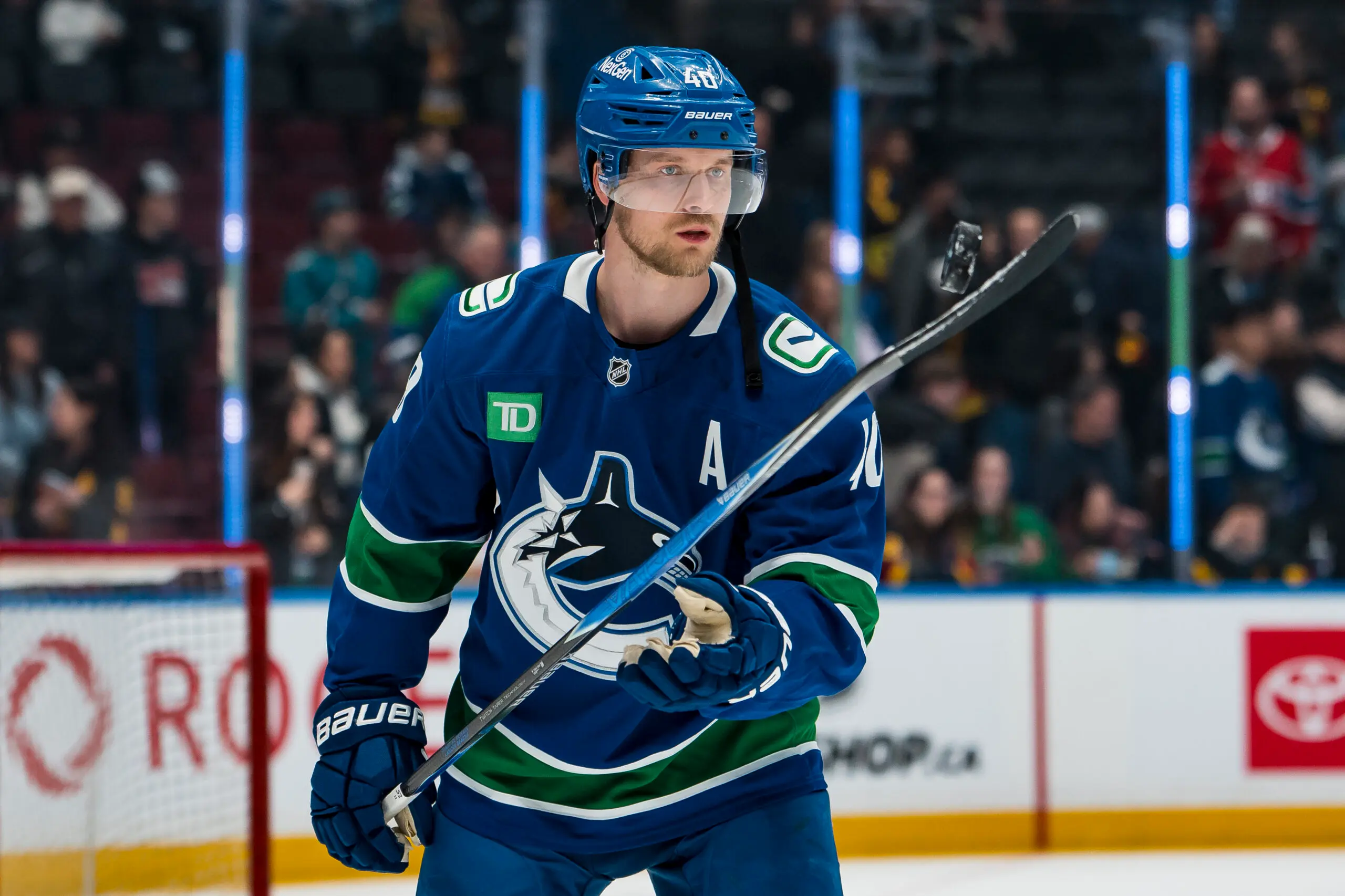
Photo credit: © Bob Frid-Imagn Images

By Tyson Cole
Mar 2, 2026, 09:00 ESTUpdated: Mar 2, 2026, 12:19 EST


Two years ago today was supposed to be a special day in Vancouver Canucks history.
The organization signed top centre and at the time, their face of the franchise, Elias Pettersson, to the largest contract in the franchise’s history, inking an eight-year, $92.8 million deal. The contract carries an average annual value of $11.6 million and includes a full no-movement clause for the entire eight-year term.
Unfortunately, it hasn’t necessarily worked out the way either party had hoped.
Before the extension, Pettersson was regarded as one of the top centremen in the league. He burst onto the scene as a highly anticipated rookie, displaying his lethal shot on a rush goal in his NHL debut against the Calgary Flames. Pettersson would finish his rookie campaign with 28 goals and 38 assists for 66 points in 71 games. These totals earned him the Calder Trophy, recognized as the rookie of the year, becoming only the second Canuck in franchise history (Pavel Bure) to take home the honour.
The next three seasons saw Pettersson hit the 30-goal plateau and finish each with at least a .81 points-per-game average. Then, in the 2022-23 season, Pettersson broke out as one of the league’s elite centers, scoring 39 goals and 63 assists for 102 points while averaging 3.2 shots on goal and over 20:33 minutes per game. These totals had him 10th in league scoring, and earned him votes for the Hart Memorial Trophy, the Lady Byng Memorial Trophy, the Frank J. Selke Trophy and fifth among forwards in All-Star voting.
The 2017 fifth overall pick carried that over into the 2023-24 season, where he scored 27 goals and 37 assists for 64 points, averaging 2.8 shots per game through the first 49 games of the season before the NHL All-Star break – doing so while playing with the likes of Ilya Mikheyev and Nils Höglander on his line for most of the season.
After the break, Pettersson’s production began to dip. However, his efforts over the previous year and a half earned him the lengthy extension to stay in Vancouver.
But after he signed his big ticket, that expected bounce back never really followed. Pettersson had just seven goals and 18 assists for 25 points, averaging 2.2 shots per game through the final 33 games. Those struggles continued into the playoffs, where he had just one goal and five assists for six points through 13 games. In his end-of-season media availability, Pettersson shared that he had been dealing with a knee injury since January, which lined up with when the decline began.
With a full summer ahead of him following the Game 7 second-round exit to the Edmonton Oilers, Pettersson should have had ample time to rest, rehab and train for the 2024-25 season. But as we know now, that didn’t happen. Pettersson finished the season with career lows in goals (15), assists (30), points (45), plus-minus rating (minus-10) and shots on goal (109) – in seasons in which he played more than 41 games.
And this year has been more of the same. Through 51 games this season, Pettersson has just 13 goals and 22 assists for 35 points and a minus-18 rating. He is on pace to finish this season with 51 points in 74 games. While the point totals aren’t where they once were, he has elevated his defensive game and has often been line-matched against top competition.
However, that was often the case when he was at the top of his game as well. Teams would send their best defensive forwards out against Pettersson in an attempt to shut him down. And oftentimes, he would win those battles. But he’s not having the same success he used to. So he’s turned to the defensive side of the game. And to his credit, he does lead NHL forwards in blocked shots. However, he has only three more shots on goal (91) than blocked shots (88) this season. For a player who was once known for having such a lethal shot, that’s extremely disappointing.
When the Canucks signed him to that lucrative deal, they did not envision paying Pettersson $11.6 million per season to be a defensive forward. But that’s what he has become. The splits between the 135 games he’s played since signing the mega-extension and the 135 games before the deal are alarming.
Pettersson has played 135 games since signing his mega-extension. In those games, he has 33 goals and 61 assists for 94 points, with 244 shots on goal and 183 blocked shots. Compare that to the 135 games before the extension, Pettersson had 65 goals and 105 assists for 170 points with 398 shots on goal and 131 blocked shots. That works out to an average of 1.26 points per game, 2.95 shots on goal per game and 0.97 blocks per game before the extension, and 0.7 points per game, 1.8 shots on goal per game and 1.36 blocks per game after the extension.
To put it into a league-wide perspective: prior to the extension, Pettersson was seventh in league scoring over that 135-game threshold, trailing only Connor McDavid, Nikita Kucherov, Nathan MacKinnon, Leon Draisaitl, David Pastrnak and Mikko Rantanen. In the 135 games after signing the extension, Pettersson is tied for 135th in league scoring, with the likes of Owen Tippett, Matty Beniers, Matvei Michkov and Mikhail Sergachev.
It’s been quite the descent production-wise for Pettersson to now be on par with the latter group, despite being paid like a player in the former group.
When fans first saw the extension, many would have been thrilled to see the Canucks lock up their 100-point scorer, who was on an 82-game pace to best his previous totals that season. And two years after he signed on the dotted line, Pettersson’s struggles have gone as far as to see him benched for the final half of the third period in a game in which they were trailing, and now his name is being floated around in trade rumours.
Looking back now, on the two year anniversary of the Pettersson extension, nobody would have anticipated this level of dropoff from a star centreman. And with the team subsequently falling to dead last in the NHL, we’ll see what the next two years look like for both the Vancouver Canucks and Elias Pettersson.
Sponsored by bet365


Breaking News
- The Stanchies: Brady Tkachuk’s natural hat trick extends Canucks losing streak to 6 in OT loss to Panthers
- Instant Reaction: Brady Tkachuk scores late hat trick in Canucks’ overtime loss to Florida
- Canucks trade Aatu Räty to Maple Leafs for forwards Jacob Quillan and Brandon Buhr
- What’s behind the early struggles from Canucks’ Zeev Buium and Filip Hronek?
- Canucks’ Räty clears NHL waivers, will report to AHL Abbotsford

Vancouver CanucksTeam Cap Summary

Cap Summary
2026-27
2027-28
Projected Cap Hit
$87,295,050
$71,329,167
Projected Cap Space
$16,704,950
$42,170,833
Current Cap Space
$18,206,519
$42,170,833
Active Players
23/23
13/23
Draft Picks
Round
'27
'28
1
1
1
2
2
2
3
1
1