
CanucksArmy has no direct affiliation to the Vancouver Canucks, Canucks Sports & Entertainment, NHL, or NHLPA
Is Quinn Hughes the best Canuck of all-time?: Hughes Week
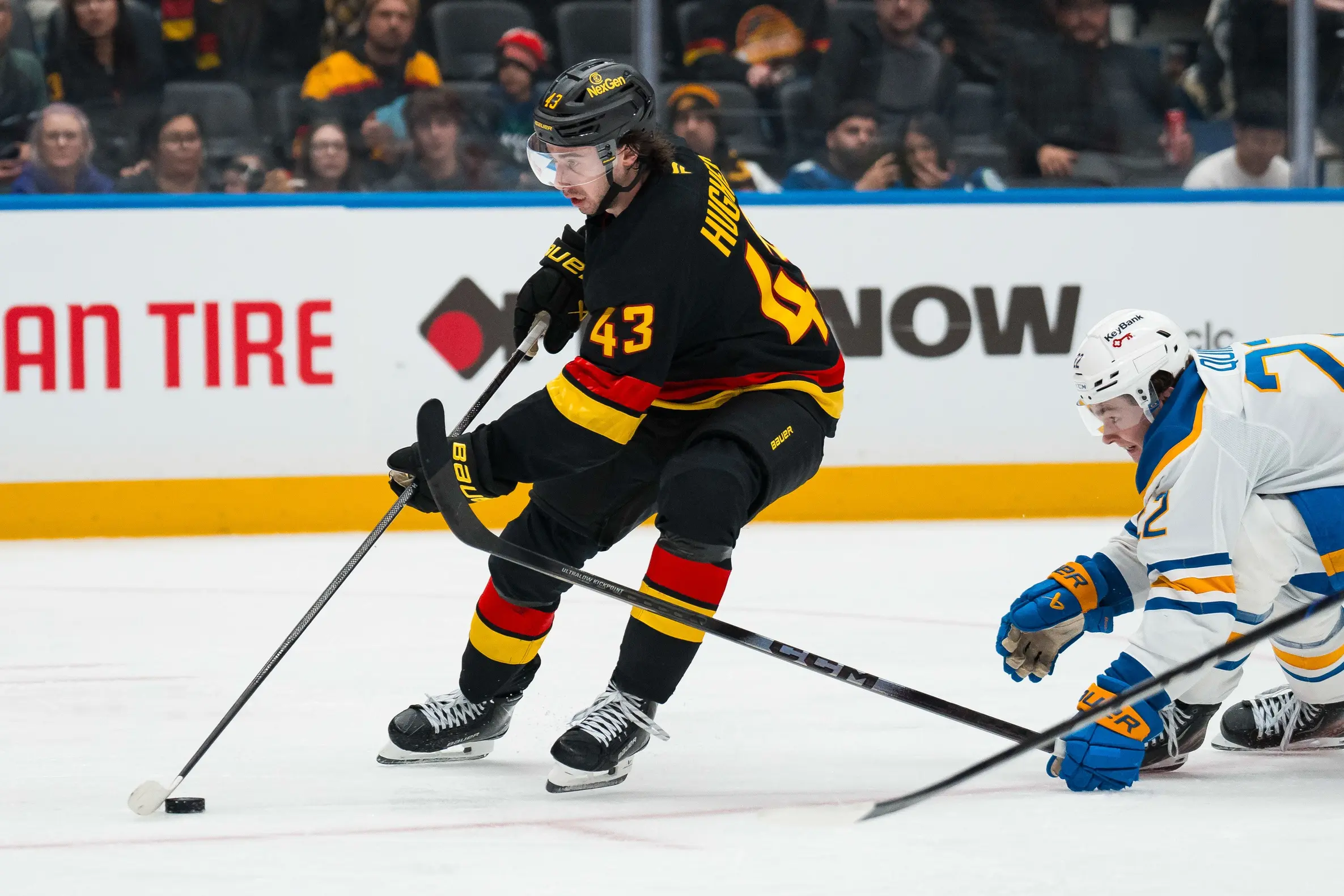
Photo credit: © Bob Frid-Imagn Images

Mar 30, 2026, 09:00 EDTUpdated: Mar 30, 2026, 12:19 EDT


With the Canucks set to take on captain Quinn Hughes and the Minnesota Wild on Thursday for the first time since the trade, we thought it made sense to dive into some Hughes-related content during what we’re calling Hughes Week!
The departure of now-former captain Quinn Hughes has left plenty of room for debate about his long-term legacy with the Vancouver Canucks.
We believe the time to argue over things like the Ring of Honour or a theoretical Canuck Mount Rushmore is a little premature – those sorts of arguments take time and retrospection. But other, less definitive and more open-ended debates, like whether Hughes was the best Canuck of all-time, can probably be made now, if not agreed upon by all.
Please note here, right off the bat, that we are drawing a clean delineation between “best” and “greatest.” We don’t think it’s premature at all to say that, barring a later-in-career return, Hughes is already out of the running for Greatest Canuck. Whatever a player’s on-ice qualities may be, most would say that greatness requires a few other, slightly less tangible factors. Greatness requires staying power, and Hughes only played six-and-a-half seasons in Vancouver. Greatness requires accomplishment, and Hughes’ Canucks only ever made it to the playoffs twice, and only ever as far as the second round (though one of those was technically a third round due to the weirdness of the bubble playoffs). Greatness requires loyalty, and Hughes more or less quit on the team while serving as captain and engineered his way out of town.
Names like Henrik and Daniel Sedin, Trevor Linden, Pavel Bure, Markus Naslund, and even Roberto Luongo probably enter the discussion for Greatest Canuck ahead of Hughes, and rightly so. CanucksArmy ranked Hughes as the fifth-greatest Canuck when we did our Top-50 earlier in the year, and we don’t think he will climb from there.
But “best” means something different, and altogether simpler. For us, being the Best Canuck of All-Time is about two things – one’s on-ice ability, and one’s effectiveness in using that on-ice ability. That’s it, and under those qualifications, Hughes has to be at least in the running, if not leading the pack.
Hughes finished his Canuck career with 432 points in 459 games. That puts him well ahead of Alex Edler as the highest-scoring Canuck defender ever, and 13th all-time among Vancouver skaters in general. If we go by points-per-game, however, Hughes leaps up the list. There, his .941 rate ranks fifth all-time behind Bure, JT Miller, Alex Mogilny, and Mike Walton. (And come on, you just had to know Mike Walton was going to get a mention in any discussion of the best all-time Canucks!)
To accomplish that from the blueline more than speaks for itself. But comparing raw scoring totals across eras is a messy business, and we can’t leave it at that. Over the decades, the truest way of measuring “best-ness” has always been to compare a player’s performance against their contemporaneous peers. And since sparingly few Canucks have ever held claim to being anywhere near the best at their position for any length of time, it’s a fairly short discussion.
Another note worth giving here is that we’re focusing entirely on a player’s time with the Canucks, and so we’re not talking about the “best all-time player to have ever been a Canuck.” If we did, we’d probably have to talk about Mark Messier, and no one ever wants to talk about Mark Messier.
For work done within a Canuck jersey, we’d reckon there are about six individuals who ever had a legitimate claim at being anywhere near the best in the league, and those players are the Sedin twins, Bure, Naslund, Luongo, and Hughes.
But each of those prior runs was relatively short, and none of them were anywhere close to unchallenged.
Working chronologically, Bure suffers in this regard for his playing prime having overlapped with the years of Wayne Gretzky, Mario Lemieux, and Jaromir Jagr. At no point was Bure ever really considered the best in the game. Even Bure’s best season, in 1993-94, saw him finish fifth overall in league point-scoring with 107 points. That year also featured a clearly better performance from Bure’s countryman, Sergei Fedorov. One could probably make an argument that Bure was the best pure goal-scorer in the league at this point, but then Lemieux is literally right there.
There is no denying Bure’s skill, and if we were picking out the most talented Canucks, it probably comes down to him, Hughes, and maybe Mogilny. But Bure doesn’t have that stand-out-from-the-crowd factor, even if his crowd was perhaps harder to stand out from.
Next up comes Naslund, whose time at the top was incredibly short. He is one of only two Canucks ever to be deemed the best by his peers, with Naslund accomplishing this in 2002-03 with the Lester B. Pearson Award, easily his best season on record. But then, Naslund lost the scoring race to Peter Forsberg that year despite Forsberg playing seven fewer games. If Naslund truly was the best at this point, it was only for this briefest moment. And few would agree that he was ever better than Forsberg at any point, anyway.
Daniel Sedin is the other Canuck to be named as the league’s best by his peers, though the trophy was called the Ted Lindsay Award by the time he won it in 2010-11, leading the league in scoring by five points with 104. The year prior, Henrik was named league MVP, winning the Hart Trophy, along with his own scoring championship and 112 points.
By this point, however, both Sidney Crosby and Alexander Ovechkin had hit the scene and had already well-established themselves as the league’s best. We talked about effectiveness being part of the equation for the best all-time, and the Sedins rank highly there. Few Canucks have got it done on the ice as consistently as they did during their peak, from about 2009 to 2013. But then, they were never the best during that time. Greatest Canucks? Sure.
Luongo might have a stronger claim there. One could make the argument that Luongo was the league’s best overall goaltender from his arrival in Vancouver in 2006 to about 2012, when the wheels started to fall off. But then consistency was an issue, and folks like Henrik Lundqvist deserve just as much recognition. Speaking of recognition, it must be said that Luongo never won a single Vezina Trophy in his playing career, which is a pretty good strike against his being “the best.”
Then there is Hughes, who is probably the easiest to rank of the bunch. Since entering his own prime years as of the 2022-23 campaign, Hughes has been the second-best defender in the NHL. He’s never been better than Cale Makar – probably not even in 2023-24, when Hughes won the Norris Trophy – and the distinction between them becomes clearer with each passing year, but Hughes is a definitive runner-up. It was a pretty short run at that spot, in the end, with just three-and-a-half seasons of that level of play prior to the trade.
So, where does that rank Hughes, in terms of being “the best Canuck of all-time”? In terms of being, if we can be a little more narrow in our view here, “the best individual at playing hockey while a member of the Vancouver Canucks”?
A three-and-a-half-year run of being the second best in the world at a position is perhaps a unique accomplishment. Bure did not do it. Naslund didn’t do it. The Sedins didn’t do it. One could say, however, that Luongo did it. The clarity is a little less there, but one could argue that Luongo spent a slightly longer period as either the best or second-best goaltender in the game than Hughes did.
The Hughes-Luongo comparison is actually a pretty strong one. Both stood out amongst their peers at their position while Canucks for a number of consecutive years, and both have harmed their long-term legacies through the manner of their exits. To name either as the “best Canuck of all-time” probably leaves a sour taste in most mouths, but that’s where the argument has led us.
If we were to pick one of the two, it would be consistency versus accomplishment. Hughes had a lot less variance in his performance than did Luongo, but Luongo still managed to do more with his play and make more of a difference in the team’s fortunes with it than Hughes ever did. It feels like a toss-up.
One might say that if we’re talking highest highs, then it’s only Naslund and the Sedin twins who have outright won awards that named them the best in the game, even if only for a brief moment in time. Luongo was nominated for the Hart once while a Canuck, but not Hughes. The highest Hughes ever finished in Hart voting was seventh in 2023-24. For many, a longer run near the top outweighs a short, perhaps circumstantial stint at the very top, but that’s a personal preference.
Perhaps the best conclusion we can reach here is to say that Hughes ultimately did not run away with the title of “best Canuck of all-time” as many suspected he might earlier in his career. He leaves the franchise with enough room for debate between him and Luongo, at the very least, and perhaps others, to give him the outright title.
And maybe it’s fitting that a franchise that has yet to see its best days has yet to find its own true all-time best.
Sponsored by bet365


Recent articles from Stephan Roget
Breaking News
- What’s behind ex-Canuck Conor Garland’s struggles in Columbus?
- NHL Notebook: Senators fans ruthless and creative in Brady Tkachuk’s return to Ottawa
- Scenes from morning skate: Signs point to Öhgren as a possible scratch for Canucks vs. Red Wings
- 3 ways the Canucks can get more out of their power play
- WDYTT: How do you want to see the Canucks handle their goaltending moving forward?

Vancouver CanucksTeam Cap Summary

Cap Summary
2026-27
2027-28
Projected Cap Hit
$87,295,050
$71,329,167
Projected Cap Space
$16,704,950
$42,170,833
Current Cap Space
$18,841,630
$42,170,833
Active Players
23/23
13/23
Draft Picks
Round
'27
'28
1
1
1
2
2
2
3
1
1