
CanucksArmy has no direct affiliation to the Vancouver Canucks, Canucks Sports & Entertainment, NHL, or NHLPA
Projecting who the Canucks might protect (and might lose) in a 2029 Expansion Draft
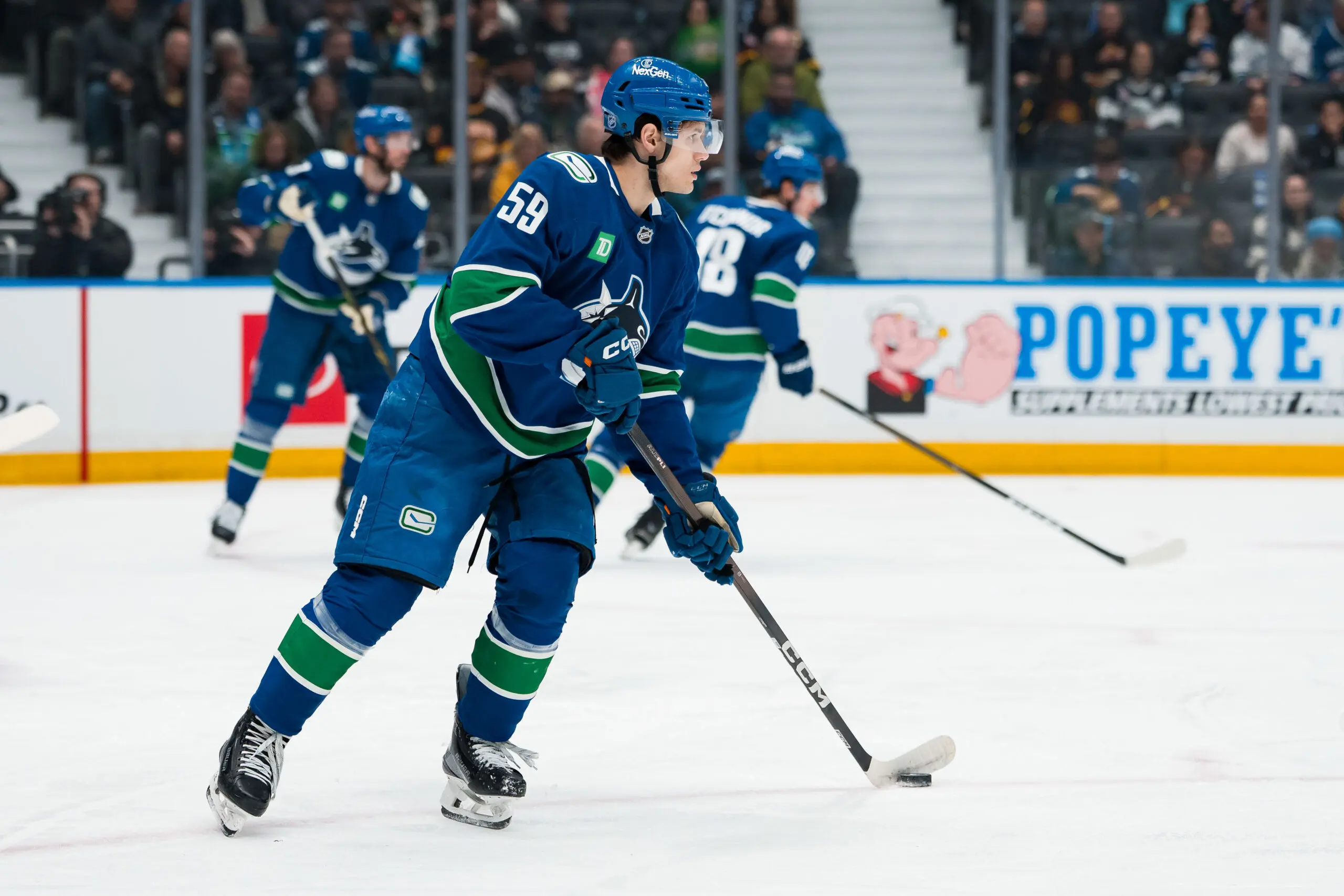
Photo credit: Bob Frid for IMAGN IMAGES via Reuters Connect

Aug 28, 2026, 13:00 EDTUpdated: Aug 28, 2026, 12:50 EDT


Those reading the tea leaves have long predicted that another round of NHL expansion is forthcoming, and that was a fairly easy prediction to make when said tea leaves read “$2 billion expansion fees.” That’s almost too much money to leave on the table, and it seems that the NHL will not, in fact, be leaving it on the table.
Deputy Commissioner Bill Daly declared during the NHL’s European Media Tour that not only was the league expanding soon, but that it had already decided on a ‘where’ and a ‘when.’ The where is somewhere in Texas, either Houston or Austin, and the when is the 2029-2030 season. Which means that the next Expansion Draft is likely coming in the year 2029. That’s probably sooner than most would have predicted.
It’s soon enough that most NHL teams can start to project and plan toward where their roster will be at the time. In saying that, it’s definitely tougher to project for a rebuilding team, and especially a rebuilding team that is just at the beginning of its rebuild, like the Vancouver Canucks.
But we’re going to give it a shot all the same.
Assuming the NHL uses the same expansion model it used for Vegas and Seattle, the Canucks will have two protection options. The first is an option to protect seven forwards, three defenders, and one goalie from their roster. The second is an option to protect eight skaters (either forwards or defenders) and one goalie.
Only players who have completed three or more professional seasons must be protected (professional meaning, more or less, NHL or AHL, with some exceptions); those with less experience are exempt. Unless they choose to waive them or have a special expansion clause written in, all players with no-movement clauses must be protected.
Goaltending
Since any protection scheme can only include a maximum of one goaltender, it makes the most sense to start there. Unfortunately, it’s the position where we have the least current information.
Had the Expansion Draft come earlier, the Canucks would have had to protect Thatcher Demko due to his NMC. But his three-year extension concludes with the 2028-29 season, and thus he will be a free agent by the time the draft rolls around. It’s possible that the Canucks have extended him again in the interim, but who can really say where Demko’s career will be at this point? For now, suffice it to say they won’t be forced to protect Demko.
The same goes for Kevin Lankinen, who will still be under contract until 2030 himself, but who loses his own NMC after this coming season when it converts to a 15-team no-trade clause. Lankinen might still be around, but he won’t require a protection slot.
So who will? If Nikita Tolopilo is still around at that point, it probably means his career has progressed to that of an NHL regular, so he’s probably the easiest answer. But then again, he could be departing the organization as soon as this preseason.
The team’s top two goalie prospects, Aleksei Medvedev and the just-drafted Dmitri Ivchenko, are guaranteed to not be eligible for selection. Even if either of them were to start their time in the AHL this season, which is highly unlikely, AHL games do not count as a professional season for 18- or 19-year-olds, at least as it pertains to expansion eligibility. So, it’s impossible for either to accumulate three professional seasons before 2029.
So, if Tolopilo’s gone by then, it might be down to whichever of Ty Young or Aku Koskenvuo is still around and has progressed most by that point. Both have already started their professional career counters, and thus will be eligible.
Alternatively, the Canucks’ goaltending protectee could be someone they’ve acquired between now and 2029.
In any case, this is the position the Canucks have to worry about the least in expansion.
Defence
From the position they need to worry the least about, to the position they need to worry the most about.
Defence is often the toughest spot for protection, because teams are allowed only three slots or have to start sacrificing multiple forwards to protect more. The Canucks already look likely to need more than three slots.
First and foremost is their trio of young NHL defenders: Zeev Buium, Tom Willander, and Elias Pettersson. The team would sure like all three to still be with the team and be playing important roles by 2029, and they’re probably the three leading candidates for protection.
But then there’s also Filip Hronek, who is under contract to 2032. Hronek’s NMC does convert to an M-NTC in the summer of 2028, one year before expansion, and so it’s possible – some might even say probable – that he’s traded before the draft, and thus does not need to be protected. But if he’s still on the roster, he’s not someone who could be freely exposed.
Luke Schenn and Jamie Oleksiak will have seen their contracts expire and will likely have moved on by now. But several others in the organizational depth chart will be eligible for selection, including some with potentially big futures in Kirill Kudryavtsev, Victor Mancini, and Sawyer Mynio.
Depending on how some of these names progress, the Canucks could have some very difficult blueline-related decisions on their hands come 2029. If they wanted, for example, to protect all six of Buium, Willander, Pettersson, Hronek, Kudryavtsev, and Mancini, that would only leave two slots left for forwards, and that’s probably not workable.
They’re a long way off from past days of being able to burn a protection slot on the likes of Olli Juolevi.
Forwards
At this point, we can almost predict that the Canucks will choose the “eight skaters” model instead of the “seven forwards, three defenders” model. For one, because of the litany of expansion-eligible D we listed in the last section. For another, because there just aren’t that many forwards they’ll need or want to protect.
There is only one forward on the roster they’ll need to protect – if they’re still with the team by then, that is – and that’s the other Elias Pettersson. His NMC runs through the entire eight-year term of his contract.
Brock Boeser, thankfully, sees his NMC turn into an M-NTC in that same summer of 2029. The wording of the last set of expansion rules specified that only “continuing” NMCs required protection, so that would leave Boeser free to be exposed.
Jake DeBrusk’s own NMC turns into an M-NTC next summer, and the odds of him being around in 2029 are slim, anyway. The only other NMC on the roster belongs to Brendan Gallagher, but he’s in the last year of his contract.
It’s really hard to predict who else will even be around in 2029 from the current set of veteran forwards. All of Gallagher, Filip Chytil, Drew O’Connor, Linus Karlsson, Paul Cotter, and Max Sasson will have hit UFA status by then, and could be long gone. Any could be extended beyond 2029, but we’d say only Karlsson is anywhere near likely to be.
Of the younger crop of players, the one we’re most certain will need protection is Liam Öhgren. Beyond him, next on the list is probably Marco Rossi, assuming he hasn’t been traded by then. Jonathan Lekkerimäki, if he proves himself a long-term NHL talent over the next year or so, would also require protection. Same goes for Aatu Räty. And maybe Ilya Safonov, too, if he turns out to be anything.
Any forward prospect – with one notable exception that we’ll get to in a moment – playing for Abbotsford this season will most likely be expansion-eligible by 2029. That includes Riley Patterson and Gabe Chiarot, who should debut as 20-year-olds this season, and also anyone who has already been there, like Vilmer Alriksson and Ty Mueller.
The interesting case is Braeden Cootes. By the letter of the law last time around, Cootes’ time in the AHL as a 19-year-old – assuming that’s where he plays this season – would not count as a professional season, and thus he wouldn’t be expansion-eligible by 2029. That’s a best-case scenario for the Canucks.
But we don’t yet know all the ins and outs of this new 19-year-old AHL deployment rule. It could be ruled that if a team assigns a CHL-drafted 19-year-old to the AHL, that counts as a professional season, in which case Cootes would be eligible by 2029.
Of course, it’s all moot if Cootes plays 11 or more games in Vancouver this season, which seems fairly likely. If he does, that’s a professional season right there, and he’ll need protection, too.
Anyone drafted after this point in time will not be able to accumulate three professional seasons before 2029, and thus don’t need to be worried about.
The only other names worth discussing, then, are Caleb Malhotra and Adam Novotny, the two forwards the Canucks’ drafted in this most recent first round.
The answer for those two is pretty straightforward. If either Novotny, through some early-season cameo, or Malhotra, through some late-season cameo, play 11 or more NHL games this season, they’d have their first professional seasons on the counter, and would require protection in 2029. The right thing for the Canucks to do, then, is to ensure that neither plays more than 10 NHL games until next season, which should be easy enough to accomplish.
If the Canucks were protecting seven forwards, right now we’d probably predict those seven to be Pettersson (if still here), Öhgren, Rossi, Lekkerimäki, Räty, Cootes (who we think will likely play 11 NHL games this season), and maybe Patterson, who seems like the next-best prospect on the list. Or Karlsson, if he’s still kicking around.
But then again, we don’t think it’s likely they go that route. If they want to protect even four defenders, they’re left with just four forward protection slots, at which point the decisions become tricky. Fortunately, only Öhgren, Rossi, and Cootes are what we might call priority protectees at this point in time.
Who will the Canucks lose?
We’ve seen enough here to suggest that the Canucks are probably going to lose a young-ish player of some value in the 2029 Expansion Draft. If they don’t, it’s almost worse news, because it means the rebuild hasn’t progressed to the point where there is an abundance of young talent on the active roster.
If the blueline progresses anywhere near where the team expects it to, the loss will probably come there. Even if the team protects Buium, Willander, and Pettersson, and trades Hronek, they’d still likely have to expose one or two of Kudryavtsev, Mancini, or Mynio. Depending on how they’ve developed, those could be unfortunate losses.
Otherwise, the loss will probably come in the form of a young forward. Protecting extra D could leave names like Lekkerimäki, Räty, and Pattersson exposed. And while we don’t yet know how valuable those players will be at that point in time, if they’re still around at all, it’s probably because they hold some value.
The losses we’re describing here wouldn’t be catastrophic. But they might be impactful enough for the Canucks to start planning for them now. That’s especially true when it comes to trade acquisitions between now and 2029. Any new talent coming in, aside from draft picks, will probably need protection, and that further eats away at the available protection slots.
On the other hand, this all grants some extra inherent value to all draft picks from 2027 onward, as they’re now assets that cannot be touched by a 2029 Expansion Draft. The Canucks should mostly focus on accessing that value via keeping and making those picks.
The Canucks aren’t in an awful position looking ahead to 2029. But they are probably in a position to lose a lot more than Luca Sbisa and Kole Lind, the two players they lost to Vegas and Seattle. Austin/Houston project to, at the very least, take a bigger bite out of the Canucks, which is probably appropriate for Texas.
Sponsored by bet365


Breaking News
- ‘It’s on us to prove them wrong’: Cotter embracing critics viewing Canucks as underdogs for 2026-27
- Canucks: Why size and speed matter so much at centre in Manny Malhotra’s system
- Scenes from practice: DeBrusk returns, Canucks shake up D pairs in early skate before long road trip
- Could the Canucks get involved in a Simon Edvinsson trade?
- Jonathan Lekkerimäki’s hot start to Canucks season all the more impressive given the context

Vancouver CanucksTeam Cap Summary

Cap Summary
2026-27
2027-28
Projected Cap Hit
$88,074,947
$71,329,167
Projected Cap Space
$15,925,053
$42,170,833
Current Cap Space
$16,521,178
$42,170,833
Active Players
23/23
13/23
Draft Picks
Round
'27
'28
1
1
1
2
2
2
3
1
1