
CanucksArmy has no direct affiliation to the Vancouver Canucks, Canucks Sports & Entertainment, NHL, or NHLPA
NCAA FA profiles: TJ Hughes could fill a role as a bottom-six centre for the Canucks
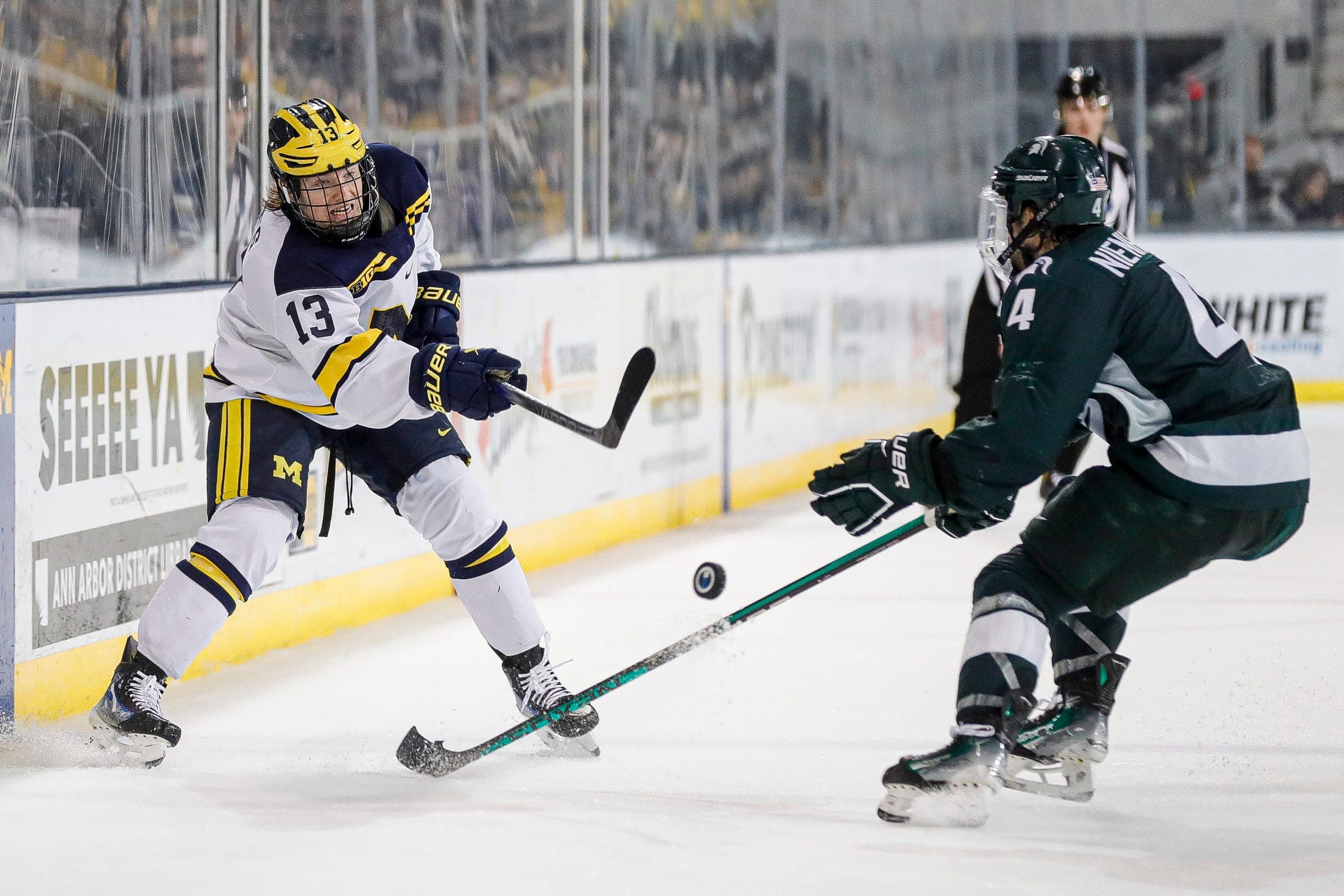
Photo credit: © Junfu Han / USA TODAY NETWORK


It’s no secret that the Vancouver Canucks will require significant help as they work their way back toward NHL relevance.
While the NCAA free agent market isn’t always the most direct path to immediate NHL impact, it remains a valuable avenue for adding depth and building out an organizational foundation.
At the top of this year’s remaining class sits University of Michigan forward T.J. Hughes, a name that has been on NHL radars for several seasons. Now a senior, multiple reports suggest that he’s garnered a check-in from nearly every team in the NHL. And according to Jeff Marek, that includes the Vancouver Canucks.
Hughes has established himself as a productive and reliable forward at the collegiate level, highlighted by a career year in his senior season. Whether that production translates immediately, or at all, to the professional level remains to be seen, but the appeal lies in the details of his game.
Now 24, Hughes has eclipsed the 50-point mark for the first time in his NCAA career, becoming one of just seven players in the nation to do so this season. With 56 points and counting, he is one of only two players to surpass the 55-point plateau. That brings his collegiate totals to an impressive 178 points (68 goals, 110 assists) in 155 games, all with the Michigan Wolverines.
Serving as captain, the Hamilton, Ontario native has been a driving force behind a Michigan team heading to the Frozen Four. While his production stands out, it’s his leadership and overall presence that consistently draw praise.
Simply put, Hughes plays a pro-style game. He thrives in all situations — power play, penalty kill, and even strength — and brings a well-rounded, detail-oriented approach. He plays a responsible two-way game and can be trusted in key moments, whether that means contributing offensively or closing out games defensively.
He doesn’t cheat for offence, but when opportunities present themselves, he capitalizes. Hughes generates offence in a variety of ways, whether that’s working off the half wall, operating in the bumper, or battling in tight around the net. Despite standing at 6-foot and 185 pounds, he consistently attacks the middle of the ice and competes in high-traffic areas.
His strength in the faceoff circle further boosts his projection, especially with the Canucks’ lack of depth up the middle. Hughes has posted win rates of 58.9%, 60.7%, 52.2%, and 57.8% throughout his NCAA career. This season, his 417 faceoff wins rank third among full-time Big Ten centres, while his win percentage sits third among faceoff regulars.
Hughes is not a high-end skater. His stride is functional, but not necessarily dynamic, and his first step lacks explosiveness. While that hasn’t limited him at the NCAA level, it will be an area to monitor as he transitions to the professional game.
That said, he compensates with a relentless motor, strong positioning, and a solid hockey IQ. He’s going to produce from the slot, chipping away at pucks and finding the open areas of the middle. Ultimately, Hughes projects as a smart, detail-driven centre who could carve out a role at the professional level relatively quickly. For a team like Vancouver, he profiles as a bottom-six option with sneaky secondary offensive upside and the type of low-risk addition that can provide value in multiple areas of the lineup.
Michigan is set to face Denver University on April 9 in the Frozen Four semifinal in Las Vegas. A win would send them to the national championship game on April 11 against the winner of the Wisconsin and North Dakota match.


Breaking News
- The Canucks have every reason to give Leevi Meriläinen a run of starts
- A look inside the Canucks early-season penalty killing struggles
- ‘Best news ever’: Max Lapierre thrilled to see Canucks put Sedins, Johnson, and Malhotra in charge
- The Statsies: Numbers back the eye test on Jonathan Lekkerimäki in Canucks’ loss to Hurricanes
- The Stanchies: 3 positives, 3 negatives, rebuilding lessons, and more from Canucks’ loss to Canes

Vancouver CanucksTeam Cap Summary

Cap Summary
2026-27
2027-28
Projected Cap Hit
$88,074,947
$71,329,167
Projected Cap Space
$15,925,053
$42,170,833
Current Cap Space
$16,790,545
$42,170,833
Active Players
23/23
13/23
Draft Picks
Round
'27
'28
1
1
1
2
2
2
3
1
1