
CanucksArmy has no direct affiliation to the Vancouver Canucks, Canucks Sports & Entertainment, NHL, or NHLPA
How the 2026-27 Canucks match up toughness-wise against the rest of the Pacific Division
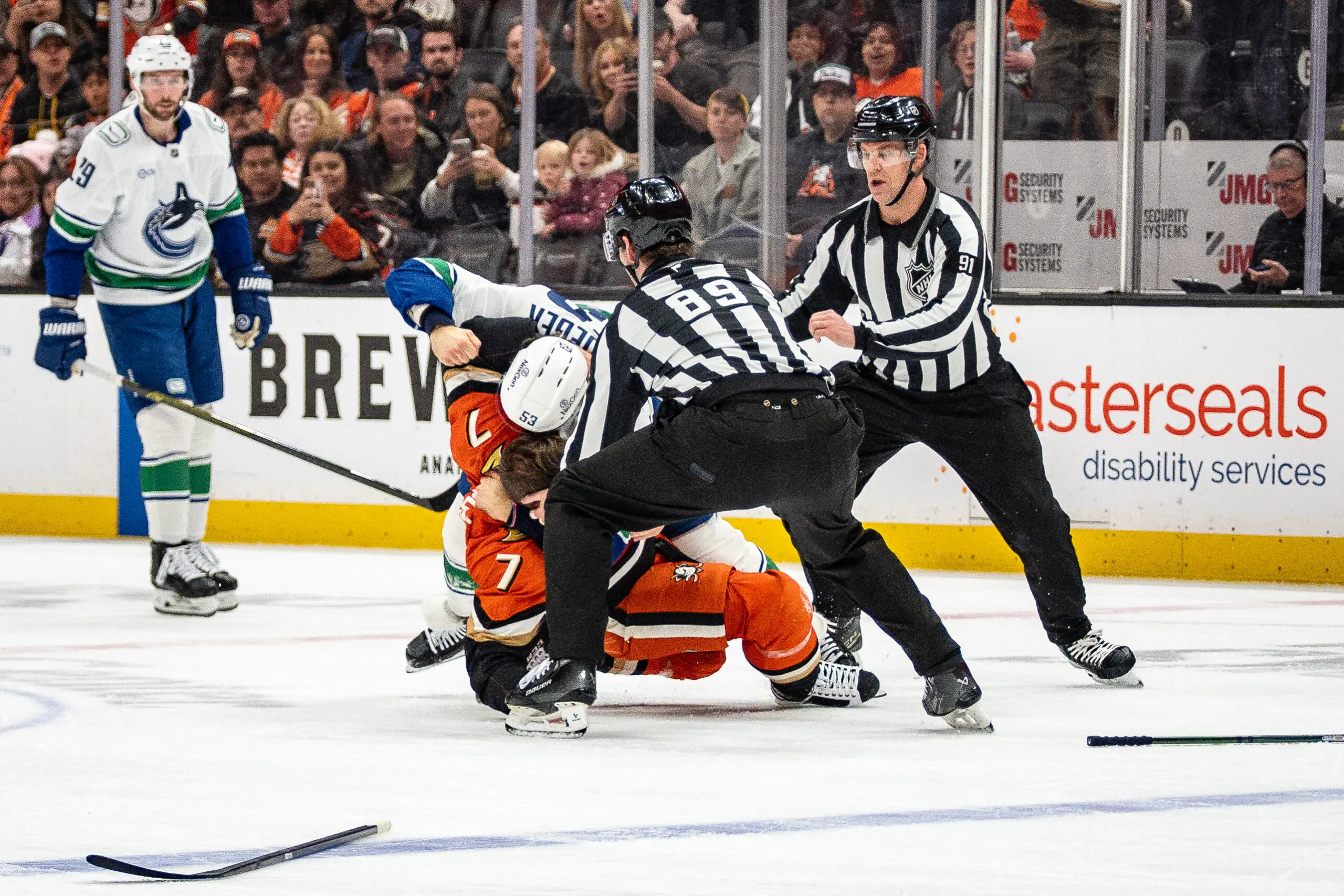
Photo credit: Corinne Votaw for IMAGN IMAGES via Reuters Connect

Sep 28, 2026, 12:00 EDTUpdated: Sep 28, 2026, 12:09 EDT


The Vancouver Canucks did not set out to become a better hockey team in the summer of 2026. Or, to be more accurate, they set out to become a better hockey team at some distant point down the road, which left them approximately the same sort of hockey team for the 2026-27 season as they were the season prior, as they were headed for last place.
If the Canucks set out to become anything for the 2026-27 season, specifically, it was tougher. Under new GM Ryan Johnson, and continuing the culture shift from last year, the team seems to have adopted a philosophy: if they’re going to keep getting shoved to the bottom of the standings, they should at least avoid being shoved around on the ice.
Most of the Canucks’ major offseason acquisitions, then, were aimed in this truculent direction. That’s especially true of Luke Schenn and Jamie Oleksiak, who stand out as two of the most fistically-capable individuals to put on a Vancouver jersey in recent memory.
Schenn and Oleksiak clearly lead the pack in this regard. But the Canucks will also open the 2026-27 season with a number of others on their roster ready and willing to throw down when necessary, including Brendan Gallagher, Paul Cotter, Victor Mancini, Drew O’Connor, and the younger Elias Pettersson.
It’s not the toughest roster the Canucks have ever put together – not by a long shot. But we’re also a long way off from the days of NHL teams stuffing an enforcer or two on their fourth lines. Toughness is a relative term, and so today we thought we’d see how the Canucks’ team toughness stacks up against the rest of the Pacific Division. Those are, after all, the opponents they’ll most be doing battle with throughout the 2026-27 campaign.
Anaheim Ducks
The Ducks might have been the toughest team in hockey for the 2025-26, what with Ross Johnston, Jeffrey Viel, Radko Gudas, and Jacob Trouba all spending significant time on their roster. But then, amid one of the more calamitous offseasons in NHL history, the Ducks lost all four of them.
Anaheim did pick up a couple of pugilistic types in former Panther AJ Greer (who will start the season on IR) and Jeff Mallott, brother of a UFC fighter, up front, but their blueline stands out as an awful lot younger and softer than it was a year ago.
The Canucks should now reasonably be the tougher team between the two.
Calgary Flames
The Flames have all the same reason the Canucks do to be focusing on physicality, and they, too, have put some emphasis on it. Calgary entered the offseason with some frequent physical troublemakers in place, including Kevin Bahl, Martin Pospisil and the enormous Adam Klapka. To that mix, they’ve added the willing Brennan Othmann and veteran blueline bruiser Jacob Middleton.
As such, we can expect some real battles to ensue between the Canucks and Flames this year. Chances are good these are two teams that will be playing more for pride than points in 2026-27, and that should directly translate into plenty of scraps and scrums.
The Canucks have the upper-end toughness advantage through Schenn and Oleksiak, but it shakes out pretty evenly past that.
Edmonton Oilers
The Oilers are a real mixed bag of toughness, especially having traded Darnell Nurse this offseason. They do have Trent Frederic up front, who was signed long-term with the idea of providing more physicality than he has so far. He’s joined by the likes of Max Jones, Colton Dach, and former Canuck Vasily Podkolzin, who are all capable of throwing hands when the situation calls for it.
Their back-end is now a lot softer, though Connor Murphy and Ty Emberson do play with some heft and occasionally get involved in more than that.
Call the Oilers a less tough team than they have been in the past, and certainly less tough than the Canucks overall, but still somewhat capable of standing up for one another when necessary.
Los Angeles Kings
The Kings, formerly the heaviest team in the division, are not what they used to be. The old guard, still featuring Drew Doughty, is nowhere near as physical as they used to be, and these new Kings rely too much on the bottom-end of their lineup for any toughness – namely in the form of Joel Edmundson, huge sophomore Samuel Helenius, and the 41-year-old Corey Perry.
It’s not nothing – with Helenius in particular standing out as a genuine heavyweight of sorts – but it’s not the sort of toughness that can make an every-night impact, and it doesn’t make up for a relatively soft rest of the roster.
Expect this to perhaps be a factor in the Kings’ success, or lack thereof, this season. And don’t expect them to stack up well to the Canucks in this regard.
San Jose Sharks
The Sharks are another team that has seemed to see the value in surrounding their rebuilt youth with some protective enforcement. Their roster is loaded up with pre-existing willing pugilists up front, including Barclay Goodrow, Zack Ostapchuk, Ty Dellandrea, and, of course, Kiefer Sherwood. To that, the Sharks have added a trio of mean-streaked defenders in the form of the aforementioned Nurse and Trouba, along with Michael Kesselring. They’ve also added the incredibly rambunctious Mason Marchment.
Put that all together, and we’d estimate that the Sharks are probably the overall toughest team in the division. As we’ve mentioned already, Schenn and Oleksiak might have the advantage in any one-on-one situation, but if we’re measuring toughness by committee, the Sharks have the Canucks beat.
Seattle Kraken
The Kraken have had a hard time establishing any sort of identity for themselves, including anything related to toughness. But they did take some steps this offseason to correct that. First and foremost in that was the signing of brief Canucks enforcer Curtis Douglas to a two-year deal. Behind Douglas, the Kraken have some big-bodied forwards like Jacob Melanson, Mackie Samoskevich, and Ryan Winterton, though only Melanson stands out as an actual fighter. The younger Pettersson already dealt pretty handily with Winterton in the preseason, after all.
Their blueline, featuring Vince Dunn, Adam Larsson, Brandon Montour, and Ryan Lindgren, is quite physical, if not especially scrappy.
Too often in Seattle, the fighting has fallen to pseudo-star players like Jared McCann. They’ve done enough to change that this past summer. They still probably trail the Canucks in overall team toughness, but they do have that nuclear deterrent in Douglas, which is something that most Pacific teams lack right now.
Vegas Golden Knights
The Knights have a lot of that inherent toughness that comes from a lot of deep playoff runs. We know certain players, like Mark Stone and William Karlsson, are absolute postseason warriors. But that doesn’t always translate to the sort of toughness that tends to feature in the regular season, and in that regard, Vegas has seen some losses of late. Long gone are the likes of Ryan Reaves and Keegan Kolesar.
The Knights still have a physical blueline, featuring names like Brayden McNabb, Jeremy Lauzon, and Rasmus Andersson. But in a brawl-type situation, they now seem a little shorthanded and a full step behind the regular-season-type toughness now assembled by the Canucks.
Hopefully, this leads to a little bit of revenge from the Canucks throughout 2026-27 on a team that has made a habit of beating them up in recent years.
Sponsored by bet365


Breaking News
- Could the Vancouver Canucks and Ottawa Senators hook up on an in-season forward trade?
- The Statsies: Canucks dominated at 5v5 in 4-2 loss to Lightning
- The Stanchies: Prime Lankinen returns, Canucks still go winless on road trip with 4-2 loss to Lightning
- Instant Reaction: Canucks give up four unanswered goals in 4-2 loss to Lightning
- Canucks: D Elias Pettersson’s impressive start is more than just passing the eye test

Vancouver CanucksTeam Cap Summary

Cap Summary
2026-27
2027-28
Projected Cap Hit
$87,295,050
$71,329,167
Projected Cap Space
$16,704,950
$42,170,833
Current Cap Space
$18,413,411
$42,170,833
Active Players
23/23
13/23
Draft Picks
Round
'27
'28
1
1
1
2
2
2
3
1
1