
CanucksArmy has no direct affiliation to the Vancouver Canucks, Canucks Sports & Entertainment, NHL, or NHLPA
Exploring the Canucks IR/LTIR options with Nils Höglander’s injury
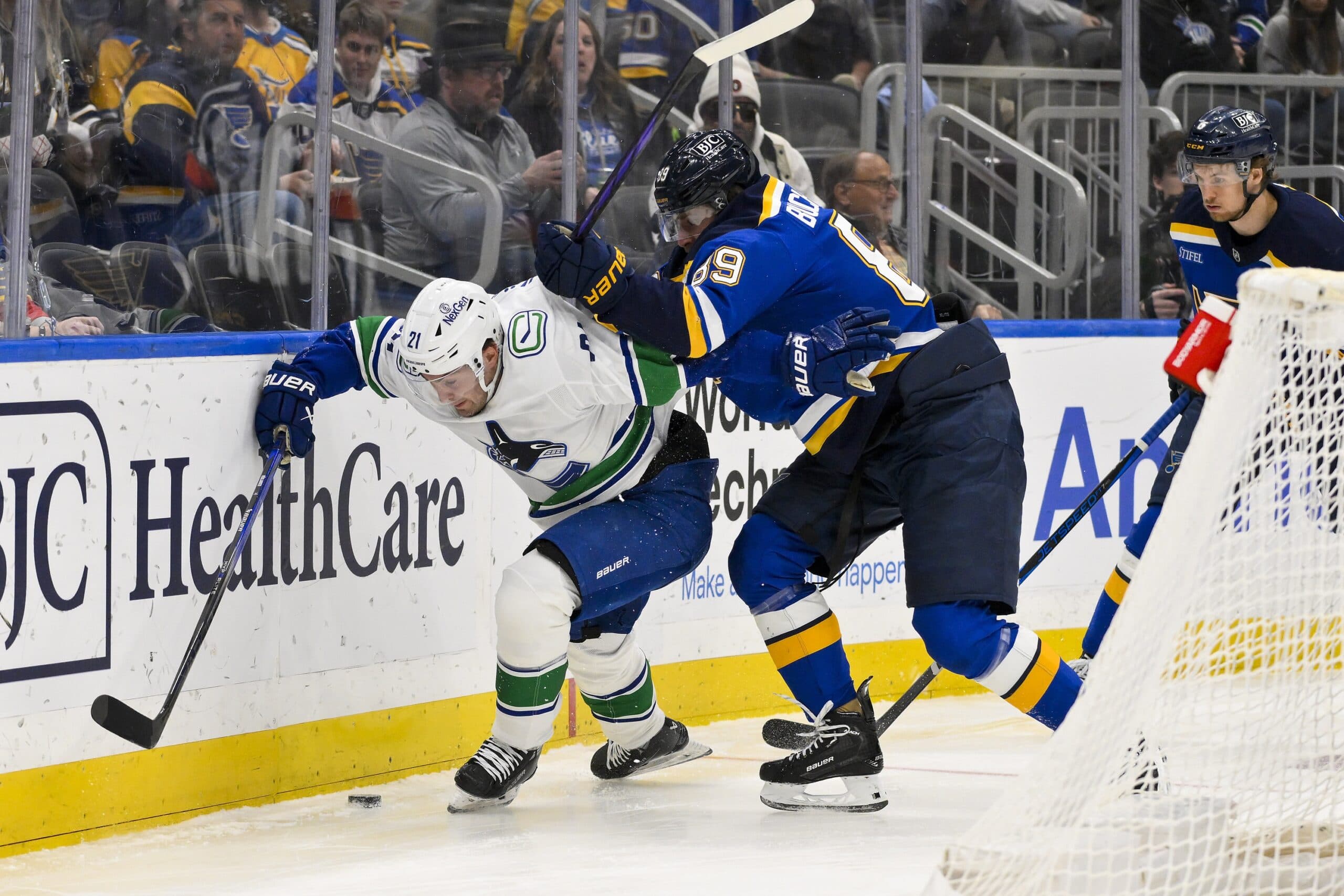
Photo credit: © Jeff Curry-Imagn Images

Sep 28, 2025, 11:00 EDTUpdated: Sep 28, 2025, 12:47 EDT


NHL injuries are a lot like Thanos. They’re inevitable, they get in the way of even the best-laid plans, and they’re often purple.
The first major injury of the NHL season for the Vancouver Canucks just went to Nils Höglander, and it just might be one of the purple variety. The early word is that Höglander’s “week-to-week lower body injury,” which had him leaving his first preseason game in a walking boot, is an ankle sprain. That will keep Höglander off the ice for the remainder of the preseason, and depending on how long his recovery takes, he could easily wind up missing multiple weeks of the regular season, too.
Where would that leave the Canucks and their roster, which still needs ample trimming before opening night?
In previous preseasons, these discussions were always incredibly complicated. That’s because, by this point in the year, most previous Canucks teams have already been effectively over the salary cap. We’d be talking about the exact dollar amounts of various contracts and trying to math our way to the ‘perfect roster’ as the front office attempted to maximize their LTIR relief space.
But about one year ago, Vancouver sent Tucker Poolman’s contract and a fourth round pick to the Colorado Avalanche in exchange for Erik Brännström, and the Canucks were finally, mercifully, under the cap again – for real this time. And aside from a brief dip back into LTIR space during Filip Hronek’s injuries last season, they’ve stayed under the cap ever since.
Being under the cap has a lot of direct benefits, like the ability to effectively accrue cap space over time, and greater flexibility with things like call-ups. It also has the direct benefit of making the rules and their implications a lot easier to follow.
If October 7 – the official start of the regular season – were to come to pass and Höglander still required more recovery time, the Canucks would almost certainly place him on Injured Reserve, more commonly known as ‘IR.’ This would allow the team to announce an official opening day roster of at least 24 players, with the usual 23 maximum players on the active roster, and with Höglander on IR.
This is some short-term good news for anyone nervous about losing some of the Canucks’ fringe forwards on waivers this preseason. To illustrate, we’ll mock up a quick opening day roster with Höglander on IR (while acknowledging that there is still plenty of preseason to be played, and nothing is yet set in stone):
DeBrusk-Pettersson-Boeser
Kane-Chytil-Garland
O’Connor-Blueger-Sherwood
Bains-Räty-Karlsson
Kravtsov/Lekkerimäki/Cootes/Sasson (pick one)
IR: Höglander
Hughes-Hronek
M.Pettersson-Myers
E.Pettersson-Mancini
Forbort-Joseph
Demko
Lankinen
That opening day roster could allow for some good things, like a longer look at the likes of Arshdeep Bains or Vitali Kravtsov or P-O Joseph before having to expose one or more of them to waivers, or a longer look at Jonathan Lekkerimäki in the top-six. Maybe it’s that nine-game Braeden Cootes audition that so many are clamouring for. (Side note: We realize that if someone like Lekkerimäki or Cootes were to make the cut, they’d be in the lineup, not in the pressbox. The above is meant to be a mock-up of roster space only, not a real attempt at lines.)
Of course, you’d rather have Höglander in there somewhere. But with Höglander potentially missing time, it’s not a bad consolation to have that extra roster spot to play around with.
As soon as Höglander misses or is expected to miss ten games and 24 days of the regular season schedule, he becomes eligible for Long-Term Injured Reserve, or ‘LTIR.’ This can be applied retroactively whenever a player passes those thresholds.
It seems a little unlikely that an ankle sprain is going to keep Höglander out of action until October 31, which is the point at which he’d have missed 24 days. But even if he were to, there would not be any need for the Canucks to place him on LTIR anyway – save for a slew of other injuries or an unforeseen trade.
There are many misconceptions around LTIR, including that it equates to ‘bonus’ or ‘rebate’ cap space. But that’s not really the case. It’s better described as a temporary exemption to exceed the salary cap by a maximum of the equivalent cap hit of the player who is injured long-term; it goes away as soon as the injury ends, and it comes with a bunch of restrictions.
There is, simply put, no reason for a team to use LTIR unless it needs to exceed the salary cap. And at the present moment, the Canucks are in absolutely no danger of exceeding the salary cap.
The offseason trade that sent Dakota Joshua to the Toronto Maple Leafs opened up plenty of room. If we take that roster from above – even with the most expensive extra forward option in Cootes at $975,000 – we’ll find it’s still at a grand total of $94,025,000, or $1,475,000 under the 2025-26 cap ceiling of $95.5 million.
That number includes Höglander’s full $3 million cap hit. There is no cap relief offered by placing a player on IR. But that’s okay, because the Canucks don’t need it yet. That $1,475,000 in space is enough room to accommodate one more call-up, should any other Canucks require a trip to the IR. Until then, it’s also enough space to slowly-but-surely accrue over time, even with Höglander and his roster replacement both on the books.
The Canuck would gain no extra cap space or any benefit at all from placing Höglander on LTIR instead of IR, even if he were projected to miss that much time. The main point we’re trying to drive home here is that the game has changed for the Canucks ever since they moved on from their truly long-term injury-sufferers like Poolman and Micheal Ferland and actually got under the salary cap. Until a team is in danger of exceeding the salary cap and has a need to do so in order to ice a full roster, there is no benefit at all to LTIR. So – for the time being, anyway – there is no benefit to the Canucks using LTIR.
When Höglander returns, nothing gets added to the daily cap expenditures, and if all else stays the same, something actually comes off the books, that being whoever loses their roster spot to the returning Höglander. At that point, the Canucks start to effectively accrue a little more cap space every day.
On the flip side of that, more injuries could quickly complicate matters. As soon as injuries necessitate calling up more replacements than can be afforded with the cap space on hand, that’s when LTIR starts to become useful again.
But it would take a lot more than a single injury to one individual forward to get the Canucks to that point. That’s a major difference from most seasons in recent memory, and it’s going to take some getting used to.
Sponsored by bet365


Recent articles from Stephan Roget
Breaking News
- ‘Hesitant with everything’: Canucks’ Buium talks early season struggles; says confidence ‘growing’
- Scenes from practice: Rossi returns and Canucks shake up forward lines in effort to snap 8-game losing streak
- Canucks and their fans hit a home run honouring John Garrett on Cheech night
- What are the Canucks’ expiring UFAs worth in a trade now, and where might they be by the deadline?
- ‘Same story again’: Canucks’ Pettersson and Sasson express frustration after losing streak extends to eight

Vancouver CanucksTeam Cap Summary

Cap Summary
2026-27
2027-28
Projected Cap Hit
$87,295,050
$71,329,167
Projected Cap Space
$16,704,950
$42,170,833
Current Cap Space
$18,732,718
$42,170,833
Active Players
23/23
13/23
Draft Picks
Round
'27
'28
1
1
1
2
2
2
3
1
1