


David Pagnotta: Re Ducks: The talk was 12, 13 [million] for Leo Carlsson and 10, 11 for Cutter Gauthier; offer sheet comes in on Friday; Cutter Gauthier...it's 15 range now - The Sheet (7/9)

CanucksArmy has no direct affiliation to the Vancouver Canucks, Canucks Sports & Entertainment, NHL, or NHLPA
Could the Canucks take advantage of a cap-strapped Ducks team?
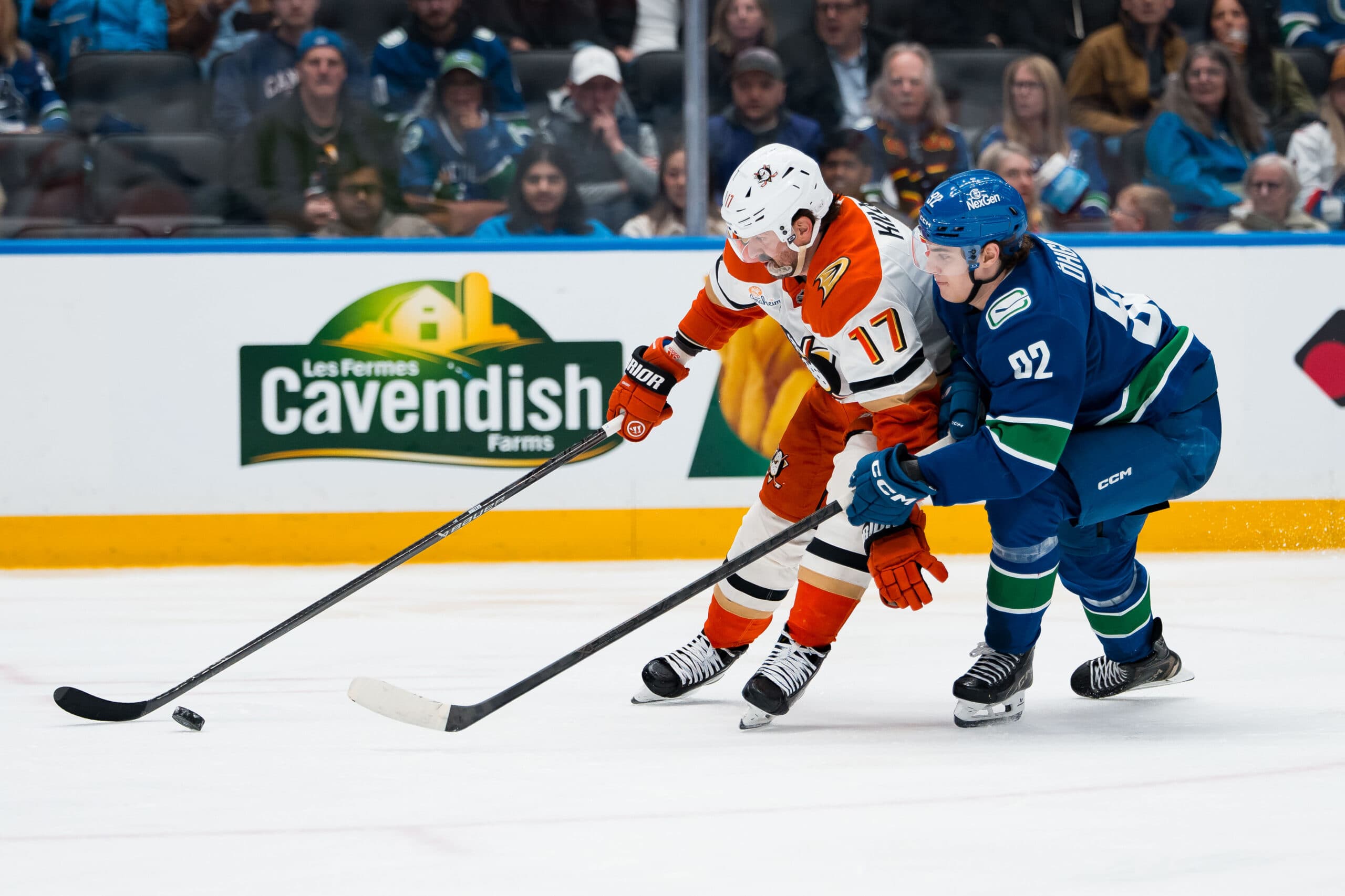
Photo credit: © Bob Frid-Imagn Images

By Tyson Cole
Jul 11, 2026, 15:51 EDT
Now in a rebuilding phase, the Vancouver Canucks are in a prime position to use their salary cap to their advantage, take on some unwanted money from overpaid players, and get paid handsomely to do so. One of those opportunities just popped up with some recent news around the NHL.
After yesterday’s news that the Anaheim Ducks matched the Philadelphia Flyers’ $18 million AAV offer sheet for Leo Carlsson, the Canucks’ Pacific Division rivals are in a tricky situation regarding their internal cap.
The Anaheim Ducks’ situation
After matching Carlsson’s monster offer sheet, the Ducks have $9,073,395 in remaining cap space. That’s a healthy amount to be under the salary cap. The problem line is 22-year-old RFA Cutter Gauthier, who needs a new contract.
Gauthier is coming off a breakout season in which he led the team in goals (41) and points (69) in 76 games. The 2022 fifth overall pick further earned his stripes by finishing the postseason as a point-per-game player, with four goals and 12 points in 12 games. Again, he led the team in points.
The numbers prove that Gauthier is in for a healthy raise off his entry-level contract. According to AFP Analytics, Gauthier is projected to make $8.8 million on a long-term contract, which the Ducks could currently fit on their books. He likely would have come in a bit higher because of the rising cap world, but that would have capped out at $10M-$11M. However, now with Carlsson setting a new internal cap standard, Gauthier’s number skyrockets – and he’s got a good case for it.
He finished tied for 11th in goals across the league and had two more points than Carlsson. Gauthier doesn’t play the premium position like Carlsson does, but goal-scorers get paid in this league. According to Daily Faceoff Insider David Pagnotta, Gauthier is likely closer to the $15 million range.
Luckily for the Ducks, they won’t run into the same issues they did with Carlsson, as Gauthier is a 10.2C RFA, which means he can not be signed to an offer sheet. So, Gauthier loses a little bit of leverage in that scenario, and it wouldn’t be surprising to see Ducks GM Pat Verbeek play hardball with him and drag this on until the end of the summer, as he has with most of his other RFAs.
The danger with that is that if the Ducks make any other moves, say, to fix their blueline, Gauthier will make his case for why that extra money should go his way. While Gauthier should be first on the Ducks’ to-do list, they certainly need to shore up their backend.
Anaheim lost John Carlson, Radko Gudas, Jacob Trouba, and Olen Zellweger this offseason, only bringing in Nick Jensen as a replacement. This now leaves the Ducks defence corps looking like this:
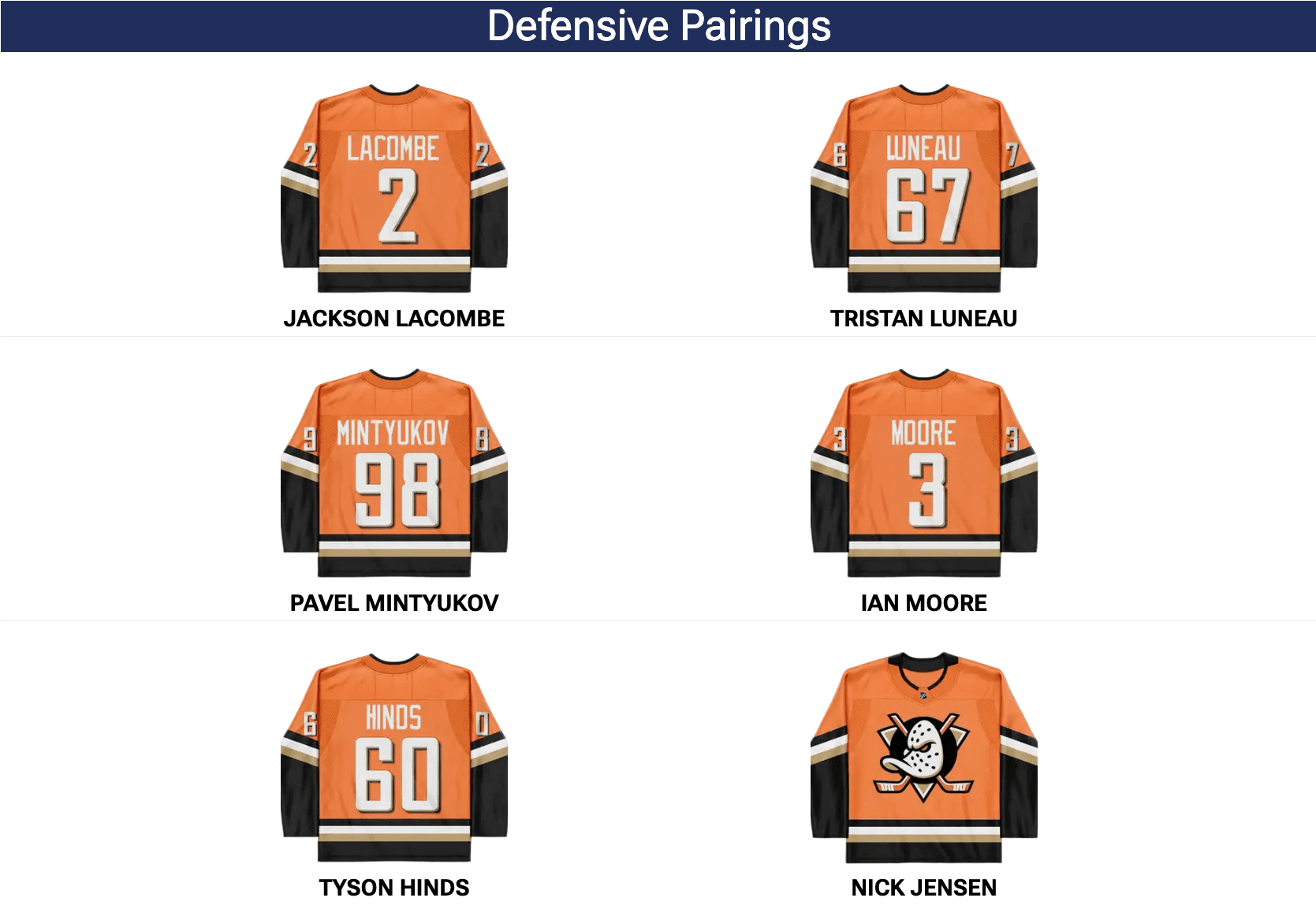
It may be even more of a struggle for the Ducks to keep the puck out of their net this upcoming season than it was last year with this defence corps.
Regardless of whether they need to free up money to sign Gauthier or fix their blueline, they will need to shed some money before the season starts. So, who are some of those potential cap-dumps?
Potential cap-dumps for the Ducks
Alex Killorn
Killorn, 36, is coming off a season scoring 15 goals and 18 assists for 33 points. The winger from Halifax, Nova Scotia, signed with the Ducks in 2023 after spending the first 11 years of his career with the Tampa Bay Lightning, capturing two Stanley Cups along the way.
He is in the final year of his contract, which pays him $6.25 million annually, so he is projected to be one of the most likely to be moved by the Ducks. His veteran leadership is an asset in the locker room for a young Ducks squad, as he currently is wearing an ‘A’ on his sweater, but with budding stars on the rise, Killorn may be in for a bottom-six role this year. And at $6.25 million, that’s a little rich for that role.
Frank Vatrano
Vatrano, 32, had a difficult first year of his new contract. Following three straight seasons with over 20 goals and 40 points, topping out at 37 goals and 60 points in 2023-24, the 5’11” winger found himself in and out of the Ducks’ lineup. Vatrano saw his minutes decline from 16-18 minutes in his first three seasons to sub-12 minutes last year. He played just 50 regular season games last season, scoring just five goals and nine points, and did not feature in any of the Ducks’ 12 postseason matches.
The writing is on the wall that a fresh start may be best for both sides. However, the issue comes in Vatrano’s contract. He carries a $4.57 million cap hit, but he signed a unique contract in which $3 million is deferred salary. As a result, he will be paid $900,000 per year for 10 years beginning in 2035, per PuckPedia.
In a world where the Canucks are living by the money-in, money-out philosophy, it seems highly unlikely that ownership would sign off on bringing in a player they would have to pay $900,000 for 10 years, starting nine years from today.
What assets could the Ducks attach?
Picks
Currently, the Ducks have plenty of draft picks they could use as potential sweeteners to package with one of those cap dumps to entice teams. For the 2027 draft, Anaheim has their first-round pick, three second-round picks (ANA, DET, STL), their own fifth- and sixth-round picks, and two seventh-round picks (ANA, CGY). The following two seasons, they have all seven of their draft choices.
Prospects
As a team that just blossomed from its rebuild, the Ducks have plenty of prospects in the system. We can probably rule out first-round prospects like Roger McQueen (2025) and Stian Solberg (2024). As well as the five 2026 draft selections: Nikita Klepov (15th overall), Marcus Nordmark (28th overall), Jayden Kurtz (45th overall), Mathis Preston (50th overall), and Rian Chudzinski (82nd overall).
There are some intriguing second- and third-round prospects that the Canucks could pry off in a potential cap-dump deal if they prefer that over draft picks:
Eric Nilson, a 19-year-old 6′ winger who scored three goals and 11 points with Michigan State in the NCAA; Lasse Boelius, a 19-year-old 6’1″ left-shot defenceman who scored one goal and eight points in 40 games with Ässät of the LIIGA; Lucas Pettersson – cause the Canucks need to hit their Pettersson quota after trading Marcus – a 20-year-old 6′ centre who scored 10 goals and 20 points in 40 SHL games for Brynäs of the SHL, and zero points in four AHL games with the Gulls; Maxim Massé, a 6’3″ winger who scored 51 goals and 102 points in 63 games with the Chicoutimi Saguenéens of the QMJHL, and Tarin Smith, a 20-year-old 6’2″ left-shot defenceman who scored 16 goals and 71 points in 65 games with the Everett Silvertips of the WHL.
To answer the article’s headline, yes, the Canucks should be taking every opportunity to take advantage of cap-strapped teams to further their rebuilding process. However, with how the team seems to be operating in a money-in, money-out mindset, it’s hard to imagine the Canucks adding right now. As is, this management group needs to subtract from its roster to make room for younger players.
The sense is that Jake DeBrusk would like to play for a contending team, so his $5.5 million could be cleared off the books. This would then make more sense for the Canucks to take on Killorn’s $6.25 million. We say Killorn over Vatrano due to the deferred salary and the unlikelihood that ownership would want to take that on.
But to play a little armchair GM, if the Canucks move DeBrusk, would a Killorn-and-Massé/Smith trade entice you, Canucks fans? Or what would be your preferred trade package in order to take advantage of a cap-strapped Ducks team? Let us know in the comments below!
Sponsored by bet365


Breaking News
- ‘Important to stay together’: Gallagher leaning on togetherness amid Canucks’ losing streak
- Scenes from practice: Canucks promote Linus Karlsson to top line; Rossi absent due to illness
- Abbotsford Weekly: Canucks’ Braeden Cootes a point-per-game player through 6 AHL games
- Canucks: Why Elias Pettersson is benefitting from playing under Manny Malhotra
- 3 Canucks Stars of the Week: Pettersson and Willander stand out on the blue line

Vancouver CanucksTeam Cap Summary

Cap Summary
2026-27
2027-28
Projected Cap Hit
$87,295,050
$71,329,167
Projected Cap Space
$16,704,950
$42,170,833
Current Cap Space
$18,625,059
$42,170,833
Active Players
23/23
13/23
Draft Picks
Round
'27
'28
1
1
1
2
2
2
3
1
1