
CanucksArmy has no direct affiliation to the Vancouver Canucks, Canucks Sports & Entertainment, NHL, or NHLPA
Beyond gunning for a high first round pick, the Canucks’ lack of direction is hard to ignore
Photo credit: © Bob Frid-Imagn Images

By Tyson Cole
Jan 9, 2026, 15:30 ESTUpdated: Jan 10, 2026, 16:32 EST


We’re genuinely asking, what are you still watching the Vancouver Canucks for?
That’s not to say don’t watch or check out our content at CanucksArmy, but we’re curious. The team has lost five straight games, is second-last in the NHL standings and doesn’t seem to have any direction for where they’re headed.
Sure, management can throw all the word salad they want to us, but we’re going to judge them on their actions.
The Canucks sent a memo to all 31 other NHL teams in late November, stating that they were making their veterans available, specifically noting that Quinn Hughes was not available at that time.
And what’s happened since then? The only trade they’ve actually made was one involving Quinn Hughes.
President of Hockey Operations Jim Rutherford described the three players acquired from the Hughes trade as a “key part of the rebuild” in the press release the team put out after the trade. He flat-out said the word “rebuild”. Now we have a direction…or so we thought.
In typical Canucks fashion, the team went on a four-game winning streak following the trade. Their final game of that five-game road trip was against the Philadelphia Flyers on Prime Monday Night Hockey. General Manager Patrik Allvin joined the panel during the first intermission to discuss the team’s new direction following the trade, and described it as a “retool with a hybrid form”.
So, one four-game winning streak after trading your best player and the rebuild is over? Or now it’s a hybrid retool. What does that even mean?
We’re going to assume that just means they’ll be selling off their UFAs and likely keeping the veterans with term. And that makes sense, the player drawing the most buzz around Canucks circles has been Kiefer Sherwood, a 30-year-old pending UFA.
But are they certainly doing that? Sportsnet’s Elliotte Friedman reported less than a week ago that the Canucks made an offer to re-sign Sherwood.
Sherwood is the only one who meets management’s criteria for what they want to sell off that has any value on the trade market. Where he doesn’t fit is the team’s criteria for the future and getting younger. He is a player who has fought, clawed, and worked so hard to earn an NHL job for himself so he can capitalize on the massive payday he’s going to get this summer.
Given that this management group has outlined the team’s new direction following the Hughes trade, is Sherwood the type of player the Canucks should retain?
Of course not. He’s the exact opposite. He’s the guy they unequivocally need to move. And turning a $1.5 million free agent signing into a potential first-round pick would be unbelievable work by this management group. They need to take this opportunity and capitalize on it. It seems like such an obvious decision. Why wouldn’t they make this move?
But then again, maybe it’s not obvious for the Canucks. Just last season, we witnessed them not capitalize on pending UFAs Pius Suter and Brock Boeser at the trade deadline. In a market where Scott Laughton went for a first-round pick and a prospect, Anthony Beauvillier went for a second-round pick, Brandon Tanev went for a second-round pick, and Luke Schenn went for a second- and fourth-round pick. And you’re telling me Suter and Boeser wouldn’t have at least fetched the same, but most likely much more, than those guys?
They can not miss out on this opportunity. With the parity in the league right now, and Sherwood’s current cap hit, management should have at the very least 25 teams calling on Sherwood. But act on it sooner, because right now, the Canucks are the only sellers. That won’t be the case when other teams start selling. FINISH THIS
Don’t make the same mistake they made last year and hold onto their guys and risk losing them for nothing.
This regime has done well at drafting in the middle-to-late rounds. Elias Pettersson, Kirill Kudryavtsev, Hunter Brzustewicz, and Ty Mueller are players the Canucks drafted in the third round or later who have played NHL games. So these picks are valuable.
Also, management talked about the importance of finding the next Dakota Joshua during his contract negotiations. And they did that with Sherwood. They should have confidence that they can sell high on the player here and go find the next Kiefer Sherwood.
Since the hybrid retool was the last update we heard from management about the team’s direction, I guess that’s what we’ll go with. With that in mind, if they do want to retool and turn this around as soon as possible, then they need to make more than just their veteran UFAs available.
Looking up and down this roster now, who do they think they are going to retool around? Elias Pettersson, Brock Boeser, Jake DeBrusk, Conor Garland, Filip Hronek? No offence to these players, but what have they done to instill the belief in management that they NEED to stay? That the Canucks simply cannot get rid of because they’re going to need them when they’re good again in a few seasons?
If all goes according to the Canucks’ plan, they want to seriously compete again in three years. By that time, Elias Pettersson will be 30, Brock Boeser and Filip Hronek will be 31, and Jake DeBrusk and Conor Garland will be 32. Not old ages by any means, but at that point, those five are no longer part of your core. It will be Braeden Cootes, Zeev Buium, Tom Willander and whoever else they draft high during that time.
We understand you can’t move all of them. It’s good to keep veterans around to help mould the next wave of Canucks. But you don’t need all of them to do that. In fact, what the team needs them for is to build for the future. The accumulation of those picks and pieces in return for those players is what’s going to help build the future and better align with the timeline for when the team wants to compete again.
The Canucks can’t be so close-minded as to just trade their UFAs. Let’s not get it twisted: selling off UFAs is something teams missing the playoffs do every year. Rebuilding teams sell more than that. This team needs to trade away some of the players they consider their core to land as many shots at an elite difference-maker in the draft as they can get.
And don’t rush it this time. As we covered post-Hughes trade, the Canucks accelerating too quickly is what ultimately cost them their captain. They tried to rush their window, wasted Hughes and Pettersson’s ELCs, and then did not have the money to extend either player long-term. Had they not gone out and rushed things, they would have had the money to lock up both players to eight-year deals coming off their ELCs. Both players would have two years left on their contract after this season. Instead, Hughes is gone, and Pettersson is overpaid because of it.
Now, the team has to switch their focus to the next wave of players: Cootes, Buium, and Willander. The sooner they make these trades, the more they will struggle. And the more they struggle, the bigger cushion they’ll gain on holding the best chance to draft in the top three in June, and truly land a franchise player, because this team doesn’t have one right now. In doing so, this will give the young players currently on the roster more ice time and help them develop into players who can help this team compete again soon.
That’s what it’s all about for this management group: turning this around quickly. But there is a right way and a wrong way to do this. Let’s look at the Los Angeles Kings as an example.
After a first-round sweep by the Vegas Golden Knights in 2017-18, the Kings missed the playoffs in three consecutive seasons. During those seasons, the Kings fully bought into a quick turnaround because they had veterans like Anze Kopitar and Drew Doughty.
Why keep them around? Well, they won Cups, for starters. Those two proved it was worth keeping them around, because management knows they can win with those guys. They earned that. But the Kings still sold off their pieces. Here are the trades they made over the three years of their retool:
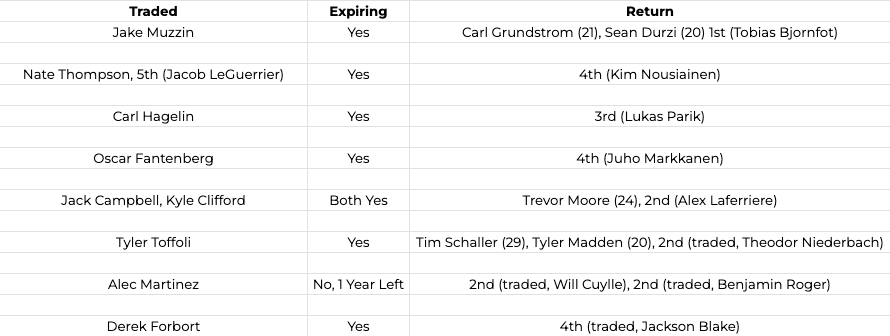
They sold off almost all of their expiring players. Even players like Nate Thompson and Oscar Fantenberg were able to return some value, and management got creative, turning Thompson into even one round of value. The Campbell/Clifford trade was a slam dunk, returning Moore and Laferriere, who have combined for 601 games with LA. And while the Kings did not keep all of those picks, look at what some of those traded picks became. Will Cuylle and Jackson Blake are both currently playing top-six roles in the NHL, for example.
You need as many darts as possible to throw at the dart board if you truly want to turn this thing around in a hurry. In those three seasons, the Kings had nine picks in year one, nine in year two, and only four in year three, all in the first three rounds. The totals came out to four firsts, six seconds and four thirds. But then again, that’s not a foolproof plan. Teams need to hit on their picks, and, to be honest, the Kings didn’t really.
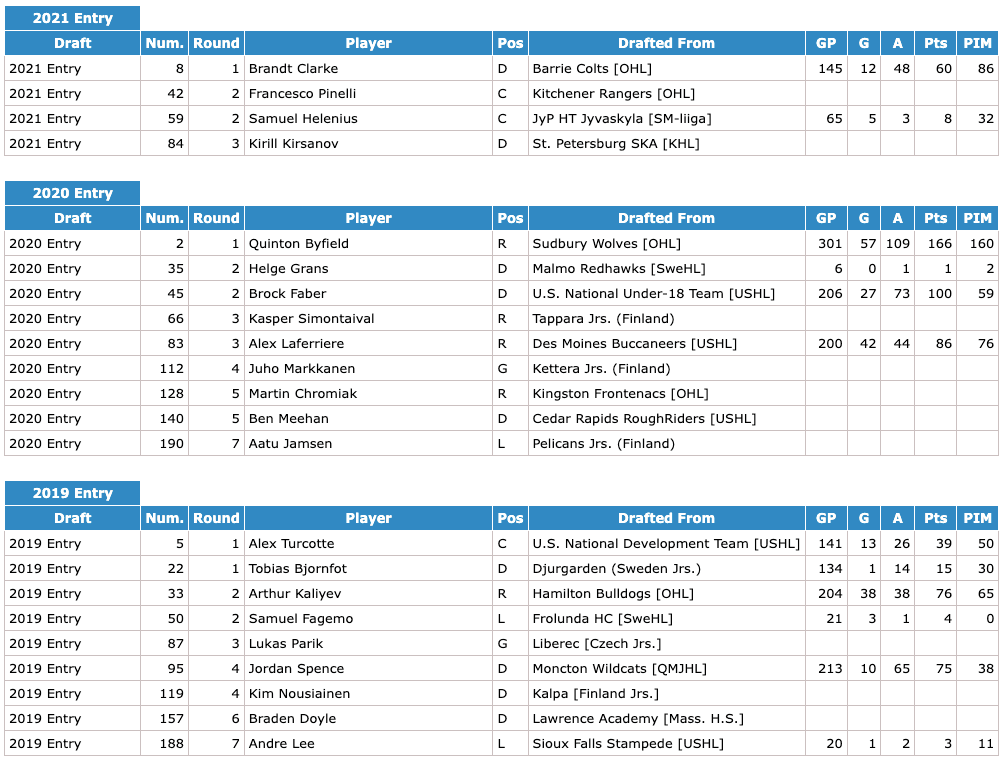
Quinton Byfield is a top-six centre, but because he was drafted second overall, the Kings likely were hoping to squeeze a bit more out of his development at this point. The same goes for Brandt Clarke, who hasn’t developed into the power play ace he was projected to be. Alex Turcotte is a bottom-six centre drafted fifth overall, while Bjornfot is in the Florida Panthers organization, but playing in the AHL.
That said, they were still able to turn things around after just three years and have made the playoffs for four consecutive seasons. So, if turning things around quickly and becoming a playoff team is what this management group is after, then there’s your blueprint.
But is the goal to make the playoffs or win in the playoffs?
Since 2020, four teams have won the Stanley Cup: the Tampa Bay Lightning, Colorado Avalanche, Vegas Golden Knights, and Florida Panthers. What do they all have in common? They have not one, not two, but three+ high-end pieces that helped them lift the Cup over their head: Tampa Bay (Nikita Kucherov, Steven Stamkos, Brayden Point, Victor Hedman, Andrei Vasilevskiy), Colorado (Nathan MacKinnon, Mikko Rantanen, Gabriel Landeskog, Cale Makar), Vegas (Jack Eichel, Mark Stone, Alex Pietrangelo, Shea Theodore), and Florida (Aleksander Barkov, Sam Reinhart, Matthew Tkachuk, Sam Bennett, Aaron Ekblad, Sergei Bobrovsky).
Looking at the Canucks roster right now, how many high-end pieces does this team have that can realistically help lead a team to a Stanley Cup? If Elias Pettersson returns to his 2022-23 form, he would fit that mould. Other than that, the Canucks have a whole lot of passengers and complementary pieces that no doubt would help a Stanley Cup-contending team, but aren’t going to be the reason you get there.
And with the way he’s tracking right now, who knows if Elias Pettersson ever does get back to that level again? And if he doesn’t, then the Canucks realistically have zero. Of course, prospects like Cootes, Buium, Willander, and Jonathan Lekkerimäki are intriguing, but let’s take a step back for a second and realize that all four of those players were drafted outside of the top-10.
It’s easy to overvalue prospects in a system that lacks high-end talent. Lekkerimäki was considered a sure thing in the Vancouver market. If that was the case, why did 14 other teams pass on him in 2022? And why does he have just 32 NHL games under his belt now, nearly two years since coming overseas?
That’s not to throw shade at Lekkerimäki. More to set realistic expectations on the prospects in the Canucks’ system. If the organization wants to turn this around quickly, it needs high-quality, high-impact prospects who can truly change the organization. The players they have in the system now are good building blocks and supporting characters around those franchise-altering players that you mostly find at the top of the draft. But even that is not good enough. There is so much more work to do to bring this team back to where this fanbase wants them to get to. It’s not going to be easy, and it’s going to take some time.
But it all starts with a clear direction. The mixed messaging of rebuilding, then hybrid retooling, then offering a contract extension to your most valuable trade chip has left the entire market confused about where the team is going from here. Hopefully, management can get on the same page, pick a lane, and make the tough yet proper decisions necessary to turn the Vancouver Canucks into a perennial Stanley Cup contender, rather than a team that bows out in the first round of the playoffs every year.
Sponsored by bet365


Recent articles from Tyson Cole
Breaking News
- How Canucks’ Cootes is doing compared to other 2025 first-round picks playing in the AHL
- Scenes from practice: Pettersson and Boeser reunited as Canucks skate at UBC on Saturday
- Abbotsford Canucks preview: Players to watch in weekend rematch with the Wranglers
- How the Canucks can fix their early-season defensive breakdowns
- ‘Glad to be somewhere I’m wanted’: Jacob Quillan excited for new opportunity with Canucks

Vancouver CanucksTeam Cap Summary

Cap Summary
2026-27
2027-28
Projected Cap Hit
$87,295,050
$71,329,167
Projected Cap Space
$16,704,950
$42,170,833
Current Cap Space
$19,063,296
$42,170,833
Active Players
23/23
13/23
Draft Picks
Round
'27
'28
1
1
1
2
2
2
3
1
1