
CanucksArmy has no direct affiliation to the Vancouver Canucks, Canucks Sports & Entertainment, NHL, or NHLPA
From Tortorella to Benning, the Canucks have won big with executive compensation


Oct 22, 2015, 21:03 EDTUpdated:


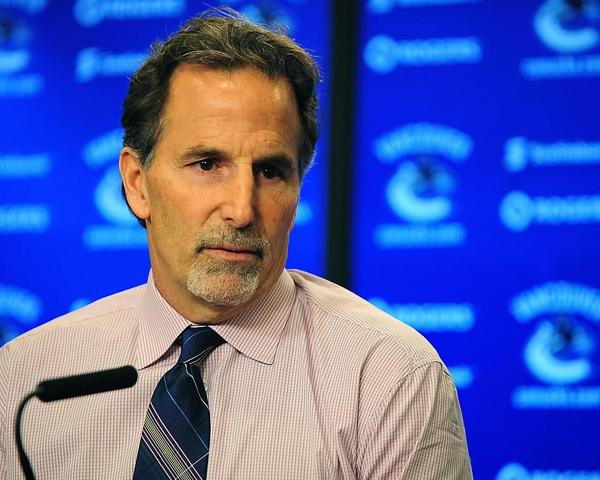
Photo Credit: Anne-Marie Sorvin/USA TODAY Sports
Ham-fisted asset management has been perhaps the most frequent criticism that’s been lobbed at Vancouver Canucks management during the Trevor Linden-Jim Benning era.
From the criticized returns in trades involving Eddie Lack, Ryan Kesler and Nick Bonino, deciding not to qualify Jordan Schroeder, giving up quality draft picks for marginal players like Adam Clendening and Linden Vey and losing Frank Corrado needlessly on waivers – the club has, its been said, bled out value slowly at the margins.
One area where the club has done extraordinarily well though is in the realm of executive compensation.
Executive compensation is a relatively new thing in the NHL, and we actually don’t know precisely how the rules work (the exact written rule hasn’t leaked or otherwise been made public). What’s essential to understand is this: teams are now able to recoup second- or third-round draft picks whenever a rival team hires an executive or coach whom they have under contract (fired or currently working) to be their new general manager or head coach. Whether it’s a second- or a third-round pick that a club gives up is determined by when that hire occurs – whether it’s in-season or during the offseason.
On Wednesday, for example, the Columbus Blue Jackets hired former Canucks head coach John Tortorella. Tortorella lasted one unrelentingly abysmal season in Vancouver after signing a lengthy five-year contract with the club in the summer of 2013. ‘Torts’ was due to draw a salary – the amount is undisclosed, but is believed to be at least seven figures – from the Canucks through the end of the 2017-2018 season.
Vancouver has reportedly agreed to continue paying some of Tortorella’s salary even as the fiery American-born bench boss moves into his new office in the bowels of the Nationwide Arena in Ohio. And for their trouble, the Canucks will receive a second-round draft pick from Columbus at some point in the next three years.
Obviously this is a big win for the club. Vancouver’s ownership group were going to be paying Tortorella for the next three years anyway, so Columbus’ decision to hire Bob Hartley’s favourite nemesis both saves the Canucks money and nets them a not-insignificant future asset.
What makes this win-win situation even more festive from Vancouver’s perspective is that they’re benefitting from a loophole that’s likely to be closed in the not-so-distant future.
Here’s a key bit from Sportsnet’s Chris Johnston, who wrote about the situation yesterday:
Many in the league feel it shouldn’t apply to coaches, general managers or presidents who have already been fired, but continue to be paid by their former team. Gary Bettman has made it clear that he feels it shouldn’t exist at all.Years ago, the commissioner eliminated a similar rule and only brought the new one into effect on Jan. 1 because some GMs were tired of losing capable employees without receiving anything in return.“The managers — for years — cajoled, begged, pleaded and demanded that we make a change,” Bettman said during the Stanley Cup final in June. “They wanted something straightforward and simple, although I don’t know if there was anything more straightforward and simple than what we had.”Come the new year the league will revisit whether it’s working properly, with an eye towards clarifying, modifying or eliminating it.
It makes no sense to compensate a team for a coach who is sitting at home doing nothing. It’s certainly not in the spirit of the executive compensation rule, which is designed to protect teams like the Detroit Red Wings – who have churned out quality coaches and executives for a decade – from having their talent pilfered repeatedly by rivals without recouping any benefit.
And that’s why, when the NHL’s general managers and then the Governors meet to revisit the executive compensation system later this season, the preposterous rule that nets the Pittsburgh Penguins a draft pick for Dan Bylsma or gives the Canucks a pick for Tortorella’s services, will probably be closed.
Vancouver’s timing, then, couldn’t have been any better.
Depending on what happens with a host of other coaches on the hot seat in the coming months, the Canucks may end up being one of the last teams to receive a pick in exchange for a fired coach or executive. Which is ironic, because they were also one of the last teams to poach brain power from rival organizations without paying any form of compensation.
When the Canucks hired Linden as president in 2014, he instantly began cozying up to the Boston Bruins. He cited Shawn Thornton as an ‘important’ ideal fourth-line player. He praised the ‘Boston model’ on live television. He went and picked Cam Neely’s brain during a meeting in Boston. And when the dust settled he managed to convince the Bruins, who were reportedly reluctant, to allow the Canucks to hire Jim Benning as his new general manager prior to the 2014 NHL Draft.
If Linden had become President a year later, the Benning hire would’ve cost the Canucks a second-round draft pick.
Once Linden got his man from Boston, he snatched Willie Desjardins – fresh off of a Calder Cup victory with the Texas Stars – out from under the nose of the Penguins. The Stars organization indicated publicly that they were happy to see Desjardins get a shot at a top job in the show, but the hire would’ve cost the Canucks a third-round pick just one year later.
Timing is everything when it comes to these sorts of compensatory mechanics, and it sure looks like the Canucks have made out like bandits. In hiring Desjardins and Benning at precisely the right moment, they were able to land highly-regarded replacements for Tortorella and Mike Gillis without digging into their asset pool. And because the Blue Jackets got a bit desperate after an 0-7-0 start, Vancouver got a ‘get out of jail free’ card on at least some of Tortorella’s remaining salary and a second-round pick to boot.
With Utica Comets coach Travis Green’s name being bandied about with increasing frequency whenever an NHL coaching vacancy opens up, the haul may keep coming.
Though it was impressive, as I’ve written previously, that Linden managed to land his first choice for general manager and head coach in 2014, a good deal of Vancouver’s good fortune on this front is just that – good fortune. It’s still worth pointing out that in the wild west arena of executive compensation the Canucks have done remarkably well, though.
Considering the emphasis the team has placed on the NHL Entry Draft and where the club is in their team-building cycle, these picks – both those gained from Tortorella and those kept in hiring Benning and Desjardins – could well prove crucial.


Breaking News
- Scenes from Canucks practice: Malhotra shuffles forward lines ahead of weekend back-to-back
- Abbotsford Canucks sign Kole Lind to one-year contract and announce opening night roster
- The Statsies: Elias Pettersson stands out in Canucks’ loss to Oilers
- The Stanchies: Canucks make it entertaining in 9-7 loss to Oilers
- Instant Reaction: Canucks give the Oilers a scare, lose 9-7 after erasing five-goal deficit

Vancouver CanucksTeam Cap Summary

Cap Summary
2026-27
2027-28
Projected Cap Hit
$88,074,947
$71,329,167
Projected Cap Space
$15,925,053
$42,170,833
Current Cap Space
$16,175,185
$42,170,833
Active Players
23/23
13/23
Draft Picks
Round
'27
'28
1
1
1
2
2
2
3
1
1