
CanucksArmy has no direct affiliation to the Vancouver Canucks, Canucks Sports & Entertainment, NHL, or NHLPA
How will the Canucks balance increasing trade value for vets while developing youth in 2026-27
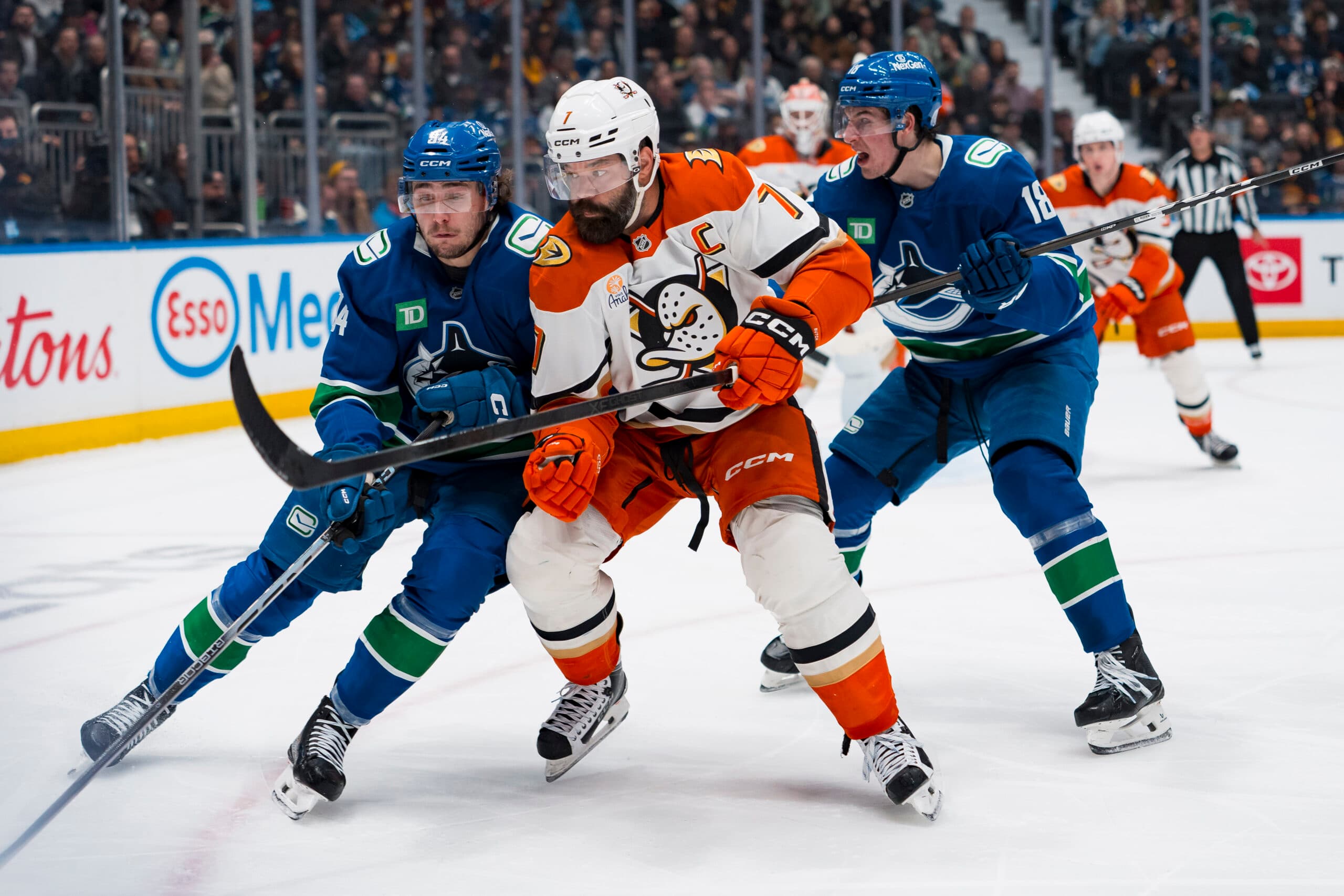
Photo credit: Bob Frid for IMAGN IMAGES via Reuters Connect

Aug 29, 2026, 13:29 EDT


For the first time in a long time, the Vancouver Canucks have a clear organizational vision of where they’re headed, or at least where they’d like to be headed. The rebuild is on, and every decision, more or less, has been and will be tilted in that direction.
But even within the seemingly clear framework of an ongoing youth movement, there are still difficult decisions to be made and balances to be struck. As we look ahead to the 2026-27 season, one line we see the Canucks having to walk carefully is the one between increasing the trade value of their remaining veterans and fostering the development of their current youthful pieces through more ice time.
It’s probably best to explain what we’re talking about with some examples.
Let’s talk about Drew O’Connor to start. He might be the most obvious trade chip heading into the season. He’s on the last year of a modest two-year, $2.5 million extension that will grant him UFA status next summer. He has a limited 12-team no-trade clause, which won’t restrict his destinations much. He’s coming off a career-high 17-goal season, and one in which he flashed both an ability to play all up and down the lineup and some specific traits that playoff teams love in a rental, including using his considerable size on the forecheck.
It would seem that the Canucks could get something fairly nice for O’Connor at or near the 2027 Trade Deadline. Maybe a second-round pick, maybe more.
And, in a vacuum, it would then probably make sense for the Canucks to prioritize maximizing O’Connor’s trade value this season. Which would be easy enough. He’s played in the top-six before, so keep him there. Give him some extra power play minutes. Put him in on Marco Rossi’s wing. Do whatever it takes to put him in a position to put up as many points as possible between now and March.
But as much as the Canucks might suck right now, this isn’t a vacuum.
Should any of O’Connor’s added deployment come at the cost of ice-time for, say, Liam Öhgren? Or for Jonathan Lekkerimäki? There are, at the end of the day, only so many spots in the top-six and only so much ice-time to go around.
This is the conflict we’re talking about here. Yes, having O’Connor put down another career season and become a real deadline commodity would be a huge plus for the Canucks in the long term. Converting him into another second-round pick, or maybe even more, would have some obvious benefits for the rebuild.
But folks like Öhgren and Lekkerimäki are at fairly crucial junctions in their own careers. Both probably need those top-six minutes at this point to truly progress in their development as NHL forwards.
What’s more important to the rebuild, in the long run? Giving O’Connor a better chance at a high trade return, or giving Öhgren a better chance of growing into a long-term top-six scoring option? That’s the sort of debate the Canucks will be having to hold internally all season long.
It’s easy to just default to prioritizing the younger player, and that’s what we believe the Canucks will largely do. But even then, it’s not quite so simple. Merit plays a role, and if someone like O’Connor is outright outplaying someone like Öhgren, well then it might not be entirely a positive for Öhgren’s development to just gift him that ice time anyway.
It’s going to be a lot of decisions like this, and they’re going to show up all over the lineup.
It could be Luke Schenn as a trade asset versus Victor Mancini as a long-term piece. Give too many of the minutes to Mancini and scratch Schenn too much, and there goes any hope of getting something good back for him at the deadline, as the Jets did last year. Give too many of the minutes to Schenn, and Mancini could stall out at a crucial time.
It could be Filip Hronek as the best current power play quarterback versus Zeev Buium as the presumed quarterback of the future. Hronek remains the Canucks’ best trade chip, even if that trade is likelier to come a few years down the road. Until then, the Canucks would want to keep Hronek at the top of the lineup and piling up the points, but there’s only one spot for a PP1 QB, and Buium needs to start getting reps there sooner rather than later.
It could be the relative top-four deployment of Jake Oleksiak versus Elias Pettersson, or even Kirill Kudryavtsev.
If he’s still on the roster, do the Canucks keep Jake DeBrusk in such a prominent place on the power play, knowing that those extra-strength goals are his bread-and-butter as an asset? Or do they start to prioritize someone who’s still going to be on the power play a few years from now instead?
Another really clear-cut example of what we’re talking about is at centre. Everyone is hoping for some level of Elias Pettersson rebound this season, but what if it doesn’t happen? Do the Canucks begin to deploy Marco Rossi as their 1C to see what they might truly have in him? That makes some sense, but at the same time, if Pettersson doesn’t rebuild at all, he will need to be traded eventually. And if he’s going to be traded eventually, the team has a vested interest in trying to juice his trade value as much as possible ahead of time, in which case they might consider leaving him with the prime minutes and hoping he can pick up some easy points therein.
And all the while the team might be debating the merits of prioritizing Pettersson versus Rossi, there will be the 19-year-old Braeden Cootes, chilling his heels in the AHL as a true potential long-term top-six option who is going to need to start grabbing those minutes himself sooner rather than later.
We’re not trying to present any of these options here as binary, or one-or-the-other situations. Much the opposite. These are all areas where the Canucks will have to strike some sort of balance between their shorter- and longer-term rebuild goals.
A note we’ll end on is that these sorts of situations can tend to drive coaching and management apart. We saw this just last season in Vancouver, as coach Adam Foote seemed to want to prioritize his veterans, and GM Patrik Allvin seemed to want to prioritize the youth once the rebuild was declared.
Fortunately, the Canucks should be able to avoid this, thanks to new coach Manny Malhotra appearing to be extremely on board with GM Ryan Johnson and co-POHOS Henrik and Daniel Sedin’s long-term vision of a rebuild. So long as they’re all pulling in the same direction most of the time, these decisions can be debated all season long, and the balance can be continually adjusted.
The Canucks may have one, large, overarching franchise goal right now, but they’ve got a differing set of smaller goals contained within that. Prioritizing and parcelling out those smaller goals will be one of the busiest tasks before them all through the 2026-27 campaign.
Sponsored by bet365


Breaking News
- How many roster spots might the Canucks need to open up between now and next season?
- WDYTT: Do you believe Canucks’ Elias Pettersson is bouncing back, and if so, how big?
- Checking in on 16 former Canucks one week into 2026-27 season
- Blackfish: Malhotra’s NCAA debut, Cootes’ AHL debut, and more
- Scenes from practice: Mancini appears set to make season debut as Canucks start road trip in Carolina

Vancouver CanucksTeam Cap Summary

Cap Summary
2026-27
2027-28
Projected Cap Hit
$88,074,947
$71,329,167
Projected Cap Space
$15,925,053
$42,170,833
Current Cap Space
$16,610,002
$42,170,833
Active Players
23/23
13/23
Draft Picks
Round
'27
'28
1
1
1
2
2
2
3
1
1